

Turkish President Recep Tayyip Erdogan called his Russian counterpart Vladimir Putin on Sunday to discuss Turkey's long-held ambition to create a 30km buffer zone on its border with Syria.
Mr Erdogan said Russia could play a role in “clearing” Kurdish militia groups from the area, having previously criticised Moscow for not following through with a 2019 agreement to do so.
Ankara has accused the Syrian Democratic Forces, a mostly Kurdish militia group backed by the US, of working with the separatist Kurdistan Workers' Party (PKK) to commit attacks inside Turkey, including a bombing on November 13 in Istanbul which killed six people including two children.
Both groups deny any role in the attack, which led to a Turkish air campaign against their positions in Syria and northern Iraq, killing at least 100 people, mostly militia fighters.
-

People inspect the damage after Turkish air strikes hit a power station in Taql Baql, Syria. AP -

A fire rages at an oil installation hit by a Turkish air strike in Tal Awdah, in north-eastern Syria's Hasakah province. AFP -
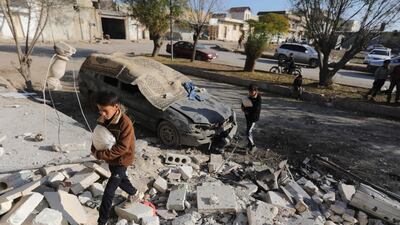
Residents walk over the rubble of a building destroyed by a rocket in the town of Azaz, Aleppo province. AFP -
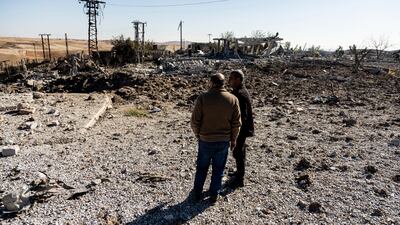
People look at a site damaged by Turkish air strikes in Taql Baql, Hasakah province. AP -
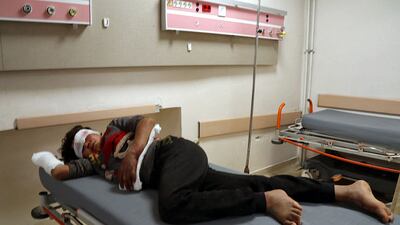
A person wounded in a rocket attack in the town of Azaz receives medical care at a clinic. AFP -
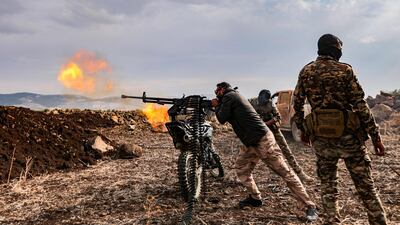
A Syrian fighter fires a machinegun mounted on the back of motorcycle during military drills by the Turkish-backed Suleiman Shah Division in the opposition-held Afrin region of northern Syria. AFP -
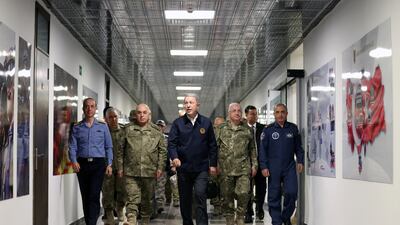
Turkey's Defence Minister Hulusi Akar visits the Land Forces Operation Centre, in Ankara. Reuters -
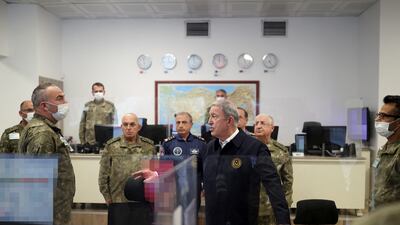
Mr Akar is briefed on the operations. Reuters -

Kurds attend a funeral of people killed in Turkish air strikes in the village of Al Malikiyah, northern Syria. AP -
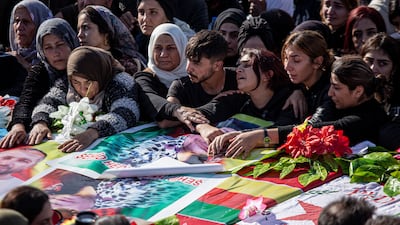
Women mourn during the funeral service. AP -
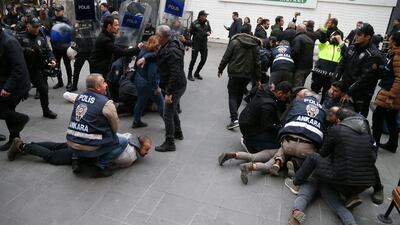
Police arrest members of the Peoples' Democratic Party (HDP) during a protest against the Turkish Armed Forces' (TSK) air campaign in the northern regions of Iraq and Syria, in Ankara. AFP


The US considers the PKK a terrorist organisation, but says that it does not work directly with the SDF. The SDF’s main fighting component is the People’s Protection Units, or YPG, a Kurdish militia that played a key role defeating ISIS in eastern Syria, with western support.
Turkish soldiers and allied Islamist militia groups made up of former anti-government rebels control northern districts of Aleppo, Hasakah and Idlib governorates and Mr Erdogan has threatened to launch deeper thrusts into Syrian territory to target Kurdish militias.
Moscow has ties to Kurdish officials — who are also allied to the US — but Russia's influence on deployment of Kurdish militias is complicated by growing co-operation between Syrian-Kurdish groups and the government of Bashar Al Assad, who has relied heavily on Russian military support.
The SDF, despite being supported by about 900 US soldiers in eastern Syria, has been losing ground to Turkish incursions since 2016, actions condemned by Damascus and Washington.
Syria considers such incursions a violation of its sovereignty while the US says they are disrupting efforts to consolidate gains against the now-diminished ISIS group.
Meanwhile, the SDF says at least 10,000 ISIS prisoners in their custody, in addition to 70,000 women and children linked to the group, could escape from camps in the event of an escalation of fighting.
Turkey's President told Mr Putin it was "important to clear the [Kurdish fighters] from the border to a depth of at least 30km", his office said. Mr Erdogan stated it was "a priority", the Turkish presidency said. Some of the Kurdish forces are stationed in areas under Russian military control.
The Kremlin confirmed the 2019 agreement was discussed in the call. "The two countries' defence and foreign services will maintain close contacts in this regard," a statement from Moscow said.
Both Moscow and Washington have been exerting diplomatic pressure on Ankara, advising against a new ground campaign.
Under a 2019 deal signed with Turkey, Russia promised to establish a buffer zone between the Turkish border and YPG forces that would be controlled by the Syrian army and Russian military police. The agreement was not fully put into place, although Russian and Syrian government forces are present in the frontier region, as well as some US troops.

