


A strong thunderstorm hit the Indian capital and adjoining regions early on Monday, bringing relief to millions from the sweltering heat.
The city’s temperature fell by 11 degrees Celsius, from 29 degrees to 18 degrees on Monday morning, the India Meteorological Department said.
The weather office has predicted Delhi will continue to record winds with speeds of 50 to 80 kmph on Monday. However, hotter temperatures are expected later, reaching 39 degrees Celsius.
“Dust storm/thunderstorm with light to moderate intensity rain and gusty winds with speed of 50-80 km/h very likely to continue over Delhi-NCR and adjoining areas during next two hours,” the India Meteorological Department said in a tweet.
Delhi and its satellite cities had been scorching under a heatwave until last week with at least two weather stations recording temperatures above 49 degrees Celsius.
-
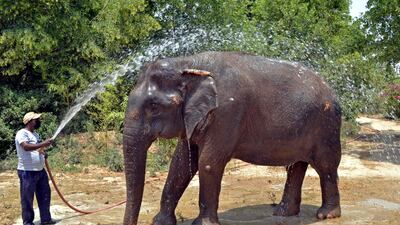
An elephant is given a cooling shower at a conservation reserve in Uttar Pradesh state. AFP -

A boy bathes as he waits to collect water from a municipal tanker on a hot summer day in New Delhi. Reuters -

A woman fills a plastic container with drinking water from a municipal tanker in New Delhi. Reuters -

A boy jumps into a pond in Mumbai. Large parts of India are experiencing the hottest April on record. EPA -

A man selling candy floss in Mumbai helps a water vendor who is using an umbrella as a parasol. AP -
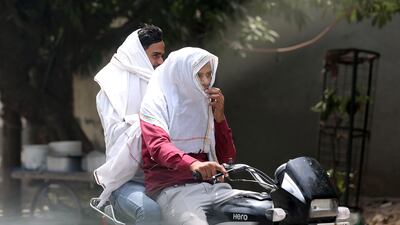
Men ride a motorcycle during a hot afternoon on the outskirts of New Delhi. EPA -

A boy eats an ice lolly on the outskirts of New Delhi. EPA -

Women ride a motorised rickshaw in Amritsar. AFP -

A boy drinks soda beside the Arabian Sea in Mumbai. AP -

At a factory in New Delhi, a worker waits to load ice blocks on to a vehicle. Reuters -

A child plays near a paddy field on the outskirts of Gauhati, Assam state. AP -

Men enjoy a slide at a water park in New Delhi. AFP -

People take a dip in a wave pool at a water park in New Delhi. AFP -
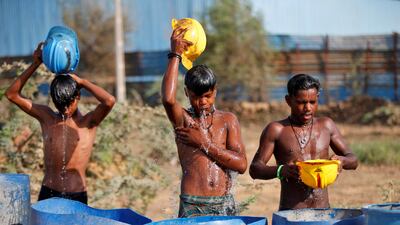
Youths use their helmets to pour water over themselves near a construction site on the outskirts of Ahmedabad. Reuters -

A labourer naps near sacks of vegetables in Jammu. AP -

A boy bathes in the Ranbir Canal in Jammu. AP -

A man drinks water in Allahabad. AFP -

A woman covers her head with a plastic tub near Sangam, the confluence of the Ganges, Yamuna and mythical Saraswati rivers. AFP -

Men walk over the bed of the Yamuna River in search of recyclable material in New Delhi. Reuters -

Residents of New Delhi fill containers with water from a municipal tanker. Bloomberg


While the rains and winds brought down the temperature, the downpour caused waterlogging in several parts of the city as scores of trees were uprooted on the roads, causing traffic jams during the morning rush hour.
At least three incidents of walls collapsing were reported from different parts of the city, though without any casualties.
The early morning thunderstorm also affected air traffic, with at least 60 flights either delayed for arrival or departure. Two flights were cancelled.
The Delhi International Airport requested passengers to get “updated flight information” before heading to the airport as flights were affected.
The weather office has predicted widespread rainfall and isolated thunderstorms in Delhi’s neighbouring states of Punjab, Haryana, Uttarakhand and Jammu and Kashmir over the next two days.
The western Rajasthan state, which had a blistering summer and acute water shortages, can expect “peak rainfall intensity” on Monday.
Mahesh Palawat, vice president of private weather forecaster Skymet Weather, said that the city recorded its coldest May temperature in the last decade, on Monday.
“The city recorded the minimum temperature during the decade. While rain has stopped and the weather system is clearing up, we are anticipating another spell of rain and thunderstorm activity tonight and tomorrow,” Mr Palawat told The National.
The South Asian nation has sweltered this year in the highest temperatures in almost 125 years.
Large parts of northern, western and central India recorded spells of hot weather in March and April as the mercury significantly breached the average monthly temperature.
But the south-west monsoon, when the country receives about 75 per cent of its rainfall, advanced early this year.
India’s southern and eastern regions are already recording heavy rainfall due to the onset of the south-west monsoon. Weather experts say the monsoon will touch the northern region by June 1.

