

World Red Cross and Red Crescent Day is a global celebration of the unity of a movement, and the ethos of humanitarianism.
With the world convulsed by war, conquest and climate change, this ethos is in ever sharper relief.
In 2020, 14.9 million Red Cross and Red Crescent volunteers reached more than 688 million people with disaster and other emergency response work, 306 million more with health activities, and 125 million with clean water and sanitation assistance.
The roots of the 192 International Federation of Red Cross and Red Crescent Societies can be traced back to the change in the global mindset of the 18th and 19th centuries.
“Sometime in the 18th century, people started to think about disasters in a different way,” Bertrand Taithe, professor of Cultural History at the University of Manchester, told The National.
“They started to find some suffering unbearable, so slavery became unbearable to a portion of the population when previously slavery was part of the economic system that everybody, if not accepted, at least tolerated.
“And there's a moment in the 19th century where people think, actually, I can do something about it.”

While organised humanitarianism only took shape post the enlightenment era, Prof Taithe said it is possible to draw a nexus between the two.
“Some people have argued that [humanitarianism] was linked to the development of the new notion of self, of who you are and what you can do,” he said.
The sense of self-empowerment and enlightenment explains why people felt inclined to humanitarian endeavours at this point, but without the globalised structural changes that took place in the 19th century, the urge to help would have been rendered impractical.
“In order to help people in a disaster in [say] Japan, you need to be able to send money there,” said Prof Taithe.
“And that's not possible until the 19th century when you have an interesting convergence of things going on.
“One is the arrival of international media, news coverage of some sort, often illustrated news coverage, and that's important.
“The second is the arrival of international banking systems — you can transfer money abroad and easily.
“And the third one is the notion that as a person, as an individual, you can do something about suffering on the other side of the world.”
The most famous wartime humanitarian is Florence Nightingale, who came to prominence in the 1850s while serving as a manager and trainer of nurses in the Crimean War in the 1850s.
Another wartime humanitarian, less renowned but no less significant, is Switzerland's Henry Dunant.
In 1859, Dunant organised local people to support the wounded in the Battle of Solferino, a key skirmish in the Second Italian War of Independence.
Later, upset by what he had witnessed in the battle, Dunant proposed the creation of national relief societies to alleviate the suffering caused by war. Crucially, these societies would be populated by people trained in peacetime.
His ideas were formalised in 1863 when the founding charter of the Red Cross was drawn up in Geneva.
Alongside the charter, Dunant made an affiliated proposal which became known as the Geneva Conventions. The proposal asserted the sanctity of medics and the wounded in war zones, and built on a code crafted during the American Civil War (1861-1865) which prohibited behaviours such as rape, pillage, murder and the destruction of cultural artefacts.
Red Crescent testament to globality of movement
After the Red Cross charter was established, national relief societies sprouted up around the globe.
The first Red Crescent society — the name adopted by Red Cross societies in Muslim countries — originated in the Ottoman Empire in 1868 in response to the Crimean War. The precursor to the British Red Cross was formed in 1870 as a consequence of the Franco-Prussian conflict.
The immediacy with which Red Crescent societies appeared is instructive and speaks to the organisation's globality.
"The Ottoman Red Crescent [was formed] almost instantly,” said Prof Taithe.
“So it's not a western thing that spreads; it's a western thing that gets international buy-in from countries like Turkey and Japan very quickly.”
The appeal lay in both the international optics and a rather more pragmatic side of polity management.
“To be part of the Red Cross family is a way of showing you are a civilised nation,” said Prof Taithe.
“It's a mass movement … the biggest Red Cross movement in 1900 is in Japan.
“And, if you want to be cynical, it's also a way of mobilising forces of society that are not normally mobilised support in conflict — women and children.
“So when it comes to total war, like in the [two world wars], you can say that the Red Cross is a tool to bring in all those forces into the service of a war.”
The League of Red Cross Societies is born
While Henry Dunant was crucial to the concept of wartime relief, it was another Henry who played an integral role in the shape of the International Federation of Red Cross and Red Crescent Societies today.
The Henry in question is Henry Davison, who brought together the Red Cross societies of France, Britain, Italy, Japan and the US under the banner of the League of Red Cross Societies in 1919 after the First World War.

The scope of the league was a little broader and more ambitious than the original wartime-relief remit fashioned by Dunant.
Instead of just focusing on care for those in conflict, the league aimed to improve the health of countries afflicted by war in a more holistic fashion. It was also a mechanism to promulgate the message of the Red Cross and to institute new societies around the world.
In this beefed-up guise, the Red Cross launched campaigns to counter an eastern European typhus epidemic, the Russian famine of 1921 and the Great Kanto earthquake in Japan in 1923.

The divide between wartime relief and more ongoing humanitarian relief underpins the structure of the Red Cross in the present day, which Prof Taithe compared to a mini United Nations.
“[The individual Red Cross and Red Crescent societies] will deal with a range of things like disaster response, nurse training, first aid training etc.,” he said
“The International Committee of the Red Cross and Red Crescent deals with humanitarian interventions in wartime.”
And while IFRC societies now even help with things such as home deliveries, it is undeniably war with which the IFRC is most synonymous. From the Franco-Prussian conflict of the 1870s, through to the Ukraine war now, it has provided relief to millions.
However, the Red Cross's greatest battle has yet to come — and it won't be fought on a conventional battlefield.

With the world effectively at war with the climate, the resulting mass displacements and extreme weather events will challenge the very precept of humanitarianism, which has always been more reactive than preventive.
“It is much better at responding to what there is right now,” said Prof Taithe.
“If there's an earthquake now, we know there's going to be humanitarian aid deployed for it. If you tell me there's going to be an earthquake in 10 years, what are you planning to do?”
Prof Taithe believes humanitarian organisations like the IFRC will need to adapt their problem-based models if they are to come up with effective mitigation strategies for climate change, which is “very easy to observe and difficult to measure”.
Red Cross in Ukraine — in pictures
-
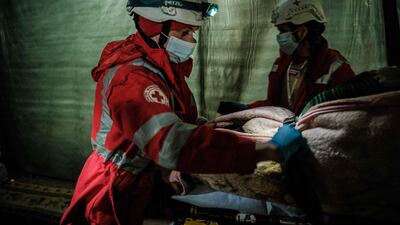
Members of the Ukrainian Red Cross carry an internally displaced 92-year-old woman to an ambulance in a bunker at a factory in Severodonetsk, eastern Ukraine. AFP -
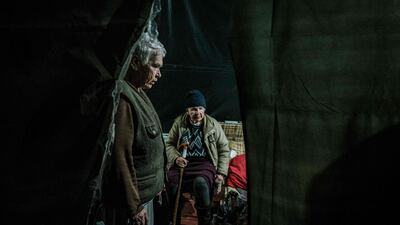
Internally displaced elderly people wait for the Ukrainian Red Cross to evacuate them from a bunker at a factory in Severodonetsk, eastern Ukraine. AFP -
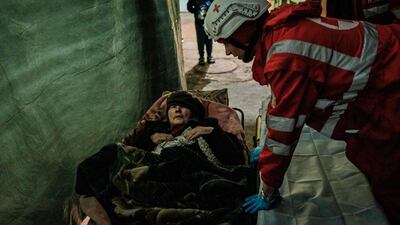
A member of the Ukrainian Red Cross talks to an internally displaced 92-year-old woman before taking her to an ambulance in a bunker at a factory in Severodonetsk, eastern Ukraine. AFP -
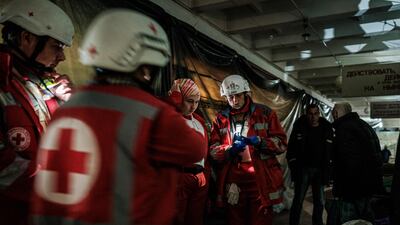
Members of the Ukrainian Red Cross before moving an elderly woman to an ambulance in a bunker at a factory in Severodonetsk, eastern Ukraine. AFP -
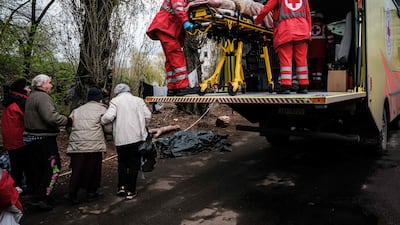
Members of the Ukrainian Red Cross carry an internally displaced 92-year-old woman to an ambulance from a bunker at a factory in Severodonetsk, eastern Ukraine. AFP -
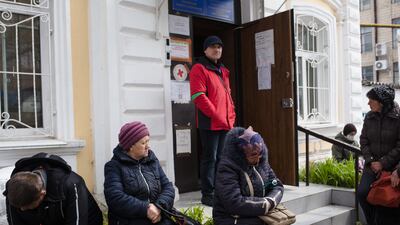
Local residents wait in line to receive humanitarian aid from the International Committee of the Red Cross in the Mykolaiv area of Ukraine. Getty Images -

Red Cross workers haul a cart with an injured Ukrainian serviceman to a hospital in Donetsk, eastern Ukraine. AP Photo -
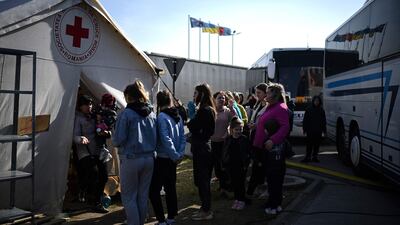
A Ukrainian refugee holds her baby as she walks out of a Romanian Red Cross tent at the Isaccea border crossing, north-eastern Romania. AFP -
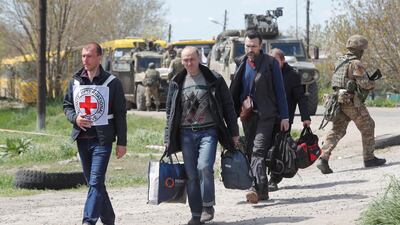
People near the Azovstal steel plant in Mariupol accompanied by a member of the International Committee of the Red Cross (ICRC) at a temporary accommodation centre in the village of Bezimenne in Donetsk, Ukraine. Reuters -

Ukrainian refugees hold their babies as they stand outside a Romanian Red Cross tent at the Isaccea border crossing, north-eastern Romania. AFP -
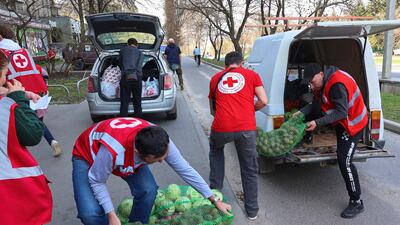
Ukrainians helping out in a Red Cross volunteer centre in Kharkiv, Ukraine. EPA -
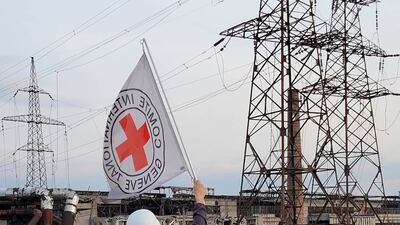
In this image provided by the International Committee of the Red Cross, an official waves a white flag while approaching the Azovstal steelworks in Mariupol, Ukraine. AP Photo



