The Philippines will elect a new president on Monday, May 9, and voting will also be held for thousands of other positions.
President Rodrigo Duterte is unable to stand for re-election under the country’s rules, which limit presidents to a single six-year term.
More than 67 million Filipinos are eligible to vote, including about 1.7 million who live overseas, in the Middle East and elsewhere.
As polling day begins, here is all you need to know.
When are the Philippines elections?
Polling stations will be open from 6am to 7pm local time on Monday, May 9.
Voting for registered overseas Filipinos opened on April 10.
When will we know the result?
Vote counting starts immediately after polls close.
A live, unofficial count could give an indication of who has won the presidency within hours, Reuters said.
The election commission is aiming to announce the complete results by the end of May.
The winner must be inaugurated as president within seven weeks of results being announced.
Who is the favourite to become the next president?
Ferdinand Marcos Jr, also known as “Bongbong”, is currently leading the race.
Polls indicate Mr Marcos Jr is on track to secure an absolute majority with more than half the vote.
He is the son of former president Ferdinand Marcos, who ruled from 1965 to 1986. Marcos Sr ruled under martial law from 1972 to 1981 and was widely considered a dictator.
On Monday, Mr Marcos Jr cast his vote with his mother, Imelda Marcos, who became notorious during and after the Marcos era for misusing billions of dollars' worth of public funds.
She was convicted by a court in the Philippines in 1993 and spent some time in exile in Hawaii with her family. In 1990, the Supreme Court of Switzerland ruled that funds deposited in Swiss bank accounts by Ms Marcos were of “criminal provenance.”
But this controversial history of the Marcos clan has not tarnished Mr Marcos Jr's campaign.
He is running on a platform of “unity” and has promised more jobs and greater security, though rights groups have voiced fears he could rule “without constraint”.
He is also allied to Sara Duterte-Carpio, the daughter of the departing president. She is running for vice president.
Who are Marcos Jr’s closest rivals?
Mr Marcos Jr’s closest challenger in the polls is Leni Robredo, the departing vice president.
Ms Robredo, who defeated Mr Marcos Jr in the 2016 vice presidential race, has been a fierce critic of both him and Mr Duterte.
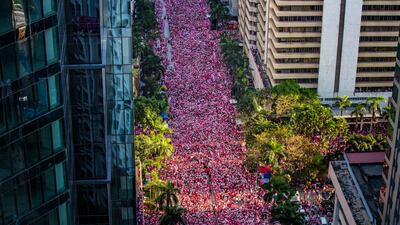
Her campaign has promised transparency and economic reforms, and has been characterised by huge rallies of supporters dressed in pink, the chosen colour of her “pink revolution”.
Recent polling put her 33 percentage points behind Mr Marcos Jr.
Other challengers include the Manila Mayor Isko Moreno Domagoso, and the international boxing star Manny Pacquiao, though both are trailing Mr Marcos Jr and Ms Robredo in the polls.
Who are the other candidates?
While ten candidates filed to compete for president, the race has come down to a few main contenders — high profile figures such as Manny Pacquiao, a former boxer, are unlikely to make significant headway, while another prominent figure, Senator Ping Lacson — who has made several runs for the president role in the past, are trailing far behind.
Who is running for vice president?
Unlike in the US, the Philippines elects vice presidents separately, though the vote is held on the same day.
Sara Duterte-Caprio is the current front-runner for the vice presidency. She is the daughter of the departing president and allied with Mr Marcos Jr.
Her main challengers are Senate President Vicente Sotto III and Leni Robredo’s running mate, Senator Francis Pangilinan.
According to the country's 1987 constitution, the vice president is “mandated to assume the presidency in case of the death, disability, or resignation of the incumbent president," although the vice president can also take the role of a cabinet minister.
Are political parties important?
Political parties are generally considered less important than personal loyalties in the Philippines.
Most candidates gain their support from personal appeal rather than a party base, and it is common for members of parliament to ally with whoever becomes president.
Can Filipinos overseas vote and how significant is their vote?
The Philippines has a large diaspora population across the world. There were 2.5 million Filipinos registered as living abroad in 2019, figures compiled by the Commission on Filipinos Overseas show.
These Filipino citizens are eligible to vote from their host countries.
About 1.7 million overseas Filipinos are registered to vote in 2022 out of the country's 67 million voters.
The country with the most registered voters is the UAE, with 290,182, followed by Saudi Arabia and the US.
More women than men are registered to vote overseas.
With inputs from Pulse Asia.

Other must-tries
Tomato and walnut salad
A lesson in simple, seasonal eating. Wedges of tomato, chunks of cucumber, thinly sliced red onion, coriander or parsley leaves, and perhaps some fresh dill are drizzled with a crushed walnut and garlic dressing. Do consider yourself warned: if you eat this salad in Georgia during the summer months, the tomatoes will be so ripe and flavourful that every tomato you eat from that day forth will taste lacklustre in comparison.
Badrijani nigvzit
A delicious vegetarian snack or starter. It consists of thinly sliced, fried then cooled aubergine smothered with a thick and creamy walnut sauce and folded or rolled. Take note, even though it seems like you should be able to pick these morsels up with your hands, they’re not as durable as they look. A knife and fork is the way to go.
Pkhali
This healthy little dish (a nice antidote to the khachapuri) is usually made with steamed then chopped cabbage, spinach, beetroot or green beans, combined with walnuts, garlic and herbs to make a vegetable pâté or paste. The mix is then often formed into rounds, chilled in the fridge and topped with pomegranate seeds before being served.
Zayed Sustainability Prize
Ten tax points to be aware of in 2026
1. Domestic VAT refund amendments: request your refund within five years
If a business does not apply for the refund on time, they lose their credit.
2. E-invoicing in the UAE
Businesses should continue preparing for the implementation of e-invoicing in the UAE, with 2026 a preparation and transition period ahead of phased mandatory adoption.
3. More tax audits
Tax authorities are increasingly using data already available across multiple filings to identify audit risks.
4. More beneficial VAT and excise tax penalty regime
Tax disputes are expected to become more frequent and more structured, with clearer administrative objection and appeal processes. The UAE has adopted a new penalty regime for VAT and excise disputes, which now mirrors the penalty regime for corporate tax.
5. Greater emphasis on statutory audit
There is a greater need for the accuracy of financial statements. The International Financial Reporting Standards standards need to be strictly adhered to and, as a result, the quality of the audits will need to increase.
6. Further transfer pricing enforcement
Transfer pricing enforcement, which refers to the practice of establishing prices for internal transactions between related entities, is expected to broaden in scope. The UAE will shortly open the possibility to negotiate advance pricing agreements, or essentially rulings for transfer pricing purposes.
7. Limited time periods for audits
Recent amendments also introduce a default five-year limitation period for tax audits and assessments, subject to specific statutory exceptions. While the standard audit and assessment period is five years, this may be extended to up to 15 years in cases involving fraud or tax evasion.
8. Pillar 2 implementation
Many multinational groups will begin to feel the practical effect of the Domestic Minimum Top-Up Tax (DMTT), the UAE's implementation of the OECD’s global minimum tax under Pillar 2. While the rules apply for financial years starting on or after January 1, 2025, it is 2026 that marks the transition to an operational phase.
9. Reduced compliance obligations for imported goods and services
Businesses that apply the reverse-charge mechanism for VAT purposes in the UAE may benefit from reduced compliance obligations.
10. Substance and CbC reporting focus
Tax authorities are expected to continue strengthening the enforcement of economic substance and Country-by-Country (CbC) reporting frameworks. In the UAE, these regimes are increasingly being used as risk-assessment tools, providing tax authorities with a comprehensive view of multinational groups’ global footprints and enabling them to assess whether profits are aligned with real economic activity.
Contributed by Thomas Vanhee and Hend Rashwan, Aurifer
'The Batman'
Stars:Robert Pattinson
Director:Matt Reeves
Rating: 5/5
%20Ramez%20Gab%20Min%20El%20Akher
%3Cp%3E%3Cstrong%3ECreator%3A%3C%2Fstrong%3E%20Ramez%20Galal%3C%2Fp%3E%0A%3Cp%3E%3Cstrong%3EStarring%3A%3C%2Fstrong%3E%20Ramez%20Galal%3C%2Fp%3E%0A%3Cp%3E%3Cstrong%3EStreaming%20on%3A%20%3C%2Fstrong%3EMBC%20Shahid%3C%2Fp%3E%0A%3Cp%3E%3Cstrong%3ERating%3A%20%3C%2Fstrong%3E2.5%2F5%3C%2Fp%3E%0A
The President's Cake
Director: Hasan Hadi
Starring: Baneen Ahmad Nayyef, Waheed Thabet Khreibat, Sajad Mohamad Qasem
Rating: 4/5
Gully Boy
Director: Zoya Akhtar
Producer: Excel Entertainment & Tiger Baby
Cast: Ranveer Singh, Alia Bhatt, Kalki Koechlin, Siddhant Chaturvedi
Rating: 4/5 stars
COMPANY PROFILE
Name: Kumulus Water
Started: 2021
Founders: Iheb Triki and Mohamed Ali Abid
Based: Tunisia
Sector: Water technology
Number of staff: 22
Investment raised: $4 million
Zayed Sustainability Prize
Mercer, the investment consulting arm of US services company Marsh & McLennan, expects its wealth division to at least double its assets under management (AUM) in the Middle East as wealth in the region continues to grow despite economic headwinds, a company official said.
Mercer Wealth, which globally has $160 billion in AUM, plans to boost its AUM in the region to $2-$3bn in the next 2-3 years from the present $1bn, said Yasir AbuShaban, a Dubai-based principal with Mercer Wealth.
“Within the next two to three years, we are looking at reaching $2 to $3 billion as a conservative estimate and we do see an opportunity to do so,” said Mr AbuShaban.
Mercer does not directly make investments, but allocates clients’ money they have discretion to, to professional asset managers. They also provide advice to clients.
“We have buying power. We can negotiate on their (client’s) behalf with asset managers to provide them lower fees than they otherwise would have to get on their own,” he added.
Mercer Wealth’s clients include sovereign wealth funds, family offices, and insurance companies among others.
From its office in Dubai, Mercer also looks after Africa, India and Turkey, where they also see opportunity for growth.
Wealth creation in Middle East and Africa (MEA) grew 8.5 per cent to $8.1 trillion last year from $7.5tn in 2015, higher than last year’s global average of 6 per cent and the second-highest growth in a region after Asia-Pacific which grew 9.9 per cent, according to consultancy Boston Consulting Group (BCG). In the region, where wealth grew just 1.9 per cent in 2015 compared with 2014, a pickup in oil prices has helped in wealth generation.
BCG is forecasting MEA wealth will rise to $12tn by 2021, growing at an annual average of 8 per cent.
Drivers of wealth generation in the region will be split evenly between new wealth creation and growth of performance of existing assets, according to BCG.
Another general trend in the region is clients’ looking for a comprehensive approach to investing, according to Mr AbuShaban.
“Institutional investors or some of the families are seeing a slowdown in the available capital they have to invest and in that sense they are looking at optimizing the way they manage their portfolios and making sure they are not investing haphazardly and different parts of their investment are working together,” said Mr AbuShaban.
Some clients also have a higher appetite for risk, given the low interest-rate environment that does not provide enough yield for some institutional investors. These clients are keen to invest in illiquid assets, such as private equity and infrastructure.
“What we have seen is a desire for higher returns in what has been a low-return environment specifically in various fixed income or bonds,” he said.
“In this environment, we have seen a de facto increase in the risk that clients are taking in things like illiquid investments, private equity investments, infrastructure and private debt, those kind of investments were higher illiquidity results in incrementally higher returns.”
The Abu Dhabi Investment Authority, one of the largest sovereign wealth funds, said in its 2016 report that has gradually increased its exposure in direct private equity and private credit transactions, mainly in Asian markets and especially in China and India. The authority’s private equity department focused on structured equities owing to “their defensive characteristics.”
Leap of Faith
Michael J Mazarr
Public Affairs
Dh67
Elvis
%3Cp%3E%3Cstrong%3EDirector%3A%3C%2Fstrong%3E%20Baz%20Luhrmann%3C%2Fp%3E%0A%3Cp%3E%3Cstrong%3EStars%3A%3C%2Fstrong%3E%20Austin%20Butler%2C%20Tom%20Hanks%2C%20Olivia%20DeJonge%3C%2Fp%3E%0A%3Cp%3E%3Cstrong%3ERating%3A%3C%2Fstrong%3E%204%2F5%3C%2Fp%3E%0A
RESULTS
6pm: Al Maktoum Challenge Round-2 – Group 1 (PA) $55,000 (Dirt) 1,900m
Winner: Rajeh, Antonio Fresu (jockey), Musabah Al Muhairi (trainer)
6.35pm: Oud Metha Stakes – Rated Conditions (TB) $60,000 (D) 1,200m
Winner: Get Back Goldie, William Buick, Doug O’Neill
7.10pm: Jumeirah Classic – Listed (TB) $150,000 (Turf) 1,600m
Winner: Sovereign Prince, James Doyle, Charlie Appleby
7.45pm: Firebreak Stakes – Group 3 (TB) $150,000 (D) 1,600m
Winner: Hypothetical, Mickael Barzalona, Salem bin Ghadayer
8.20pm: Al Maktoum Challenge Round-2 – Group 2 (TB) $350,000 (D) 1,900m
Winner: Hot Rod Charlie, William Buick, Doug O’Neill
8.55pm: Al Bastakiya Trial – Conditions (TB) $60,000 (D) 1,900m
Winner: Withering, Adrie de Vries, Fawzi Nass
9.30pm: Balanchine – Group 2 (TB) $180,000 (T) 1,800m
Winner: Creative Flair, William Buick, Charlie Appleby
Turkish Ladies
Various artists, Sony Music Turkey
The%20end%20of%20Summer
%3Cp%3EAuthor%3A%20Salha%20Al%20Busaidy%3C%2Fp%3E%0A%3Cp%3EPages%3A%20316%3C%2Fp%3E%0A%3Cp%3EPublisher%3A%20The%20Dreamwork%20Collective%C2%A0%3C%2Fp%3E%0A
The specs: 2018 BMW X2 and X3
Price, as tested: Dh255,150 (X2); Dh383,250 (X3)
Engine: 2.0-litre turbocharged inline four-cylinder (X2); 3.0-litre twin-turbo inline six-cylinder (X3)
Power 192hp @ 5,000rpm (X2); 355hp @ 5,500rpm (X3)
Torque: 280Nm @ 1,350rpm (X2); 500Nm @ 1,520rpm (X3)
Transmission: Seven-speed automatic (X2); Eight-speed automatic (X3)
Fuel consumption, combined: 5.7L / 100km (X2); 8.3L / 100km (X3)