

The director of Russia’s space programme said economic sanctions aimed at the country threaten partnerships at the International Space Station (ISS) and he supports a move to end future co-operation with other agencies.
In a series of social media posts on Saturday, Roscosmos general director Dmitry Rogozin shared what he claimed were replies from the respective heads of the US space agency Nasa, the European Space Agency and the Canadian Space Agency to his demand that their countries lift sanctions against enterprises involved in the Russia space industry.
“Nasa will continue to work with relevant US Federal departments and agencies to facilitate continued co-operation on and operation of the ISS,” read one of the posted statements that appears to be signed by the US agency's administrator, Bill Nelson. A phone call to Nasa by Bloomberg News on Saturday to confirm the authenticity of the letter wasn’t returned.
Questions regarding Russia’s relationship with the ISS have brewed since the country invaded Ukraine in February.
Mr Rogozin told a state-owned television network last month that Russia would end sales of rocket engines to the US, and Moscow cancelled the launch of three dozen satellites for OneWeb, a London-based satellite internet company partly owned by the UK government.
Mr Rogozin will shortly submit to Russian leaders specific proposals on ending co-operation on the ISS, he said in the social media posts.
At the moment though, ISS operations seem mostly unaffected by politics on Earth. Nasa astronaut Mark Vande Hei returned to earth in a Soyuz capsule on Wednesday, landing in Kazakhstan with two cosmonauts. Mr Vande Hei spent a record 355 days on-board the ISS. Three Americans, three Russians and a German are currently based at the ISS, while Axiom Space plans to send up three space tourists and their captain as soon as April 6.
Nasa plans to operate the space station through 2030. SpaceX and Northrop Grumman Corporation were awarded Nasa contracts on March 25 for a dozen more cargo missions to the ISS.
-
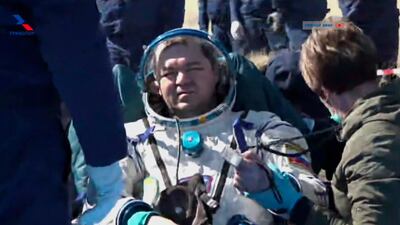
A grab from video footage released by Roscosmos space agency shows Russian cosmonaut Oleg Skripochka shortly after returning from the International Space Station aboard the Soyuz MS-15 space capsule near the town of Dzhezkazgan, Kazakhstan on April 17, 2020. Roscosmos Space Agency via AP -
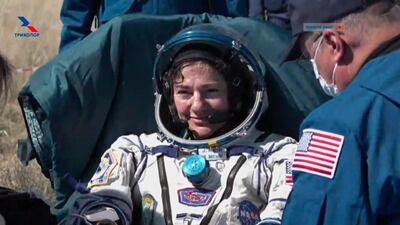
US astronaut Jessica Meir returns to Earth after taking part in the first all-women space walk in October 2019. Roscosmos Space Agency via AP -
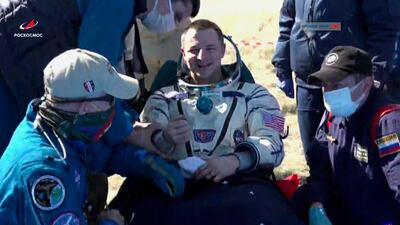
Astronaut Andrew Morgan, is the third crew member to return to Earth on April 17, 2020 after more than 200 days aboard the space station. Roscosmos Space Agency via AP



