

At least seven people have been killed in an attack on a train travelling between the Nigerian capital of Abuja and the northern city of Kaduna.
The attack happened on Tuesday when the train was derailed by a bomb and raided by gunmen. Several people are missing.
The trainline, which opened in 2017, was considered to be one of the country’s more successful infrastructure projects in recent years.
But violence has grown in the north-east of the country, where armed gangs are known to operate, as well as terrorist groups linked to Al Qaeda and ISIS.
-
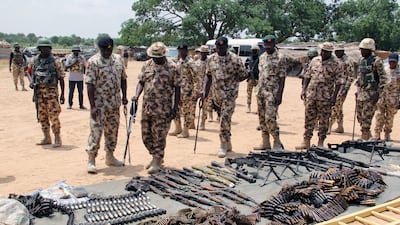
Military commanders inspect arms and ammunitions recovered from Boko Haram militants in Nigeria. -

Niger Army soldier takes a breather during security patrol near the Nigerian border on the hunt for Boko Haram militants. -
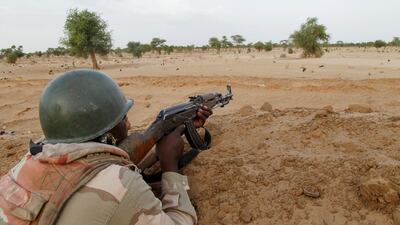
The area around Diffa, Niger, has experienced fighting between Boko Haram and African security forces. -

A car burns at the scene of a militant attack on a church outside the Nigerian captial of Abuja. At least 27 people were killed in five bomb attacks claimed by Boko Haram. -
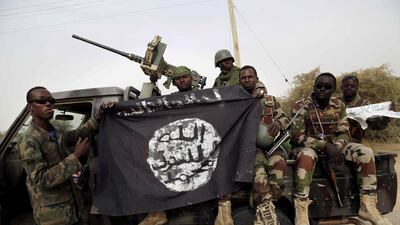
Nigerian soldiers hold up a Boko Haram flag seized in the town of Damasak in 2015. -
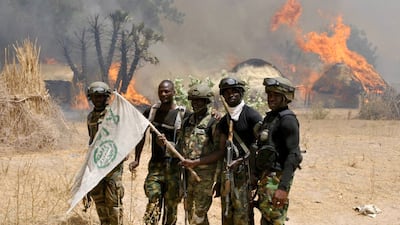
Nigerian soldiers are seen after an operation against Boko Haram in Borno, Nigeria, in 2016. -
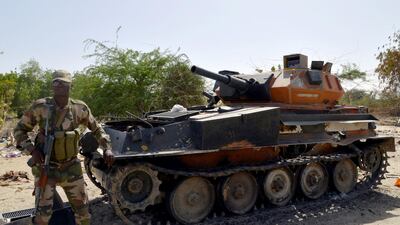
A soldier from the Niger army stands next to a burnt out tank belonging to Boko Haram. -
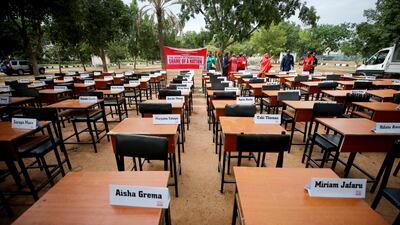
Names of missing Chibok schoolgirls kidnapped by Boko Haram are displayed in Abuja, Nigeria. -
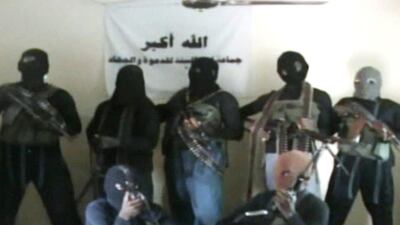
A screengrab from a video reportedly released by Boko Haram shows seven members in an undisclosed location. -

A screengrab from a video released in 2018 shows Boko Haram leader Abubakar Shekau amid a surge in violence in Nigeria. He was recently reported as having been killed. -

A screengrab from a video released in 2014 shows Abubakar Shekau, who had voiced support for ISIS. He was recently reported as having been killed.


About 970 passengers were on board the train when it was derailed and shot at.
"Passengers who sustained injuries, and the fatalities, have been moved to hospitals," Kaduna State security commissioner Samuel Aruwan said.
The bodies of those killed are at 44 Army Reference Hospital in Kaduna, along with 22 wounded people, sources at the hospital said.
A train security guard told AFP that seven people were killed, including two cleaners.
Kaduna State Governor Nasir El Rufai visited some of the wounded and criticised the attack.
Surviving passengers were moved to safety by the armed forces and Mr Aruwan said search and rescue operations were under way.
The Nigerian Railway Corporation said services on the Abuja-Kaduna route had been suspended temporarily.
The attack came two days after a security guard at Kaduna airport was killed by gunmen in an attack thwarted by the armed forces.
Gunmen also carried out an attack on the railway line in October.
Bandits in the north-west and central Nigerian states have terrorised communities for a long time, conducting mass kidnappings, raiding villages and stealing cattle.
But their violence has intensified and dozens of gunmen often carry out attacks on motorbikes, sometimes striking several villages and killing or abducting residents.
Main roads have also been targets, with people kidnapped by gangs between the capital and cities such as Kaduna and Kano in the north.
Nigeria's military has been carrying out operations and air strikes to clear bandits from their camps hidden in forests that straddle several states in the north-west.
Security forces are also fighting against a 12-year insurgency in the north-east that has killed 40,000 people and displaced more than two million.

