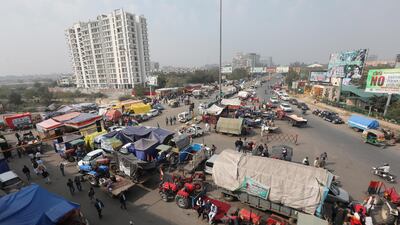
Congress party election vehicles line a street in Amritsar, in Indian state of Punjab. Photo: AP

Modi faces tough challenge winning rural support after Indian farmers' protests


  • English
  • Arabic

More than 21 million voters will cast their ballots in India's Punjab state on Sunday in polls that are regarded as a barometer of Prime Minister Narendra Modi and his party's popularity before general elections in 2024.

Pitched against Mr Modi's Bharatiya Janata Party (BJP) is the incumbent Congress Party and the regional Aam Aadmi Party (AAP), which is seeking to consolidate its political dominance through the election.

The AAP was formed in 2013 to eliminate corruption and has ruled the capital territory of Delhi for two consecutive terms.

On a recent afternoon, Harbhajan Singh, one of the party's candidates from the Jandiala constituency, sat on top of a car during door-to-door campaigning.

A band of young men followed him on motorbikes waving flags brandishing the party symbol – a broom to sweep out corruption.

Mr Singh stopped near a public park and talked to his supporters about chipping away at the entrenched political system.

The BJP implemented controversial farm laws in September 2020 using its executive powers and without any consultation in Parliament. The legislation was met with some of the fiercest protests in India in recent years.

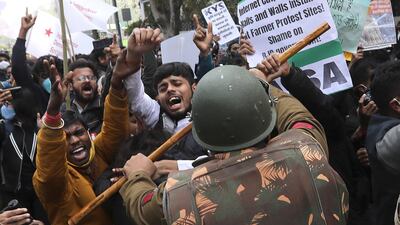
  • Security personnel clash with demonstrators during a rally in support of Indian farmers. The farmers are protesting at various locations at the capital, New Delhi. EPA
    Security personnel clash with demonstrators during a rally in support of Indian farmers. The farmers are protesting at various locations at the capital, New Delhi. EPA
  • A protester is surrounded by security personnel at a demonstration in support of farmers, in New Delhi, India. Reuters
    A protester is surrounded by security personnel at a demonstration in support of farmers, in New Delhi, India. Reuters
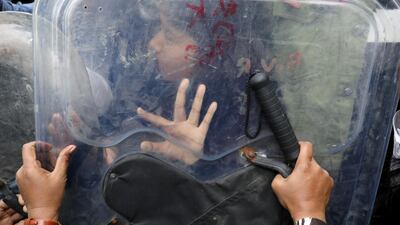
  • A demonstrator is held back behind a police shield at a rally in support of Indian farmers in New Delhi, India. Farmers are protesting against new farming laws. Reuters
    A demonstrator is held back behind a police shield at a rally in support of Indian farmers in New Delhi, India. Farmers are protesting against new farming laws. Reuters
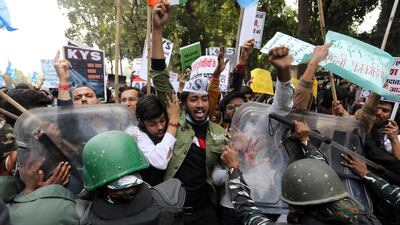
  • Security personnel and protesters clash at a demonstration in solidarity with Indian farmers in New Delhi, India. Farmers say new laws leave them at the mercy of corporations. EPA
    Security personnel and protesters clash at a demonstration in solidarity with Indian farmers in New Delhi, India. Farmers say new laws leave them at the mercy of corporations. EPA
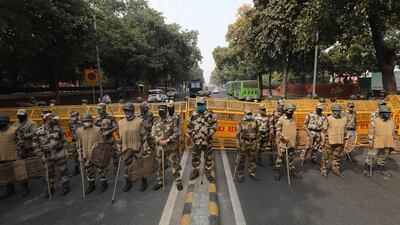
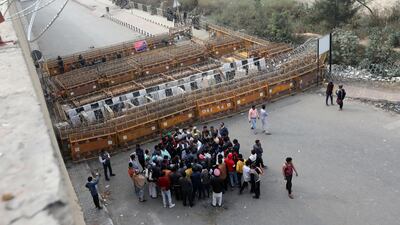
  • Security personnel, some carrying 'lathi' sticks for crowd control, block a road in New Delhi, India, during a protest in support of farmers. EPA
    Security personnel, some carrying 'lathi' sticks for crowd control, block a road in New Delhi, India, during a protest in support of farmers. EPA
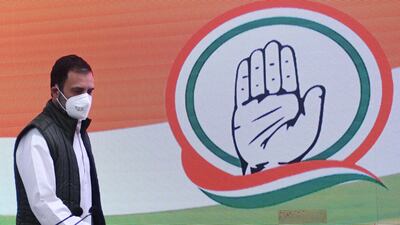
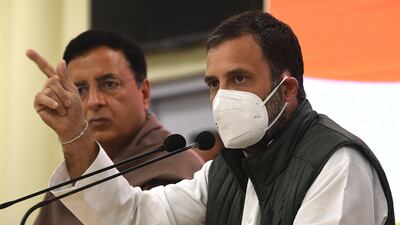
  • Indian National Congress leader Rahul Gandhi arrives at press conference in New Delhi, India. Congress has called for the new farming laws to be repealed. EPA
    Indian National Congress leader Rahul Gandhi arrives at press conference in New Delhi, India. Congress has called for the new farming laws to be repealed. EPA
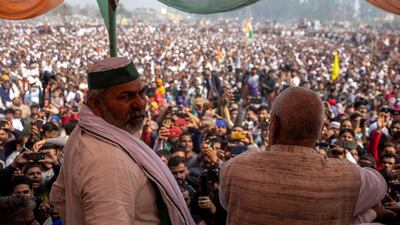
  • Rakesh Tikait, a leader of Bharatiya Kisan Union farmers' group, is helped onstage at a Maha Panchayat village council meeting, in Kandela village, Jind district, Haryana state, India. Reuters
    Rakesh Tikait, a leader of Bharatiya Kisan Union farmers' group, is helped onstage at a Maha Panchayat village council meeting, in Kandela village, Jind district, Haryana state, India. Reuters
  • Rakesh Tikait, a leader of Bharatiya Kisan Union farmers' organisation at a grand village council meeting in Kandela village, Jind district, in Haryana state, India. Reuters
    Rakesh Tikait, a leader of Bharatiya Kisan Union farmers' organisation at a grand village council meeting in Kandela village, Jind district, in Haryana state, India. Reuters
  • Rakesh Tikait, a leader of Bharatiya Kisan Union farmers' group, turns from the crowd at a grand village council meeting at Kandela village, Jind district, in Haryana state, India. Reuters
    Rakesh Tikait, a leader of Bharatiya Kisan Union farmers' group, turns from the crowd at a grand village council meeting at Kandela village, Jind district, in Haryana state, India. Reuters
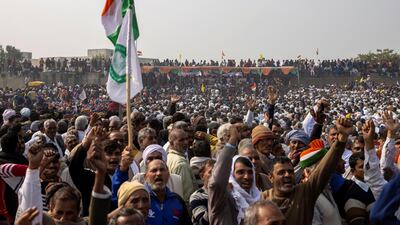
  • Farmers and supporters attend a grand village council meeting at Kandela village, Jind district, in Haryana state, India. Reuters
    Farmers and supporters attend a grand village council meeting at Kandela village, Jind district, in Haryana state, India. Reuters
  • Protesting farmers encounter barbed wire and barricades placed by security personnel at the Delhi Ghazipur Border, near New Delhi, India. EPA
    Protesting farmers encounter barbed wire and barricades placed by security personnel at the Delhi Ghazipur Border, near New Delhi, India. EPA
  • Indian lawyers from Punjab state attend a protest by farmers at the Delhi Ghazipur Border, near New Delhi, India. EPA
    Indian lawyers from Punjab state attend a protest by farmers at the Delhi Ghazipur Border, near New Delhi, India. EPA
  • Villagers leave after a grand village council meeting as part of farmers' protests against farming laws, at Kandela, Jind district, in Haryana state, India. Reuters
    Villagers leave after a grand village council meeting as part of farmers' protests against farming laws, at Kandela, Jind district, in Haryana state, India. Reuters
  • Indian farmers with tractors and trailers protesting at the Delhi Ghazipur Border near New Delhi, India. EPA
    Indian farmers with tractors and trailers protesting at the Delhi Ghazipur Border near New Delhi, India. EPA
  • Protesting Indian farmers rest in a trailer at the Delhi Ghazipur Border near New Delhi, India. EPA
    Protesting Indian farmers rest in a trailer at the Delhi Ghazipur Border near New Delhi, India. EPA
  • Indian National Congress leader Rahul Gandhi addresses a press conference in New Delhi, India. Congress has backed the protesting farmers. EPA
    Indian National Congress leader Rahul Gandhi addresses a press conference in New Delhi, India. Congress has backed the protesting farmers. EPA

Mr Modi's administration billed them as necessary reforms, but farmers feared the laws signalled the government was moving away from a system in which they sold their harvest only in government-sanctioned marketplaces.

They worried this would leave them poorer and at the mercy of private corporations.

The laws triggered a year of protests as angry farmers – most of them Sikhs from Punjab state – camped on the outskirts of New Delhi through a harsh winter and coronavirus pandemic.

In a major reversal, Mr Modi withdrew the laws a year later, three months before the crucial polls in Punjab and four other states.

BJP has a small presence in Punjab but hopes to form a government there with a regional ally and strengthen its voter base among farmers, one of the largest blocs in India.

Punjab, where people are deeply proud of their state's cultural and religious tapestry, also represents a test for Mr Modi's party's Hindu nationalist reach, which has flourished in most of northern India since 2014.

The BJP is running its campaign by trying to portray the Congress government as corrupt.

It is also making grand promises to create more jobs, provide farm subsidies and free electricity for farmers, and eradicate the drug problem that has afflicted the state for years.

Analysts said the moves are intended to placate the farmers, and that the elections were a major reason behind Mr Modi's sudden decision to withdraw the laws.

Bitterness after protest crackdown

That anger, however, runs deep.

More than 700 farmers died during the protests as they weathered harsh cold, record rainfall and sweltering heat, according to Samyukt Kisan Morcha, or the United Farmers Front, the umbrella group of farm unions that organised the agitation. Dozens also died by suicide.

But in December last year, Agriculture Minister Narendra Singh Tomar told Parliament that his government had no record of the farmers' deaths.

This caused widespread anger among the families of the deceased, many of whom are small or landless farmers who constitute the lowest rung of India's farming community.

"Where did those 700 to 750 people go then? The Modi government is responsible for that," said Amarjeet Singh, choking back tears in his family home in Kaler Ghuman village, about 40 kilometres from Amritsar, the state's capital.

Mr Singh's father, Sudagar Singh, died on a hot September afternoon from a sudden heart attack, according to his death certificate.

At the time of his death, he was accompanied by his friend Charan Singh, the village head, who said the 72-year-old collapsed while returning home after spending weeks at the protests.

Scarred by the death, Sudagar Singh's younger brother fell into depression, the family said. He stopped eating and working on his farm. Three months later, he died.

Another farmer, Kulwant Singh, died in an accident during the farmers' protest.

"I could never imagine this," said Balwinder Kaur, Kulwant Singh's wife.

In some cases, the Punjab government has announced jobs and funds for the families of the deceased, but farmers said the elections are an opportunity to turn their anger into meaningful change.

At its peak, the protest drew support from Punjab's rural and urban populations.

Now, those protests find very little resonance among city voters who say the farmers' issues should take a back seat since the laws have been withdrawn.

The election results will be announced on March 10.

RESULTS

Bantamweight: Jalal Al Daaja (JOR) beat Hamza Bougamza (MAR)

Catchweight 67kg: Mohamed El Mesbahi (MAR) beat Fouad Mesdari (ALG)

Lightweight: Abdullah Mohammed Ali (UAE) beat Abdelhak Amhidra (MAR)

Catchweight 73kg: Mosatafa Ibrahim Radi (PAL) beat Yazid Chouchane (ALG)

Middleweight: Yousri Belgaroui (TUN) beat Badreddine Diani (MAR)

Catchweight 78KG: Rashed Dawood (UAE) beat Adnan Bushashy (ALG)

Middleweight: Sallah-Eddine Dekhissi (MAR) beat Abdel Enam (EGY)

Catchweight 65kg: Yanis Ghemmouri (ALG) beat Rachid Hazoume (MAR)

Lightweight: Mohammed Yahya (UAE) beat Azouz Anwar (EGY)

Catchweight 79kg: Souhil Tahiri (ALG) beat Omar Hussein (PAL)

Middleweight: Tarek Suleiman (SYR) beat Laid Zerhouni (ALG)

Company%20Profile
%3Cp%3E%3Cstrong%3ECompany%20name%3A%3C%2Fstrong%3E%20Hoopla%3Cbr%3E%3Cstrong%3EDate%20started%3A%20%3C%2Fstrong%3EMarch%202023%3Cbr%3E%3Cstrong%3EFounder%3A%3C%2Fstrong%3E%20Jacqueline%20Perrottet%3Cbr%3E%3Cstrong%3EBased%3A%3C%2Fstrong%3E%20Dubai%3Cbr%3E%3Cstrong%3ENumber%20of%20staff%3A%3C%2Fstrong%3E%2010%3Cbr%3E%3Cstrong%3EInvestment%20stage%3A%20%3C%2Fstrong%3EPre-seed%3Cbr%3E%3Cstrong%3EInvestment%20required%3A%3C%2Fstrong%3E%20%24500%2C000%3C%2Fp%3E%0A
The specs

Engine: 1.5-litre 4-cyl turbo

Power: 194hp at 5,600rpm

Torque: 275Nm from 2,000-4,000rpm

Transmission: 6-speed auto

Price: from Dh155,000

On sale: now

Desert Warrior

Starring: Anthony Mackie, Aiysha Hart, Ben Kingsley

Director: Rupert Wyatt

Rating: 3/5

Ten tax points to be aware of in 2026

1. Domestic VAT refund amendments: request your refund within five years

If a business does not apply for the refund on time, they lose their credit.

2. E-invoicing in the UAE

Businesses should continue preparing for the implementation of e-invoicing in the UAE, with 2026 a preparation and transition period ahead of phased mandatory adoption. 

3. More tax audits

Tax authorities are increasingly using data already available across multiple filings to identify audit risks. 

4. More beneficial VAT and excise tax penalty regime

Tax disputes are expected to become more frequent and more structured, with clearer administrative objection and appeal processes. The UAE has adopted a new penalty regime for VAT and excise disputes, which now mirrors the penalty regime for corporate tax.

5. Greater emphasis on statutory audit

There is a greater need for the accuracy of financial statements. The International Financial Reporting Standards standards need to be strictly adhered to and, as a result, the quality of the audits will need to increase.

6. Further transfer pricing enforcement

Transfer pricing enforcement, which refers to the practice of establishing prices for internal transactions between related entities, is expected to broaden in scope. The UAE will shortly open the possibility to negotiate advance pricing agreements, or essentially rulings for transfer pricing purposes. 

7. Limited time periods for audits

Recent amendments also introduce a default five-year limitation period for tax audits and assessments, subject to specific statutory exceptions. While the standard audit and assessment period is five years, this may be extended to up to 15 years in cases involving fraud or tax evasion. 

8. Pillar 2 implementation 

Many multinational groups will begin to feel the practical effect of the Domestic Minimum Top-Up Tax (DMTT), the UAE's implementation of the OECD’s global minimum tax under Pillar 2. While the rules apply for financial years starting on or after January 1, 2025, it is 2026 that marks the transition to an operational phase.

9. Reduced compliance obligations for imported goods and services

Businesses that apply the reverse-charge mechanism for VAT purposes in the UAE may benefit from reduced compliance obligations. 

10. Substance and CbC reporting focus

Tax authorities are expected to continue strengthening the enforcement of economic substance and Country-by-Country (CbC) reporting frameworks. In the UAE, these regimes are increasingly being used as risk-assessment tools, providing tax authorities with a comprehensive view of multinational groups’ global footprints and enabling them to assess whether profits are aligned with real economic activity. 

Contributed by Thomas Vanhee and Hend Rashwan, Aurifer

COMPANY%20PROFILE
%3Cp%3E%3Cstrong%3EName%3A%3C%2Fstrong%3E%20Floward%0D%3Cbr%3E%3Cstrong%3EBased%3A%20%3C%2Fstrong%3ERiyadh%2C%20Saudi%20Arabia%0D%3Cbr%3E%3Cstrong%3EFounders%3A%20%3C%2Fstrong%3EAbdulaziz%20Al%20Loughani%20and%20Mohamed%20Al%20Arifi%0D%3Cbr%3E%3Cstrong%3ESector%3A%20%3C%2Fstrong%3EE-commerce%0D%3Cbr%3E%3Cstrong%3ETotal%20funding%3A%20%3C%2Fstrong%3EAbout%20%24200%20million%0D%3Cbr%3E%3Cstrong%3EInvestors%3A%20%3C%2Fstrong%3EAljazira%20Capital%2C%20Rainwater%20Partners%2C%20STV%20and%20Impact46%0D%3Cbr%3E%3Cstrong%3ENumber%20of%20employees%3A%20%3C%2Fstrong%3E1%2C200%3C%2Fp%3E%0A
ELIO

Starring: Yonas Kibreab, Zoe Saldana, Brad Garrett

Directors: Madeline Sharafian, Domee Shi, Adrian Molina

Rating: 4/5

Bangladesh tour of Pakistan

January 24 – First T20, Lahore

January 25 – Second T20, Lahore

January 27 – Third T20, Lahore

February 7-11 – First Test, Rawalpindi

April 3 – One-off ODI, Karachi

April 5-9 – Second Test, Karachi

GROUPS

Group Gustavo Kuerten
Novak Djokovic (x1)
Alexander Zverev (x3)
Marin Cilic (x5)
John Isner (x8)

Group Lleyton Hewitt
Roger Federer (x2)
Kevin Anderson (x4)
Dominic Thiem (x6)
Kei Nishikori (x7)

What are the GCSE grade equivalents?
 
  • Grade 9 = above an A*
  • Grade 8 = between grades A* and A
  • Grade 7 = grade A
  • Grade 6 = just above a grade B
  • Grade 5 = between grades B and C
  • Grade 4 = grade C
  • Grade 3 = between grades D and E
  • Grade 2 = between grades E and F
  • Grade 1 = between grades F and G
John%20Wick%3A%20Chapter%204
%3Cp%3E%3Cstrong%3EDirector%3A%3C%2Fstrong%3E%20Chad%20Stahelski%3C%2Fp%3E%0A%3Cp%3E%3Cstrong%3EStars%3A%3C%2Fstrong%3E%20Keanu%20Reeves%2C%20Laurence%20Fishburne%2C%20George%20Georgiou%3C%2Fp%3E%0A%3Cp%3E%3Cstrong%3ERating%3A%20%3C%2Fstrong%3E4%2F5%3C%2Fp%3E%0A
Updated: February 20, 2022, 10:34 AM