



US troops landed in south-east Poland near the border with Ukraine on Sunday, after President Joe Biden ordered the stationing of 1,700 soldiers there. The move is widely seen as being aimed at deterring a possible Russian invasion of Ukraine.
Hundreds more are still expected to arrive about 90 kilometres from Poland’s border with Ukraine.
Their commander is Maj Gen Christopher Donahue, who on August 30 was the last American soldier to leave Afghanistan.
“Our national contribution here in Poland shows our solidarity with all of our allies here in Europe and, obviously, during this period of uncertainty, we know that we are stronger together,” Maj Gen Donahue said at the airport.
-
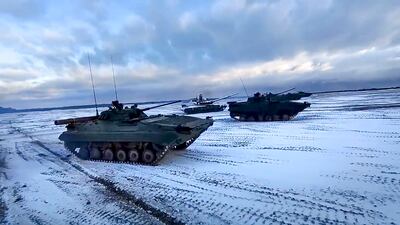
Russian and Belarus troops held joint combat training at firing ranges in Belarus as tensions remain high under the looming threat of war with Ukraine. AP Photo -
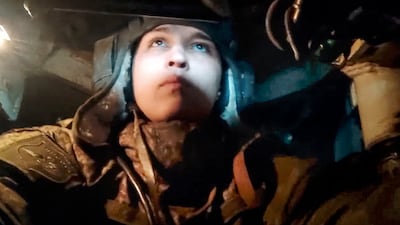
A soldier drives an armoured vehicle at Brestsky firing range, Belarus. AP Photo -
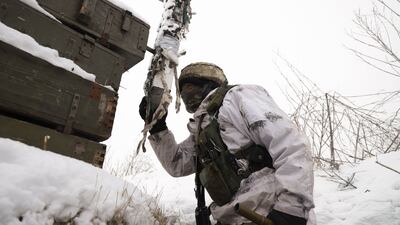
A Ukrainian serviceman carries out checks not far from the pro-Russian militant-controlled city of Donetsk, Ukraine. EPA -
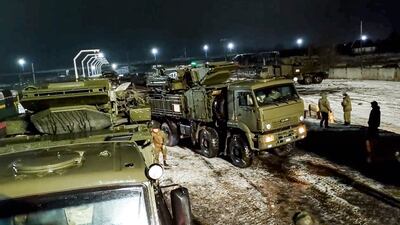
A Russian military vehicle drives off a railway platform after arriving in Belarus. AP Photo -
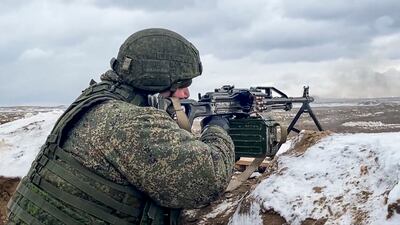
A soldier takes aim during a Russian and Belarusian military drill at Brestsky firing range. AP Photo -

A Ukrainian serviceman repairs a shelter near Donetsk, Ukraine. EPA -
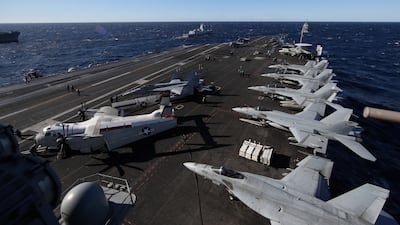
Aircraft are lined up on 'USS Harry S Truman' in the Adriatic Sea. The Truman strike group is operating under Nato command and control along with several other Nato allies for co-ordinated maritime manoeuvres, anti-submarine warfare training and long-range training. Reuters -
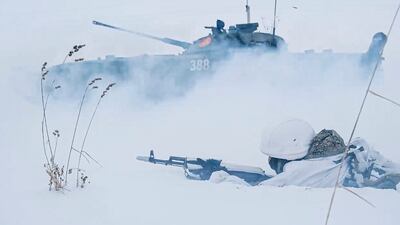
Russian soldiers attend the Yurginsky training ground in the Kemerovo region, Russia. AP Photo -
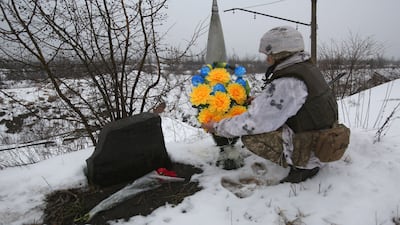
A Ukrainian serviceman lays flowers where one of his friends was killed in 2017 near Avdiivka. Anatolii Stepanov / AFP -

A Ukrainian serviceman stands guard in a dugout on the frontline with the Russia-backed separatists near Avdiivka. AFP -
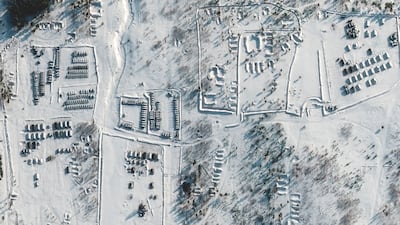
This satellite image shows troops gathered at a training ground in Pogonovo, Russia. AP Photo
In Warsaw, Polish Defence Minister Mariusz Blaszczak hailed the arrival of the troops, saying that “deterrence and solidarity are the best response to Moscow’s aggressive policy, to the aggressive attempt at reconstructing the Russian empire”.
Russia has amassed about 100,000 troops on the borders of Ukraine, some for joint military exercises in Belarus, but insists it has no intention of invading Ukraine.
A collective response by Nato members is “the best response to a threat, the only method of assuring security to Poland and to other Nato countries on the alliance’s eastern flank,” Mr Blaszczak said.
He emphasised that he held a number of talks on the subject with US Secretary of Defence Lloyd Austin.
Mr Biden ordered additional US troops to Poland, Romania and Germany to demonstrate to both allies and foes America’s commitment to Nato’s eastern flank amid rising tensions between Russia and Ukraine, his office said.
Nato’s eastern member Poland and Romania both border Ukraine.
The US division can be rapidly deployed within 18 hours and carry out parachute assaults to secure key objectives. Based in Fort Bragg, North Carolina, the division’s history goes back to 1917.
Earlier in the week, US planes brought equipment and logistics troops in preparation for the arrival of part of the division at the airport.
Polish soldiers have previously worked with the US division on missions in Iraq and Afghanistan and they have trained together, said Maj Przemyslaw Lipczynski, a spokesman for the Polish Army’s 18th Mechanised Division.
About 4,000 US troops have been stationed in Poland since 2017 on a rotating basis, to boost security in the face of Russia’s increased military activity.
European officials fear that the continent’s energy supplies are vulnerable in the case of hostilities over Ukraine.

