


Six giraffes lie dead in a circle, their ragged bodies almost intertwined near the spot where they met a grim end, killed by drought.
The scene was pictured at the Sabuli Wildlife Conservancy in Wajir, Kenya, where the majestic animals had gathered by a lake to drink.
But the water levels were so low, the giraffes apparently became stuck in the mud and died of dehydration.
The image shocked the world and drew attention to Kenya’s climate crisis, where in recent years average rainfall is only half that of pre-drought levels, according to the UN’s Office for the Co-ordination of Humanitarian Affairs.
-

The carcass of a donkey who died, thirsty and hungry, near the town of Kargi, Marsabit county, Kenya. Drought has descended yet again in the north of the country, the latest in a series of climate shocks rippling through the Horn of Africa. Reuters -
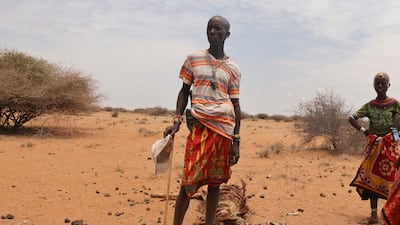
Bargeri, a herdsman from the Rendille ethnic group, surveys the carcass of his donkey. Some desperate people have resorted to slaughtering and drying the meat from their animals that die from hunger as a way of preserving some food for later use. Reuters -

A herdsman from the Rendille ethnic group, walks his camel to drink at a waterhole. Reuters -

Herder Yusuf Abdullahi is aghast at the sight of the carcasses of his 40 goats who died in Dertu, Wajir County. AP Photo -

An emaciated cow tries to feed on a tree branch with dry leaves in one of the villages that has lost most of its livestock due to famine caused by the continuing. An estimated two million Kenyans face starvation and President Uhuru Kenyatta declared the drought a 'national disaster' and ordered the immediate release of emergency relief food for the victims. EPA -
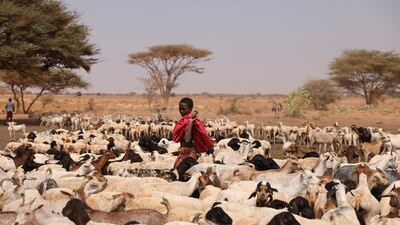
Herding goats across the parched landscape.towards some much-needed water. Reuters -

Herder children who look after their family's camels cool off and fill plastic containers at a water point in the desert near Dertu. AP Photo


In September, the OHCA laid bare the risk to human beings and livestock as drought persists in many areas of the country, also shedding light on the fate of animals searching for water in drying lakes.
“Many open water sources – including rivers, water pans and dams – have dried up across pastoral and marginal agricultural livelihood zones, and other open water sources at 20 [per cent] to 40 per cent of capacity,” the report said, while warning that the number of people facing hunger in the country could rise to 2.4 million this year.
Some herders in drought-affected counties in Kenya have reported herd losses of up to 70 per cent, and the government has declared a national disaster in 10 of its 47 counties.
Wildlife has begun to die, too, the chair of the Subuli Wildlife Conservancy, Mohamed Sharmarke, told Associated Press last month.
“The heat on the ground tells you the sign of starvation we’re facing,” he said.

