

When Mohammed Atta and Abdul Aziz Al Omari strolled on to a flight from Portland, Maine, to Boston the morning of September 11, 2001, the security checks were, by today’s standards, perfunctory.
The airport “was a sleepy little place, it was early in the morning and nobody had had their Dunkin Donuts coffee yet,” said Bob Mann, a New York-based aviation consultant.
The two men had booked first-class tickets, connecting in Boston, to Los Angeles — a destination they would never reach.
Within hours, Atta, a trained pilot, Al Omari and 17 accomplices had wreaked devastation on the US eastern seaboard, crashing two planes into the World Trade Centre in New York, a third into the Pentagon and a fourth into a field in Shanksville, Pennsylvania.
Somehow, the 19 hijackers had cleared security — despite carrying knives and other weapons including mace and pepper spray.
Investigators believe Atta and Al Omari chose Portland to sidestep what they thought would have been tighter security in Boston.
“9/11 was both a reminder of how lax airline security had become since Lockerbie in 1985,” Mr Mann said, referring to the downing of Pan Am Flight 103 over Scotland that year, “and the most complex scheme yet to politicise aviation … and weaponise it against a national economy.”
Eight of the hijackers were randomly tagged for additional screening and two were regarded as suspicious by gate agents, but all boarded their flights nonetheless.
-
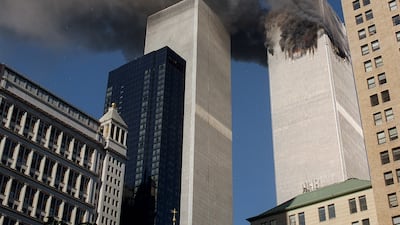
Smoke billows from the North Tower of the World Trade Centre in New York City after terrorists crashed a plane into the building on September 11, 2001. AP Photo -

The plane was thought to have hit the North Tower between floors 93 and 99 sparking a fierce fire on those storeys from which people desperately tried to escape. Reuters -
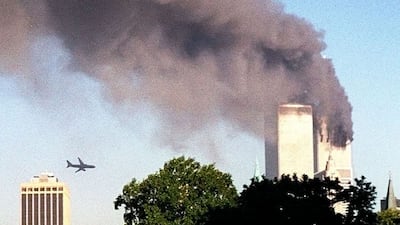
American Airlines flight 175 closes in on the south face of the South Tower of the World Trade Centre as the North Tower burns. Shutterstock -
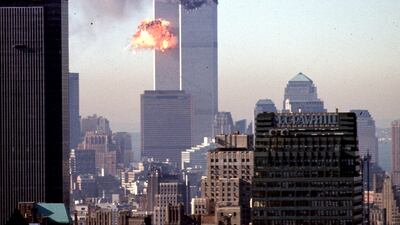
The moment of impact. AFP -
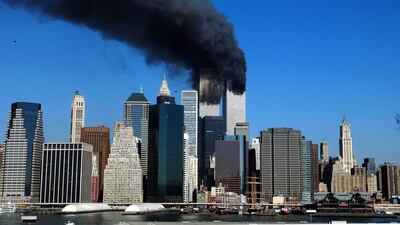
With both towers ablaze, pandemonium ensues in Manhattan in the building and on the ground. AFP -
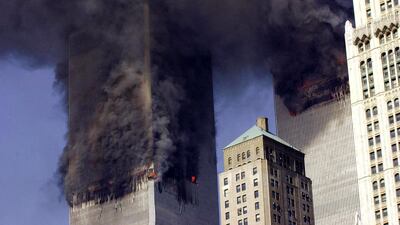
The cloudless, blue sky gave little portent of the dark, history-changing day that was to come but would remain etched on the memory of those involved and beyond. AFP -
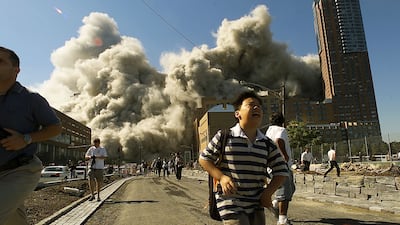
People run for their lives as the North Tower of World Trade Centre collapses. The South Tower had come down 29 minutes earlier. Getty Images -

Emergency personnel tend to injured people in Liberty Park, New Jersey, as the enormity of the day's events slowly begin to hit home. Reuters -
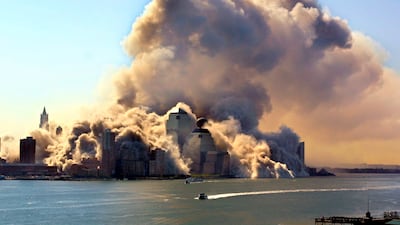
The World Trade Centre disappears in a thick cloud of smoke as the second tower implodes. AP Photo -
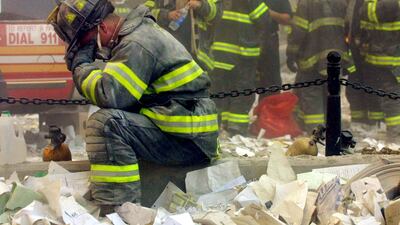
Firefighter Gerard McGibbon, of Engine 283 in Brownsville, Brooklyn, prays after the buildings collapse. Getty Images -

Smoke pours from the site and drifts across the New York sky. Reuters


The attacks claimed 2,996 lives, with 2,763 perishing in New York’s Twin Towers.
David Learmount, consulting editor at the FlightGlobal news site, recalled the very different security landscape in 2001.
“Until 9/11, suicide hijackers had not been invented. If the threat from on-board hijackers was credible, pilots were told to follow their instructions and the issue would be dealt with by security forces on the ground,” Mr Learmount said.
Security protocols at the time focused on “baggage reconciliation”, in which every bag loaded on a plane had to be linked to a passenger on board, otherwise it would be removed.
“After 9/11, that changed completely. Now we knew there were people willing to use a plane as a guided missile, so there was no point in giving in to a hijacker,” Mr Learmount told The National.
A radical redesign of commercial aircraft and in-flight security measures followed, with cockpit doors and bulkheads kept locked and made bulletproof.
“Even cabin crew were not allowed in, except by the pilots,” Mr Learmount said.
“Suddenly, nobody, including boys and girls who wanted to be pilots when they grew up, could visit the flight deck … If the cabin crew were made hostages at the back, the pilot’s only task was to get the plane safely on the ground.”
In the US, the government responded to 9/11 by creating the Transportation Security Administration (TSA), which became responsible for screening passengers instead of the airlines.

Distinguishable by their royal blue shirts and black trousers, TSA staff run airport security checkpoints.
Gone were the days of bringing scissors and penknives on the plane.
Things became even more restrictive a few months after 9/11 after the so-called Shoe Bomber, Richard Reid, tried to blow up a flight from Paris to Miami by packing explosives in his trainers.
As a result, passengers in the US and many other countries often must remove their shoes for inspection while passing through security.
Additionally, belts, which normally contain a metal buckle, have to be removed. In 2003, passengers were limited to one carry-on bag.
In 2006, US authorities introduced a ban on bringing liquids on to planes after the thwarting of a terrorist plot that involved mixing the liquid components of a bomb on board.
The restrictions caused considerable headaches for flyers, with TSA agents snatching everything from baby milk, medicines and Marmite jars before rules were eventually tweaked to allow liquids in containers measuring up to 100 millilitres.
All of these annoyances and the extra time it took to clear security made flying less attractive for some.
“It eliminated aviation’s speed advantage on short trips — less than 200 miles — causing many high-value individuals to shun commercial aviation altogether for private jets,” Mr Mann said.

He argued that the changes made passengers at airports more vulnerable.
“Security-process queues have created alternate opportunities for terrorists. Some would say, ‘Screw the plane, I will take out the airport’,” he said.
Attacks at several airports including Brussels and Istanbul indicate his fears are not misplaced.
In the US, security procedures have adapted, with government and private programmes created to pre-screen frequent flyers and allow them to avoid some security hassles such as taking off shoes and removing laptops from bags.
TSA’s Pre-Check service, costing $85 for five years, is open to US citizens and green card holders, with 22 million travellers signing up so far.
Overall, 9/11 had a devastating impact on the airline industry, said Paul Moore, who was Virgin Atlantic’s spokesman at the time.
“London to New York was the biggest transatlantic route. Flights stopped for a few days and then there was a 20 per cent reduction in demand,” he told The National.
“It took two to three years to recover. Airlines’ bottom lines were hit and they had to cut their cloth accordingly.”
The industry has changed irrevocably, said James Healy-Pratt, a leading aviation lawyer.
“The 9/11 terrorist attacks were a seismic shock. Airliners had not been weaponised as operational flying bombs before.
“Passenger confidence dropped through the floor, airlines haemorrhaged cash, their survival was threatened, government bailouts refloated them, airport security changed and passenger confidence returned within 18 months.
“Plastic cutlery, tiresome security queues and the TSA became commonplace, flight deck visits and flying the friendly skies became a fond memory.”


