Turkish President Recep Tayyip Erdogan. AP

Erdogan's outreach to Taliban risks political backlash in Turkey


Andrew Wilks
  • English
  • Arabic

As the last US flight left Kabul’s airport on Monday evening, the question of what Afghanistan’s future relations with the international community will look like remained largely unanswered.

But it is a question that diplomats and politicians around the world are rushing to resolve – none more so than those in Turkish President Recep Tayyip Erdogan’s Ankara palace.

Even before the Taliban took Kabul more than two weeks ago, Mr Erdogan had moved to place Turkey at the fore of prospective ties with the militant group.

“The Erdogan government hopes that its attempts to build a relationship with the Taliban will provide Turkey with additional leverage in its relations with the United States, the European Union and Nato,” said Aykan Erdemir, senior director of the Turkey programme at the Washington-based Foundation for the Defence of Democracies.

“Moreover, Ankara sees the developments in Afghanistan as an opportunity to secure economic opportunities in the war-torn country while also enhancing Turkey’s power projection globally.”

Much of the discussion about Turkey’s role in Afghanistan has focused on Kabul’s Hamid Karzai International Airport, a crucial lifeline for a country reeling from more than four decades of war.

Mr Erdogan first suggested a Turkish role in operating and guarding the airport in a June meeting with US President Joe Biden. But the Taliban’s rapid takeover left the plan unworkable when the militants insisted on all Turkish forces withdrawing, something completed at the weekend.

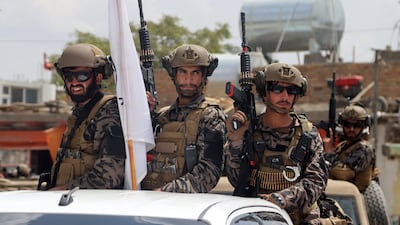
  • In recent days, the Taliban's Badri special forces unit has been in charge of security outside Kabul international airport. AFP
    In recent days, the Taliban's Badri special forces unit has been in charge of security outside Kabul international airport. AFP
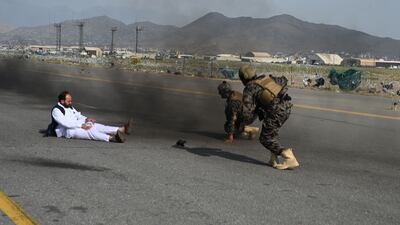
  • Taliban special force fighters and a journalist get up after they fell down from a vehicle at the airport in Kabul. AFP
    Taliban special force fighters and a journalist get up after they fell down from a vehicle at the airport in Kabul. AFP
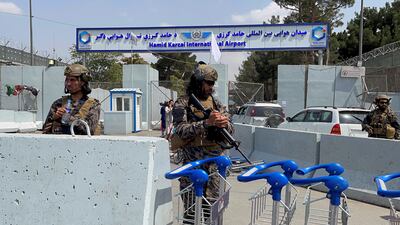
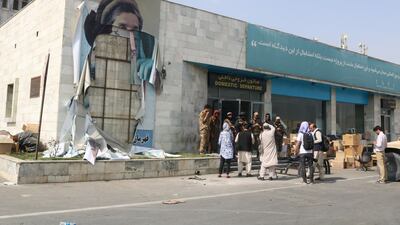
  • Taliban forces stand guard at the entrance gate of the airport a day after the withdrawal of US troops from Kabul. Reuters
    Taliban forces stand guard at the entrance gate of the airport a day after the withdrawal of US troops from Kabul. Reuters
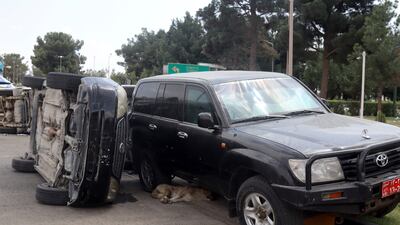
  • Vehicles are toppled inside the Hamid Karzai International Airport. AP
    Vehicles are toppled inside the Hamid Karzai International Airport. AP
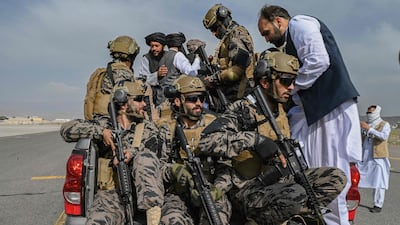
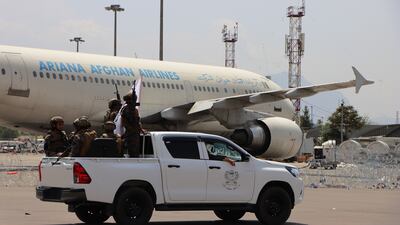
  • Taliban special force fighters arrive inside the Hamid Karzai International Airport. AP
    Taliban special force fighters arrive inside the Hamid Karzai International Airport. AP
  • A commercial aircraft at the airport. Reuters
    A commercial aircraft at the airport. Reuters
  • Journalists film a group of Taliban fighters a day after the US troop withdrawal. Reuters
    Journalists film a group of Taliban fighters a day after the US troop withdrawal. Reuters
  • Taliban forces patrol the airport grounds. EPA
    Taliban forces patrol the airport grounds. EPA
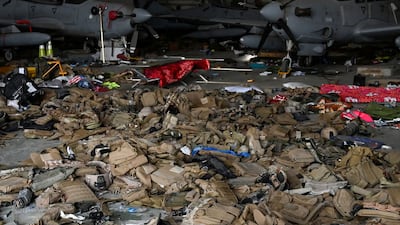
  • Afghan Air Force A-29 attack aircraft parked inside a hangar at the airport in Kabul, with armoured vests lying strewn on the ground. AFP
    Afghan Air Force A-29 attack aircraft parked inside a hangar at the airport in Kabul, with armoured vests lying strewn on the ground. AFP
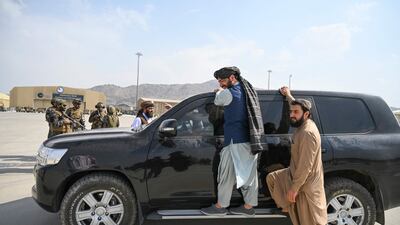
  • Taliban fighters stand on the footrest of an armoured vehicle. AFP
    Taliban fighters stand on the footrest of an armoured vehicle. AFP
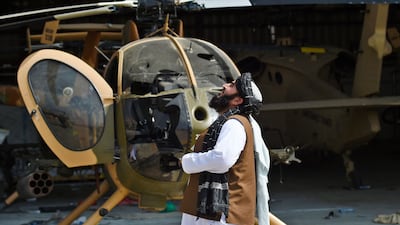
  • A Taliban member stands next to a damaged helicopter. AFP
    A Taliban member stands next to a damaged helicopter. AFP
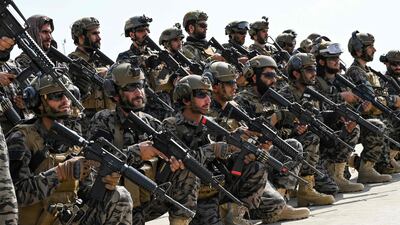
  • Taliban Badri special force fighters dressed in uniforms, boots, balaclavas and body armour similar to those worn by special forces around the world. AFP
    Taliban Badri special force fighters dressed in uniforms, boots, balaclavas and body armour similar to those worn by special forces around the world. AFP
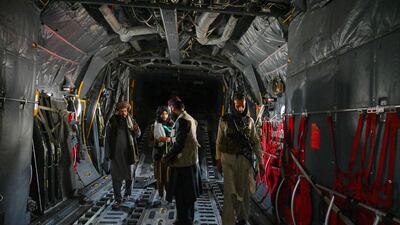
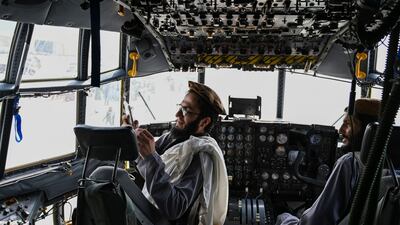
  • Taliban fighters inside an Afghan Air Force aircraft. AFP
    Taliban fighters inside an Afghan Air Force aircraft. AFP
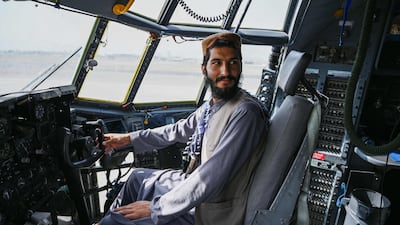
  • A Taliban fighter sits inside the cockpit of an Afghan Air Force aircraft. AFP
    A Taliban fighter sits inside the cockpit of an Afghan Air Force aircraft. AFP
  • The US Department of Defence has confirmed the Taliban are in possession of dozens of US-supplied and other aircraft. AFP
    The US Department of Defence has confirmed the Taliban are in possession of dozens of US-supplied and other aircraft. AFP
  • A member of the Taliban walks out of an Afghan Air Force aircraft. AFP
    A member of the Taliban walks out of an Afghan Air Force aircraft. AFP

Turkey is now in talks with its ally Qatar, which has strong ties to the Taliban leadership, over running the airport together. Turkey’s defence and foreign ministers spoke with their Qatari counterparts at the weekend.

On a wider front, Mr Erdogan hopes to develop close ties with the Taliban and has spoken in conciliatory tones about the group in recent weeks.

On a return flight from Montenegro on Sunday, he told journalists that Turkey would retain its diplomatic presence.

“Afghanistan must recover quickly. The Afghan people cannot bear such a burden,” he said.

Mr Erdogan also offered Turkish construction and infrastructure know-how while holding out the prospect of a “Libya-like” deal with the Taliban.

Turkey signed a security and military co-operation deal with Libya’s UN-recognised government in late 2019.

Despite its insistence on the removal of Turkish troops, the Taliban have also been making overtures to Ankara.

“The Turkish people and state are our friends. We have many reasons to continue this friendship,” Taliban spokesman Zabihullah Mujahid told Turkey’s state-run news agency on Sunday.

Any arrangement will be bound to result in Ankara recognising the Taliban as Afghanistan’s legitimate government.

However, potential Turkish involvement in the early stages of the post-US period has led to concern about policy direction.

“Currently, even the Taliban describe themselves as an interim administration; there’s no government. The phrase ‘Libya-like deal’ is a hasty statement,” said retired Brig Gen Ali Er.

Turkey seems to be pursuing a role in Afghanistan “no matter what happens,” he said. “I can explain the intent as strengthening Turkey as the go-between with the US and the EU, as well as China and Russia.”

Onur Oymen, a former Turkish diplomat and MP, also raised concerns about the current uncertainty in Afghanistan.

“It is unclear how much support the Taliban’s government will receive from around the world,” he said. “It is unclear where Afghanistan will go yet; there is no government. It is unclear what kind of governance will be formed ... It is incomprehensible to rush into the middle of all this uncertainty to say ‘We can make a deal'.”

Others suggested that Mr Erdogan’s eagerness to embrace the Taliban echoed his previous foreign ventures.

Gonul Tol, director of the Middle East Institute’s Centre for Turkish Studies, said Mr Erdogan “sees opportunity where others see trouble,” citing Turkey’s hosting of 3.7 million Syrian refugees that he has used as a “trump card” in relations with Europe.

“From Syria and Libya to the eastern Mediterranean, Turkey has been engaged in a high-stakes gambit in search of much-needed leverage,” she said. “Afghanistan is next in line.”

Dr Erdemir, meanwhile, said Mr Erdogan was banking on his close ties to Pakistan and Qatar to reach deals with the Taliban.

There has been a recent sharp rise in anti-migrant feelings – Turkey is home to an estimated 300,000 Afghans – and Karol Wasilewski, head of the Middle East and Africa programme at the Polish Institute of International Affairs, said this could create “bigger complications” for Mr Erdogan.

“Since Turkey’s presence in Afghanistan does not seem to be popular among the electorate, there may be additional pressure on the decision makers to withdraw from any deals with the Taliban,” he said.

But Dr Erdemir issued a warning that, in addition to security risks for Turkish contractors in Afghanistan, “such a close working relationship with the Taliban government could also further tarnish the Erdogan government’s image”.

Any deal between Ankara and the Taliban is “fraught with risks and it is unclear whether it will deliver the intended results, but Erdogan is determined to try”, Dr Tol said.


Mercer, the investment consulting arm of US services company Marsh & McLennan, expects its wealth division to at least double its assets under management (AUM) in the Middle East as wealth in the region continues to grow despite economic headwinds, a company official said.

Mercer Wealth, which globally has $160 billion in AUM, plans to boost its AUM in the region to $2-$3bn in the next 2-3 years from the present $1bn, said Yasir AbuShaban, a Dubai-based principal with Mercer Wealth.

Within the next two to three years, we are looking at reaching $2 to $3 billion as a conservative estimate and we do see an opportunity to do so,” said Mr AbuShaban.

Mercer does not directly make investments, but allocates clients’ money they have discretion to, to professional asset managers. They also provide advice to clients.

“We have buying power. We can negotiate on their (client’s) behalf with asset managers to provide them lower fees than they otherwise would have to get on their own,” he added.

Mercer Wealth’s clients include sovereign wealth funds, family offices, and insurance companies among others.

From its office in Dubai, Mercer also looks after Africa, India and Turkey, where they also see opportunity for growth.

Wealth creation in Middle East and Africa (MEA) grew 8.5 per cent to $8.1 trillion last year from $7.5tn in 2015, higher than last year’s global average of 6 per cent and the second-highest growth in a region after Asia-Pacific which grew 9.9 per cent, according to consultancy Boston Consulting Group (BCG). In the region, where wealth grew just 1.9 per cent in 2015 compared with 2014, a pickup in oil prices has helped in wealth generation.

BCG is forecasting MEA wealth will rise to $12tn by 2021, growing at an annual average of 8 per cent.

Drivers of wealth generation in the region will be split evenly between new wealth creation and growth of performance of existing assets, according to BCG.

Another general trend in the region is clients’ looking for a comprehensive approach to investing, according to Mr AbuShaban.

“Institutional investors or some of the families are seeing a slowdown in the available capital they have to invest and in that sense they are looking at optimizing the way they manage their portfolios and making sure they are not investing haphazardly and different parts of their investment are working together,” said Mr AbuShaban.

Some clients also have a higher appetite for risk, given the low interest-rate environment that does not provide enough yield for some institutional investors. These clients are keen to invest in illiquid assets, such as private equity and infrastructure.

“What we have seen is a desire for higher returns in what has been a low-return environment specifically in various fixed income or bonds,” he said.

“In this environment, we have seen a de facto increase in the risk that clients are taking in things like illiquid investments, private equity investments, infrastructure and private debt, those kind of investments were higher illiquidity results in incrementally higher returns.”

The Abu Dhabi Investment Authority, one of the largest sovereign wealth funds, said in its 2016 report that has gradually increased its exposure in direct private equity and private credit transactions, mainly in Asian markets and especially in China and India. The authority’s private equity department focused on structured equities owing to “their defensive characteristics.”

The specs
  • Engine: 3.9-litre twin-turbo V8
  • Power: 640hp
  • Torque: 760nm
  • On sale: 2026
  • Price: Not announced yet
The specs

Engine: 2.0-litre 4cyl turbo

Power: 261hp at 5,500rpm

Torque: 405Nm at 1,750-3,500rpm

Transmission: 9-speed auto

Fuel consumption: 6.9L/100km

On sale: Now

Price: From Dh117,059

Infiniti QX80 specs

Engine: twin-turbocharged 3.5-liter V6

Power: 450hp

Torque: 700Nm

Price: From Dh450,000, Autograph model from Dh510,000

Available: Now

Company%20Profile
%3Cp%3E%3Cstrong%3EName%3A%3C%2Fstrong%3E%20Neo%20Mobility%3Cbr%3E%3Cstrong%3EStarted%3A%3C%2Fstrong%3E%20February%202023%3Cbr%3E%3Cstrong%3ECo-founders%3A%3C%2Fstrong%3E%20Abhishek%20Shah%20and%20Anish%20Garg%3Cbr%3E%3Cstrong%3EBased%3A%3C%2Fstrong%3E%20Dubai%3Cbr%3E%3Cstrong%3EIndustry%3A%3C%2Fstrong%3E%20Logistics%3Cbr%3E%3Cstrong%3EFunding%3A%3C%2Fstrong%3E%20%2410%20million%3Cbr%3E%3Cstrong%3EInvestors%3A%3C%2Fstrong%3E%20Delta%20Corp%2C%20Pyse%20Sustainability%20Fund%2C%20angel%20investors%3C%2Fp%3E%0A
UAE currency: the story behind the money in your pockets
It Was Just an Accident

Director: Jafar Panahi

Stars: Vahid Mobasseri, Mariam Afshari, Ebrahim Azizi, Hadis Pakbaten, Majid Panahi, Mohamad Ali Elyasmehr

Rating: 4/5

The Library: A Catalogue of Wonders
Stuart Kells, Counterpoint Press

Other IPL batting records

Most sixes: 292 – Chris Gayle

Most fours: 491 – Gautam Gambhir

Highest individual score: 175 not out – Chris Gayle (for Royal Challengers Bangalore against Pune Warriors in 2013)

Highest strike-rate: 177.29 – Andre Russell

Highest strike-rate in an innings: 422.22 – Chris Morris (for Delhi Daredevils against Rising Pune Supergiant in 2017)

Highest average: 52.16 – Vijay Shankar

Most centuries: 6 – Chris Gayle

Most fifties: 36 – Gautam Gambhir

Fastest hundred (balls faced): 30 – Chris Gayle (for Royal Challengers Bangalore against Pune Warriors in 2013)

Fastest fifty (balls faced): 14 – Lokesh Rahul (for Kings XI Punjab against Delhi Daredevils in 2018)


The Sand Castle

Director: Matty Brown

Stars: Nadine Labaki, Ziad Bakri, Zain Al Rafeea, Riman Al Rafeea

Rating: 2.5/5

Sole survivors
  • Cecelia Crocker was on board Northwest Airlines Flight 255 in 1987 when it crashed in Detroit, killing 154 people, including her parents and brother. The plane had hit a light pole on take off
  • George Lamson Jr, from Minnesota, was on a Galaxy Airlines flight that crashed in Reno in 1985, killing 68 people. His entire seat was launched out of the plane
  • Bahia Bakari, then 12, survived when a Yemenia Airways flight crashed near the Comoros in 2009, killing 152. She was found clinging to wreckage after floating in the ocean for 13 hours.
  • Jim Polehinke was the co-pilot and sole survivor of a 2006 Comair flight that crashed in Lexington, Kentucky, killing 49.
The specs: 2018 Nissan 370Z Nismo

The specs: 2018 Nissan 370Z Nismo
Price, base / as tested: Dh182,178
Engine: 3.7-litre V6
Power: 350hp @ 7,400rpm
Torque: 374Nm @ 5,200rpm
Transmission: Seven-speed automatic
​​​​​​​Fuel consumption, combined: 10.5L / 100km

Updated: November 01, 2021, 12:48 PM