



Follow the latest updates on Afghanistan here
Sirajuddin Haqqani, the head of the deadly Haqqani network and a high ranking member of the FBI's most-wanted list, is now Afghanistan's interim interior minister. His group reportedly controls security in Kabul, as well as along the Afghanistan-Pakistan border.
What are the Haqqani Network?
So who are the Haqqani network now in a prime position in Afghanistan?
The Haqqanis have been blamed for some of the deadliest attacks in recent years, which have claimed the lives of civilians, government officials and foreign forces.
The shadowy group was formed by Jalaluddin Haqqani, who gained prominence in the 1980s as a hero of the anti-Soviet resistance. At the time, he was a valuable CIA asset as the US and its allies, such as Pakistan, funnelled arms and money to the mujahideen.
During that conflict and following the Soviet withdrawal, Jalaluddin Haqqani fostered close ties with foreign fighters, including Osama bin Laden.
He later allied with the Taliban who took over Afghanistan in 1996, serving as the regime's minister until it was toppled by US-led forces in 2001.

Jalaluddin Haqqani's death after a long illness was announced by the Taliban in 2018, and his son Sirajuddin formally became the network's chief.
Thanks to their financial and military strength, a reputation for ruthlessness, the Haqqani network is considered semi-autonomous, while remaining within the Taliban fold.
Where is the Haqqani Network based?
Mainly based in eastern Afghanistan, with alleged bases across the border in Pakistan's north-west, the group became more visible in the Taliban leadership in recent years, and Sirajuddin Haqqani was appointed deputy leader in 2015.
His younger brother Anas, once jailed and sentenced to death by the previous Afghan government, has held talks with former president Hamid Karzai and former chief executive Abdullah Abdullah since the fall of Kabul.
-
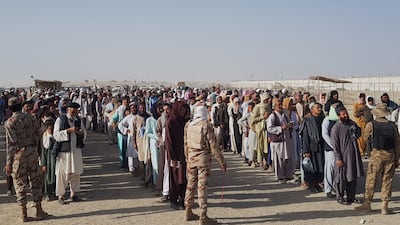
Pakistani soldiers stand guard as Afghan and Pakistani citizens queue to cross into Afghanistan at the border in Chaman, Pakistan. AFP -

Indonesians repatriated from Kabul, Afghanistan, arrive in Jakarta. Reuters -

Taliban fighters patrol Kabul. AP -

A Taliban fighter patrols the Wazir Akbar Khan district of Kabul. AP -
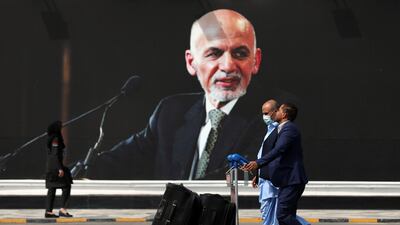
Passengers at the departure terminal of Hamid Karzai International Airport in Kabul. AP -

A US Air Force officer assists people aboard a C-17 Globemaster III plane at Hamid Karzai International Airport in Kabul. AFP -

A US Marine waits with a child at the airport in Kabul. AFP -
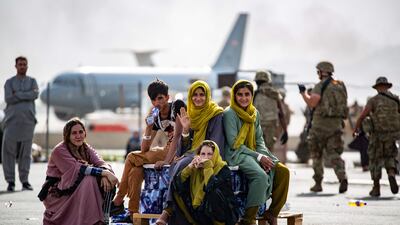
Children wait for the next flight at Hamid Karzai International Airport. AFP -
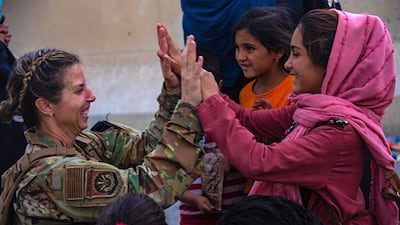
A US soldier with a reunited family at the airport in Kabul. AFP -

US troops provide assistance at Hamid Karzai International Airport. AFP -

A US C-17 aircraft transports US Marines to Afghanistan from an air base in Kuwait. Reuters -

US soldiers help a woman over a wall as crowds gather at Kabul airport. Reuters -
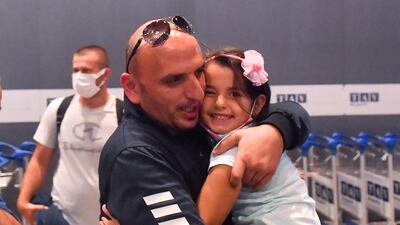
A daughter hugs her father at Skopje International Airport in North Macedonia, after he was repatriated from Afghanistan. EPA -

A man from Afghanistan with his son at an undisclosed location in the Middle East after being flown out of Kabul. AP


The Haqqani network is blamed for some of the deadliest and most shocking attacks in Afghanistan during the past two decades.
They have been designated as a foreign terrorist group by the US, and are also under UN sanctions.
The Haqqanis have a reputation for frequently using suicide bombers – including drivers in cars and lorries packed with huge amounts of explosives – and have demonstrated the ability to carry out complex, high-casualty assaults on major targets, including military installations and embassies.
In October 2013, Afghan forces intercepted a Haqqani lorry in eastern Afghanistan that contained about 28 tonnes of explosives, according to the US National Counterterrorism Centre.
The Haqqanis have been accused of assassinations, including an attempt against Mr Karzai when he was president in 2008, as well as kidnapping officials and western citizens for ransom and forcing prisoner exchanges.
They have also long been suspected of links with the Pakistani military establishment. US Admiral Mike Mullen described them as a "veritable arm" of Islamabad's intelligence in 2011.
Pakistan denies the allegation.
What is their connection to the Taliban and Al Qaeda?
The Haqqanis have also hugely contributed to the Taliban's fighting ranks, and are the group's "most combat-ready forces", UN monitors said in a June report.
The monitors also described the network as the "primary liaison" between the Taliban and Al Qaeda.
The Haqqanis have emerged as serious players in the Taliban's political project, with at least two of their leaders in Kabul as talks begin on the formation of the next government.
Sirajuddin Haqqani's formal elevation to the deputy leader position six years ago cemented that role, analysts said.
The release of his brother Anas from Afghan custody in 2019 was viewed as a move to help to initiate the direct US-Taliban talks that eventually led to the troop withdrawal.
Sirajuddin Haqqani even wrote an op-ed in The New York Times last year, outlining the Taliban's position on the US talks and the conflict in Afghanistan, although in diplomatic tones that belied the network's violent reputation.
While Anas Haqqani has held talks with Mr Karzai, his uncle Khalil Haqqani was seen leading prayers in Kabul on Friday.
Sirajuddin and Khalil are both still listed as wanted by the US, with millions of dollars in bounties on offer.

