


The statistics have been saying the same thing for some years now – demand for electric cars is on the increase, and likely to accelerate in the next decade.
However, there is rather less information available about the future of hybrid cars, that midpoint between full-on petrol and diesel and their more sustainably-powered counterparts.
There is little doubt that demand for hybrid vehicles is also rising, but if you drill down into what is actually happening, the march towards an electric future might be a little farther off than the figures suggest.
Just last week, Toyota’s most senior research scientist issued a warning that an overly rapid transition to electric vehicles, or EVs, could result in drivers holding on to their petrol cars longer than they would have otherwise.
chief scientist, Toyota Motor Corporation
Ahead of a G7 leaders summit in Japan, Gill Pratt, the head of the manufacturer’s research institute, said in Hiroshima that subsidies and restrictions targeting combustion cars will make EVs attractive for customers who can afford them, but hybrids will remain a better fit for most consumers for some years to come.
“Battery materials and renewable charging infrastructure will eventually be plentiful,” he said. “But it will take decades for battery material mines, renewable-power generation facilities, transmission lines and seasonal energy-storage facilities to scale up.
“Eventually, resource limitations will end, but for many years we will not have enough battery material and renewable recharging resources for a battery-electric-vehicle-only solution.”
As a manufacturer, Toyota is a pioneer in the hybrid vehicle market.
The Prius might well be the most famous of its type in automotive history, and it made its name by being the vehicle Hollywood A-listers had to be seen in, despite the fact they invariably had a few more grunty, petrol-powered options in their garages.
______________________________
Top selling hybrid cars in UAE - in pictures
-
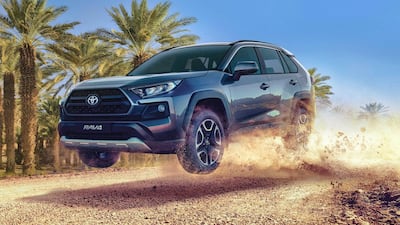
Toyota RAV4 Hybrid, which starts at Dh139,900, was the manufacturer's first hybrid SUV to go on sale in the Emirates. Photo: Toyota -
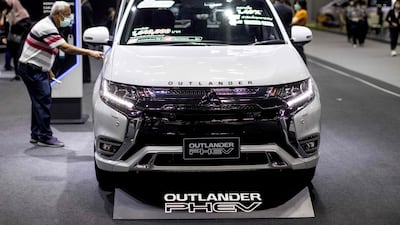
The Mitsubishi Outlander PHEV plug-in hybrid SUV has capacity to pack in 43 litres of fuel, with economy of 50km per litre. The PHEV version starts from Dh140,000, while its petrol equivalent sells for Dh79,500. AFP -
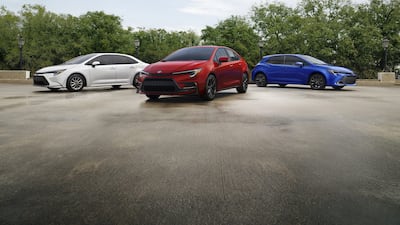
One of the most popular hybrid vehicles is the Toyota Corolla Sedan Hybrid, which starts at Dh83,900. The new models come upgraded with a re-engineered drive motor and battery, and customers can now opt for an all-wheel drive version. Photo: Toyota -
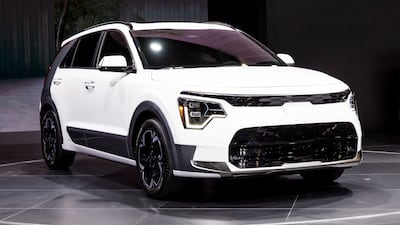
The Kia Niro comes with a lithium-ion polymer battery that works in tandem with a permanent magnet electric motor and a traditional 1.6L petrol engine. Prices start from Dh96,000. EPA -
With a new two-litre hybrid engine, the Toyota Corolla Cross brings a combination of power and low carbon dioxide emissions. When equipped with front-wheel-drive, the vehicle can do about 14km per litre on the road. Prices start from Dh110,000. Photo: Toyota -
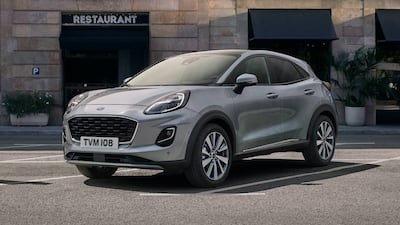
Ford Puma 1.0L EcoBoost features a one-litre EcoBoost engine that uses regenerative braking technology to recharge the battery, helping to increase the vehicle’s fuel economy. Prices start from Dh115,000. Photo: Ford -

The Toyota C-HR Hybrid comes with a 1.8L engine, giving you 24 kilometres per litre. Prices start from Dh87,000. Reuters -

Lexus's ES 300h, popular with Uber and Careem drivers due to its fuel efficiency and long range, starts at Dh215,000. Reuters -

Toyota Camry Hybrid, favoured by Dubai Taxis, starts from Dh135,000 and comes with a 2.5L engine. EPA -

The all-wheel drive Volvo Plug-In Hybrid (PHEV) XC90 T8 SUV has a 2.0-litre four-cylinder turbo and supercharged engine, which takes it from 0-100 in 5.8 seconds. -
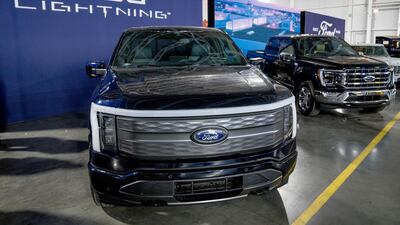
A Ford F-150 Lightning pickup at its launch at the Rouge Electric Vehicle Centre in Dearborn, Michigan. EPA -

The F150 Hybrid Platinum gives 1,000 kilometres of range from its combined 3.5-litre, twin-turbocharged V6 and 46bhp (35kW) electric motor. Prices start from Dh284,445. Photo: Ford


______________________________
This isn’t the first time Toyota has made the argument that a multifaceted approach including hybrids and other alternatives will reduce emissions faster, and the company is not alone in this belief.
Adam Withnall, chief executive of UAE car-buying comparison site Drive Ninja, is also convinced the way forward is electric, but sees hybrid options as being the best short-term solution.
On a practical level, he envisages the time when we see the number of electric cars on the road dwarfing petrol and diesel options as being some way off.
“Hybrid cars are a good stop gap,” he told The National.
“Electricity is the way to go, but the infrastructure is not there yet.”
When it comes to hybrids, there are several options available to customers looking to get a car that has a lower environmental impact than the traditional variety.
Mild hybrid vehicles contain a battery and an electric motor alongside a petrol or diesel engine, with the latter providing the primary means of propulsion.
Plug-in hybrids also have a petrol or diesel engine, but a more powerful battery allows them to travel a much greater distance on electric power alone.
Electric cars, meanwhile, rely solely on their battery pack, so there is no fossil-fuel back-up if you run out of power.
You also, of course, have vehicles that run on hydrogen, an option that seems to be gaining momentum in the public transport sector but which many see as a distinct competitor to all other sustainably powered vehicles.
Mr Withnall describes hybrids as being a “brilliant mix of both worlds”, but doesn’t see a time before the early 2030s when they will be overtaken by electric or possibly hydrogen vehicles.
It will be about a decade after that before fossil-fuel powered cars are all but a thing of the past, he said.
The future is likely to be combustion-free by then, but hybrids will be a crucial element on the path to that ultimate scenario.

