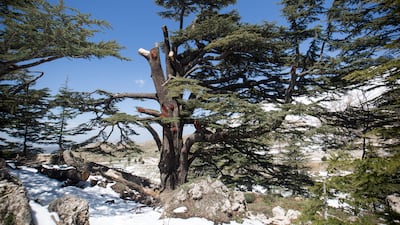
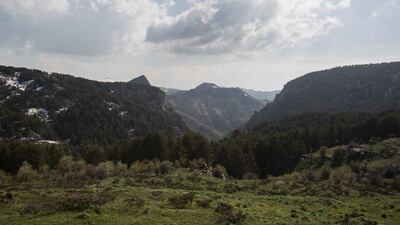
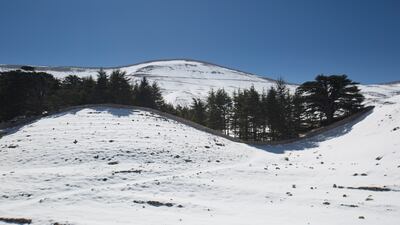
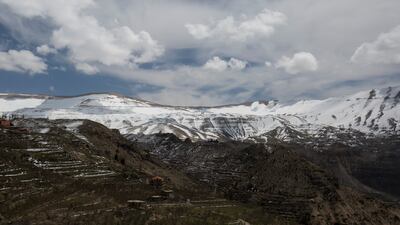
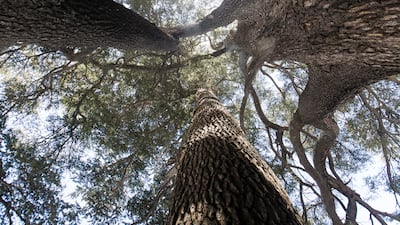
Draped with snow, the ancient cedars on the mountain slopes of northern Lebanon spread their evergreen branches like arms welcoming visitors. On Mount Makmel, the country’s oldest cedar grove towers over Wadi Qadisha, the “Holy Valley”, where monasteries carved into cliffs for centuries were a place of refuge and meditation.
Known locally as Arz al-Rab or “Cedars of God”, the forest has been under the protection of the Maronite Church, which built a small chapel in the centre of the grove, where a mass is celebrated each year to honour the trees. Some of the cedars there are more than 30 metres tall and 2,000 years old, their roots anchored deep in the rocky soil.
“The forest is considered a sacred place,” says Cherbel Tawk, a member of the nonprofit Friends of the Cedar Forest Committee. In 1998, the cedar grove was added to the list of Unesco World Heritage together with the Qadisha Valley.
“The cedars are mentioned in the bible at least 75 times for their majesty and beauty. It is said the temple of Solomon was built with cedar wood,” Tawk says. In the Old Testament, cedars are referred to as “the first of trees” and the “glory of Lebanon". In the 16th century, there were so many pilgrims visiting the Cedars of God that the Maronite Church issued an edict threatening to excommunicate visitors who damaged them.
For centuries, the ancient giants have been visited by travellers, pilgrims and poets. Inspired by the majestic trees, artists composed songs, paintings and poems. Some, like the English poet Lord Byron and the French politician and poet Alphonse de Lamartine, decided to leave their mark and carved their initials into the trunks.
"[Cedars] know the history of the Earth better than history itself,” wrote Lamartine, who described Lebanon’s ancient trees as “the most famous natural monument” in the world. The poet Gibran Kahlil Gibran, who was from nearby Bcharri, mentioned the trees in his poems and asked to be buried under a cedar.
Celebrated by religion, poetry and history, Lebanon’s cedar is a source of national pride. The tree is the centrepiece of the Lebanese flag, and is featured on the currency, the Lebanese airlines and the national anthem. It’s so cherished that some Lebanese even swear upon the cedars.
“The cedar became a unifying symbol for Lebanese all over the world,” Tawk says. According to him, the tree used as a model for the flag can still be visited in the Cedars of God. It has been damaged by a snowstorm and a lightning strike, but Tawk says his organisation is taking care of the elderly cedars. “Old trees need special care. We are treating their wounds and protecting them from storms,” he adds.
A history of deforestation
Accounts of the cedar go back to one of the first stories written, the Sumerian Epic of Gilgamesh, which dates back at least 4,000 years. In a quest for fame and glory, Gilgamesh travels to a forest that stretches for thousands of miles where “the cedars uplift their abundance” and sweet-smelling flowers grow under their branches. But instead of enjoying the beauty and the shade, Gilgamesh kills the guardian of the forest, cuts down the cedars and takes the wood to his city in ancient Mesopotamia.
For Faisal Abu-Izzeddin, a conservationist who wrote a book about cedars, the history of Lebanon’s most famous tree is one of environmental devastation. Over millennia, the forests that once blanketed Mount Lebanon were cut down by different civilisations.
Phoenicians used the wood to build their merchant ships. Ancient Egyptians used the resin in the mummification process. Greeks, Romans, Byzantines, crusaders and colonisers all exploited Lebanon’s cedars. Centuries of reckless deforestation have left only scattered remnants of what were once extensive forests.
“There is this idea that the cedar is going to bring us peace, glory and closer to gGod. And yet we cut it down,” Abu-Izzeddin says. “What is left is what couldn’t be cut, in the most remote places.”
The tree has been added to the International Union for Conservation of Nature's list of threatened species, and today only 17 square kilometres of cedars remain in Lebanon. Additional populations of Lebanese cedars can be found on rocky slopes in Turkey and Syria.
The urgency of protecting the surviving forests is felt across Lebanon. The Cedars of God have been fenced off since 1876, and in recent years volunteers have planted more than 100,000 seedlings around the forest.
The Shouf Biosphere Reserve, established in 1996, the country’s largest protected area, is home to a quarter of the remaining stands of cedar. “The cedar tree is part of our history, it’s an iconic tree,” says Nizar Hani, the reserve director. “We are looking at the cedar’s ecosystem as a unit, and trying to protect it by ensuring connectivity with the full participation of local communities,” he says.
While Hani says there is now more awareness about conservation and the cedar is protected by law, new threats have emerged in the past few decades.
“Last year the forest fires were very close to the cedar forest, it was the first time they reached such a high altitude,” Hani says. To grow, cedars need humidity and enough rain and snow, so the tree is particularly vulnerable to climate change.
Rising temperatures and worsening drought are driving wildfires and spawning infestations of sawflies, which can kill cedars. Conservationists are hoping that planting cedars with other species can make ecosystems more diverse and more resilient to the pressures of a warming and drying climate.
“The cedar cannot live alone, it needs other trees, plants, birds. It needs an ecosystem,” says Abu-Izzeddin, who was one of the founding members of the Shouf Reserve. “Without an ecosystem cedars cannot live. And without ecosystems we cannot live.”
A symbol of strength and endurance
The cedar’s ability to outlive empires and to survive under difficult conditions is precisely what makes it such a compelling symbol of Lebanon.
Growing on high and rocky mountains, cedars have endured harsh winters, strong winds and drought. Their roots can penetrate rock and find springs in even the roughest terrain. For many Lebanese, this strong tree came to symbolise their own ability to survive occupation, war and devastation.
“The cedar is a symbol of belonging, of our roots,” says Alice Mogabgab, who owns an art gallery that was damaged three times by blasts in the past three decades. “We are struggling with corruption, bankruptcy, destruction. More than ever we need to strengthen our roots and attachment to the land,” she says.
On August 4, 2020, her gallery was shattered by the enormous explosion at the port in Beirut that wreaked destruction across the city. While sweeping the broken glass and picking up shards, Mogabgab thought about closing the gallery. She changed her mind when she was moving paintings of trees, and decided to make the first exhibition after the explosion about Lebanon’s cedars.
“I wanted to show the most beautiful thing we have in reaction to the destruction,” she says, adding that she wanted to spread a message of hope when everything and everyone around her seemed devastated.
“It’s time to be inspired by the trees. To plant them, and to protect them,” she says in a soft, cautiously hopeful voice. “To show a different way of living in this country.”

Pros%20and%20cons%20of%20BNPL
%3Cp%3E%3Cstrong%3EPros%3C%2Fstrong%3E%0D%3C%2Fp%3E%0A%3Cul%3E%0A%3Cli%3EEasy%20to%20use%20and%20require%20less%20rigorous%20credit%20checks%20than%20traditional%20credit%20options%0D%3C%2Fli%3E%0A%3Cli%3EOffers%20the%20ability%20to%20spread%20the%20cost%20of%20purchases%20over%20time%2C%20often%20interest-free%0D%3C%2Fli%3E%0A%3Cli%3EConvenient%20and%20can%20be%20integrated%20directly%20into%20the%20checkout%20process%2C%20useful%20for%20online%20shopping%0D%3C%2Fli%3E%0A%3Cli%3EHelps%20facilitate%20cash%20flow%20planning%20when%20used%20wisely%0D%3C%2Fli%3E%0A%3C%2Ful%3E%0A%3Cp%3E%3Cstrong%3ECons%3C%2Fstrong%3E%3C%2Fp%3E%0A%3Cul%3E%0A%3Cli%3EThe%20ease%20of%20making%20purchases%20can%20lead%20to%20overspending%20and%20accumulation%20of%20debt%0D%3C%2Fli%3E%0A%3Cli%3EMissing%20payments%20can%20result%20in%20hefty%20fees%20and%2C%20in%20some%20cases%2C%20high%20interest%20rates%20after%20an%20initial%20interest-free%20period%0D%3C%2Fli%3E%0A%3Cli%3EFailure%20to%20make%20payments%20can%20impact%20credit%20score%20negatively%0D%3C%2Fli%3E%0A%3Cli%3ERefunds%20can%20be%20complicated%20and%20delayed%0D%3C%2Fli%3E%0A%3C%2Ful%3E%0A%3Cp%3E%3Cem%3ECourtesy%3A%20Carol%20Glynn%3C%2Fem%3E%3C%2Fp%3E%0A
Who's who in Yemen conflict
Houthis: Iran-backed rebels who occupy Sanaa and run unrecognised government
Yemeni government: Exiled government in Aden led by eight-member Presidential Leadership Council
Southern Transitional Council: Faction in Yemeni government that seeks autonomy for the south
Habrish 'rebels': Tribal-backed forces feuding with STC over control of oil in government territory
Real Madrid 1
Ronaldo (87')
Athletic Bilbao 1
Williams (14')
UAE currency: the story behind the money in your pockets
Profile of MoneyFellows
Founder: Ahmed Wadi
Launched: 2016
Employees: 76
Financing stage: Series A ($4 million)
Investors: Partech, Sawari Ventures, 500 Startups, Dubai Angel Investors, Phoenician Fund
Our legal columnist
Name: Yousef Al Bahar
Advocate at Al Bahar & Associate Advocates and Legal Consultants, established in 1994
Education: Mr Al Bahar was born in 1979 and graduated in 2008 from the Judicial Institute. He took after his father, who was one of the first Emirati lawyers
MATCH INFO
Champions League quarter-final, first leg
Ajax v Juventus, Wednesday, 11pm (UAE)
Match on BeIN Sports
Company Profile
Name: Thndr
Started: 2019
Co-founders: Ahmad Hammouda and Seif Amr
Sector: FinTech
Headquarters: Egypt
UAE base: Hub71, Abu Dhabi
Current number of staff: More than 150
Funds raised: $22 million
Getting%20there%20and%20where%20to%20stay
%3Cp%3EFly%20with%20Etihad%20Airways%20from%20Abu%20Dhabi%20to%20New%20York%E2%80%99s%20JFK.%20There's%2011%20flights%20a%20week%20and%20economy%20fares%20start%20at%20around%20Dh5%2C000.%3Cbr%3EStay%20at%20The%20Mark%20Hotel%20on%20the%20city%E2%80%99s%20Upper%20East%20Side.%20Overnight%20stays%20start%20from%20%241395%20per%20night.%3Cbr%3EVisit%20NYC%20Go%2C%20the%20official%20destination%20resource%20for%20New%20York%20City%20for%20all%20the%20latest%20events%2C%20activites%20and%20openings.%3Cbr%3E%3C%2Fp%3E%0A
CHINESE GRAND PRIX STARTING GRID
1st row
Sebastian Vettel (Ferrari)
Kimi Raikkonen (Ferrari)
2nd row
Valtteri Bottas (Mercedes-GP)
Lewis Hamilton (Mercedes-GP)
3rd row
Max Verstappen (Red Bull Racing)
Daniel Ricciardo (Red Bull Racing)
4th row
Nico Hulkenberg (Renault)
Sergio Perez (Force India)
5th row
Carlos Sainz Jr (Renault)
Romain Grosjean (Haas)
6th row
Kevin Magnussen (Haas)
Esteban Ocon (Force India)
7th row
Fernando Alonso (McLaren)
Stoffel Vandoorne (McLaren)
8th row
Brendon Hartley (Toro Rosso)
Sergey Sirotkin (Williams)
9th row
Pierre Gasly (Toro Rosso)
Lance Stroll (Williams)
10th row
Charles Leclerc (Sauber)
arcus Ericsson (Sauber)
What is a robo-adviser?
Robo-advisers use an online sign-up process to gauge an investor’s risk tolerance by feeding information such as their age, income, saving goals and investment history into an algorithm, which then assigns them an investment portfolio, ranging from more conservative to higher risk ones.
These portfolios are made up of exchange traded funds (ETFs) with exposure to indices such as US and global equities, fixed-income products like bonds, though exposure to real estate, commodity ETFs or gold is also possible.
Investing in ETFs allows robo-advisers to offer fees far lower than traditional investments, such as actively managed mutual funds bought through a bank or broker. Investors can buy ETFs directly via a brokerage, but with robo-advisers they benefit from investment portfolios matched to their risk tolerance as well as being user friendly.
Many robo-advisers charge what are called wrap fees, meaning there are no additional fees such as subscription or withdrawal fees, success fees or fees for rebalancing.
Mercer, the investment consulting arm of US services company Marsh & McLennan, expects its wealth division to at least double its assets under management (AUM) in the Middle East as wealth in the region continues to grow despite economic headwinds, a company official said.
Mercer Wealth, which globally has $160 billion in AUM, plans to boost its AUM in the region to $2-$3bn in the next 2-3 years from the present $1bn, said Yasir AbuShaban, a Dubai-based principal with Mercer Wealth.
“Within the next two to three years, we are looking at reaching $2 to $3 billion as a conservative estimate and we do see an opportunity to do so,” said Mr AbuShaban.
Mercer does not directly make investments, but allocates clients’ money they have discretion to, to professional asset managers. They also provide advice to clients.
“We have buying power. We can negotiate on their (client’s) behalf with asset managers to provide them lower fees than they otherwise would have to get on their own,” he added.
Mercer Wealth’s clients include sovereign wealth funds, family offices, and insurance companies among others.
From its office in Dubai, Mercer also looks after Africa, India and Turkey, where they also see opportunity for growth.
Wealth creation in Middle East and Africa (MEA) grew 8.5 per cent to $8.1 trillion last year from $7.5tn in 2015, higher than last year’s global average of 6 per cent and the second-highest growth in a region after Asia-Pacific which grew 9.9 per cent, according to consultancy Boston Consulting Group (BCG). In the region, where wealth grew just 1.9 per cent in 2015 compared with 2014, a pickup in oil prices has helped in wealth generation.
BCG is forecasting MEA wealth will rise to $12tn by 2021, growing at an annual average of 8 per cent.
Drivers of wealth generation in the region will be split evenly between new wealth creation and growth of performance of existing assets, according to BCG.
Another general trend in the region is clients’ looking for a comprehensive approach to investing, according to Mr AbuShaban.
“Institutional investors or some of the families are seeing a slowdown in the available capital they have to invest and in that sense they are looking at optimizing the way they manage their portfolios and making sure they are not investing haphazardly and different parts of their investment are working together,” said Mr AbuShaban.
Some clients also have a higher appetite for risk, given the low interest-rate environment that does not provide enough yield for some institutional investors. These clients are keen to invest in illiquid assets, such as private equity and infrastructure.
“What we have seen is a desire for higher returns in what has been a low-return environment specifically in various fixed income or bonds,” he said.
“In this environment, we have seen a de facto increase in the risk that clients are taking in things like illiquid investments, private equity investments, infrastructure and private debt, those kind of investments were higher illiquidity results in incrementally higher returns.”
The Abu Dhabi Investment Authority, one of the largest sovereign wealth funds, said in its 2016 report that has gradually increased its exposure in direct private equity and private credit transactions, mainly in Asian markets and especially in China and India. The authority’s private equity department focused on structured equities owing to “their defensive characteristics.”
Cryopreservation: A timeline
- Keyhole surgery under general anaesthetic
- Ovarian tissue surgically removed
- Tissue processed in a high-tech facility
- Tissue re-implanted at a time of the patient’s choosing
- Full hormone production regained within 4-6 months
SPEC%20SHEET%3A%20APPLE%20IPAD%20PRO%20(12.9%22%2C%202022)
%3Cp%3E%3Cstrong%3EDisplay%3A%3C%2Fstrong%3E%2012.9-inch%20Liquid%20Retina%20XDR%2C%202%2C732%20x%202%2C048%2C%20264ppi%2C%20wide%20colour%2C%20True%20Tone%2C%20ProMotion%2C%201%2C600%20nits%20max%2C%20Apple%20Pencil%20hover%3C%2Fp%3E%0A%3Cp%3E%3Cstrong%3EChip%3A%3C%2Fstrong%3E%20Apple%20M2%2C%208-core%20CPU%2C%2010-core%20GPU%2C%2016-core%20Neural%20Engine%3C%2Fp%3E%0A%3Cp%3E%3Cstrong%3EMemory%3A%3C%2Fstrong%3E%20Storage%20%E2%80%93%20128GB%2F256GB%2F512GB%20%2F%201TB%2F2TB%3B%20RAM%20%E2%80%93%208GB%2F16GB%3C%2Fp%3E%0A%3Cp%3E%3Cstrong%3EPlatform%3A%3C%2Fstrong%3E%20iPadOS%2016%3C%2Fp%3E%0A%3Cp%3E%3Cstrong%3EMain%20camera%3A%3C%2Fstrong%3E%20Dual%2012MP%20wide%20(f%2F1.8)%20%2B%2010MP%20ultra-wide%20(f%2F2.4)%2C%202x%20optical%2F5x%20digital%2C%20Smart%20HDR%204%3C%2Fp%3E%0A%3Cp%3E%3Cstrong%3EVideo%3A%3C%2Fstrong%3E%20ProRes%204K%20%40%2030fps%2C%204K%20%40%2024%2F25%2F30%2F60fps%2C%20full%20HD%20%40%2025%2F30%2F60fps%2C%20slo-mo%20%40%20120%2F240fps%3C%2Fp%3E%0A%3Cp%3E%3Cstrong%3EFront%20camera%3A%3C%2Fstrong%3E%20TrueDepth%2012MP%20ultra-wide%20(f%2F2.4)%2C%202x%2C%20Smart%20HDR%204%2C%20Centre%20Stage%2C%20Portrait%2C%20Animoji%2C%20Memoji%3B%20full%20HD%20%40%2025%2F30%2F60fps%3C%2Fp%3E%0A%3Cp%3E%3Cstrong%3EAudio%3A%3C%2Fstrong%3E%20Four-speaker%20stereo%3C%2Fp%3E%0A%3Cp%3E%3Cstrong%3EBiometrics%3A%3C%2Fstrong%3E%20Face%20ID%2C%20Touch%20ID%3C%2Fp%3E%0A%3Cp%3E%3Cstrong%3EI%2FO%3A%3C%2Fstrong%3E%20USB-C%2C%20smart%20connector%20(for%20folio%2Fkeyboard)%3C%2Fp%3E%0A%3Cp%3E%3Cstrong%3EBattery%3A%3C%2Fstrong%3E%20Up%20to%2010%20hours%20on%20Wi-Fi%3B%20up%20to%20nine%20hours%20on%20cellular%3C%2Fp%3E%0A%3Cp%3E%3Cstrong%3EFinish%3A%3C%2Fstrong%3E%20Silver%2C%20space%20grey%3C%2Fp%3E%0A%3Cp%3E%3Cstrong%3EIn%20the%20box%3A%3C%2Fstrong%3E%20iPad%2C%20USB-C-to-USB-C%20cable%2C%2020-watt%20power%20adapter%3C%2Fp%3E%0A%3Cp%3E%3Cstrong%3EPrice%3A%3C%2Fstrong%3E%20WiFi%20%E2%80%93%20Dh4%2C599%20(128GB)%20%2F%20Dh4%2C999%20(256GB)%20%2F%20Dh5%2C799%20(512GB)%20%2F%20Dh7%2C399%20(1TB)%20%2F%20Dh8%2C999%20(2TB)%3B%20cellular%20%E2%80%93%20Dh5%2C199%20%2F%20Dh5%2C599%20%2F%20Dh6%2C399%20%2F%20Dh7%2C999%20%2F%20Dh9%2C599%3C%2Fp%3E%0A
'The Batman'
Stars:Robert Pattinson
Director:Matt Reeves
Rating: 5/5