


As India experiences a surge in Covid-19 case numbers driven by a subvariant of Omicron, death rates linked to the virus for the world as a whole are at record lows.
According to World Health Organisation figures, fatalities are sharply down from the tens of thousands a week recorded in much of December and January, when China was at the peak of its post-lockdown surge.
Fewer people are dying now than at any time since the WHO declared the coronavirus’s spread to be a pandemic, with the most recent weekly figure being 4,745. The last time a number this low was recorded was in March 2020, when the numbers of virus infections were beginning to increase globally for the first time.
“We’re just seeing successive waves of infection and each successive wave generally is putting fewer and fewer people in hospital. This is what we expected way back,” said Paul Hunter, professor in medicine at the University of East Anglia in the UK.
As reported in The National, India, which has recorded more than half a million deaths from Covid-19, is experiencing a surge in case numbers. Amid concerns about further increases, officials asked hospitals to hold drills and ensure that medical equipment works properly.
Infection rates in India, mostly due to a subvariant of Omicron, XBB.1.16, remain just a fraction, however, of what they were during the country’s several previous waves.
With thousands dying every week around the world, Covid-19 is still a major killer today. Thanks to factors such as vaccination and previous infection, however, the dangers are much reduced, compared with the early phase of the pandemic.
Indicating the scale of the continued threat, the US government recently announced $5 billion in funding for new vaccines and treatments against Covid-19. Some of the funds will be allocated to protect against other coronaviruses that may emerge as threats.
Vaccination updates are key
-
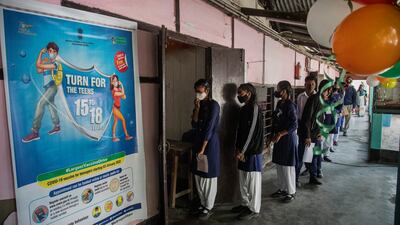
Indian teenagers wait to receive a Covid-19 vaccination at a government school in Gauhati. India has begun vaccinating teenagers in the age group 15 to 18, as more states enforce tighter restrictions to arrest a surge of infections driven by the Omicron variant. AP Photo -
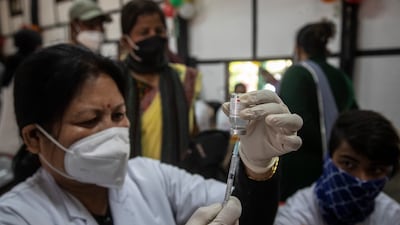
A health worker prepares to vaccinate a teenager in Gauhati, India. On Monday, state governments across the country administered doses at schools, hospitals and special vaccination sites amid a rapid rise in coronavirus infections. AP Photo -
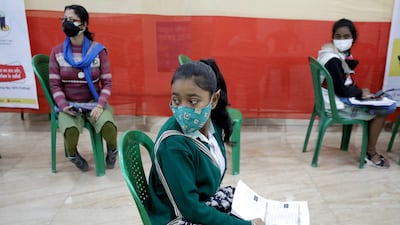
Indian pupils visit their school for a Covid-19 vaccine dose in Kolkata. EPA -
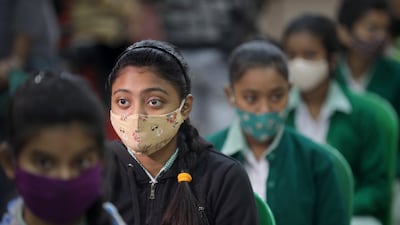
Indian students visit their school for a COVID-19 vaccine dose in Kolkata Eastern India. Indian government announced a Covid-19 vaccine drive for students aged 15 to 18 at their schools from 03 January 2022. EPA -

Teenage pupils queue for vaccinations at a government school in Gauhati. AP Photo -
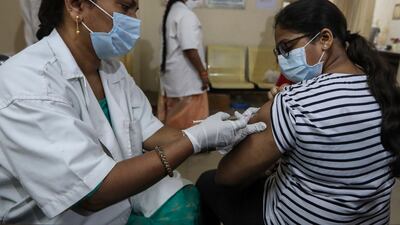
A teenager receives a Covaxin Covid-19 vaccine at a government hospital in Hyderabad, India. AP Photo -
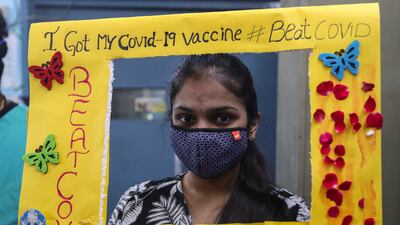
An Indian teenager after receiving a Covaxin inoculation in Hyderabad. India is experiencing a rapid rise in coronavirus infections, particularly in the country's densely populated cities. AP Photo -

Pupils visit their school in Kolkata to be inoculated against Covid-19. EPA -
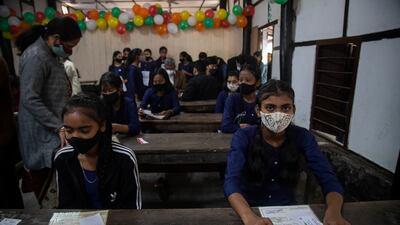
At a government school in Gauhati, India, pupils wait to receive a Covid-19 vaccination, part of a drive to inoculate teenagers in the age group 15 to 18. AP Photo -

A teenager after being vaccinated at a government school in New Delhi, India. AP Photo


Bharat Pankhania, a senior consultant in communicable disease control and a senior clinical lecturer at the University of Exeter in the UK, said there needed to be “continuous vaccine updates”.
“You’re tweaking it a little bit to mirror changes in the virus,” Dr Pankhania said.
“The majority of the population has been immunised and therefore they’re not at risk of death. The difficulty is how long does vaccine-induced immunity last.
“We may find the immunity is keeping us safe and we can safely live with this and update our vaccines every two, three, four years or something like that.”
As well as looking to develop vaccines effective against a wide variety of coronaviruses, the new funds will be used to create new monoclonal antibody treatments for people with Covid-19.
Monoclonal antibody treatments involve giving a patient large amounts of identical laboratory-made antibodies to strengthen the body’s ability to fight off infection.
These have played an important role in treating Covid-19 patients, but some have become less effective as Sars-CoV-2, the novel coronavirus, has evolved.
“After [the] Omicron [variant] it was quite clear many of the monoclonal treatment options didn’t work with the new variant,” said Eskild Petersen, a professor at Aarhus University Hospital in Denmark and chair of the emerging diseases task force of the European Society of Clinical Microbiology and Infectious Diseases.
Building immunity
Prof Petersen believes further vaccination programmes, perhaps aimed at the over-60s or over-65s, may be necessary in the coming year.
In the longer term, Prof Hunter said it was possible that Sars-CoV-2 would become less of a threat to the elderly because they will have built up protection through repeated infections over a long period.
He drew parallels with other coronaviruses that infect people and that cause about one fifth of cases of the common cold.
“When you look at the other human coronaviruses, by the time we are elderly, we have had a huge number of infections through our lives. We [will] have built up strong protection,” he said.
Over time, he said that waves of coronavirus infections would probably become more clearly seasonal, with larger numbers of cases in winter and fewer in summer. But this situation was still some way away, he said.
“It’s still causing hundreds of deaths a week in England,” he said. “It’s still a major public health problem and one that, other than through vaccination, is difficult to control.”
Prof Hunter said there was no guarantee that a more virulent form of the virus would not emerge in future. "[It's] certainly possible, if not probable.”

