Dr Ouided Bouchamaoui is a Tunisian businesswoman and 2015 Nobel Peace Prize laureate
December 09, 2022
In an era of 24/7 news cycles and hyper-connectivity, we are constantly confronted with images of division, devastation and conflict. When looking at the complexities of these tensions, it is easy to feel overwhelmed or hopeless in our efforts to find solutions and, ultimately, make possible one of the most challenging goals of our time: sustainable peace.
I strongly believe peaceful co-existence is possible. However, to achieve this ambitious goal we must envision how to actively integrate all members of society, as a mission of this magnitude can only be reached through true collaboration and understanding.
Through my experiences as the first female president of the Tunisian Confederation of Industry, Trade, and Handicrafts (UTICA) and as a member of the Tunisian Quartet – a group which I helped set up to consolidate democratic gains and form a lasting constitutional settlement in Tunisia, for which I was awarded the Nobel Peace Prize in 2015 – I realised that there are two powerful, yet underleveraged, groups in society that can play an impactful role in peacebuilding: youth and women.
“Our youth are our future” is a phrase we have heard time and time again. And I believe this to be true now more than ever. As the world becomes increasingly globalised and technology advances at a never-before-seen rate, young people have gained access to knowledge, opportunities and connections more than any past generation.
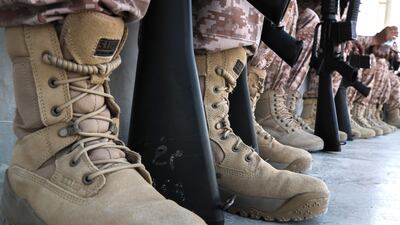
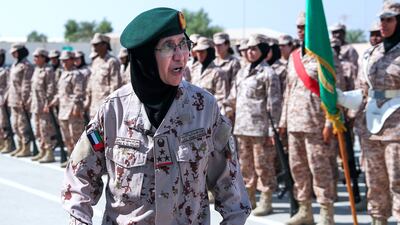
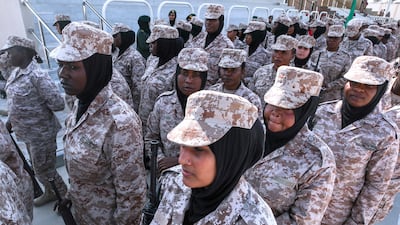
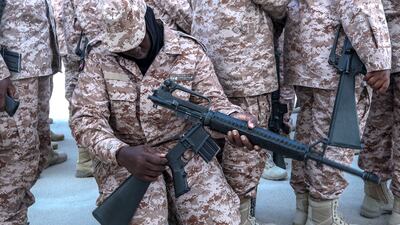
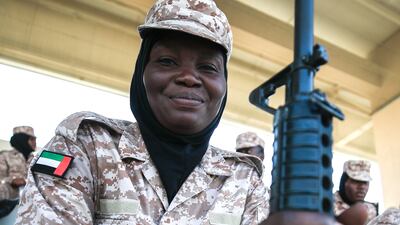
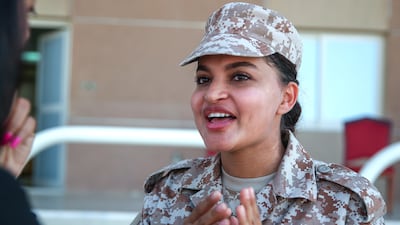
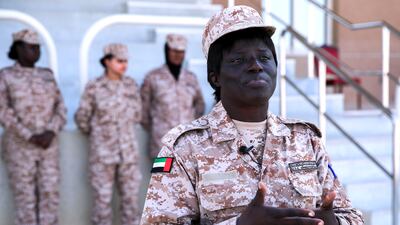
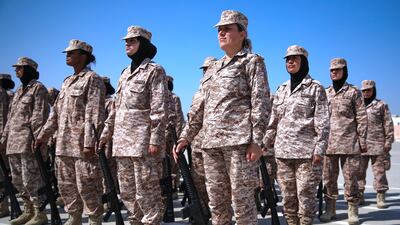
A team of 157 cadets are put through their paces during a UN peacekeeping training programme at the Khawla bint Al Azwar Military School in Abu Dhabi. All photos: Victor Besa / The National
The women could soon be engaged in challenging situations around the world.
Brig Afra Al Falasi, commander of the military school, rallies the troops for another day of crucial training.
The trainees aim to make a difference in the world.
The UAE has trained more than 350 peacekeepers under a partnership between the General Women's Union, UN Women and the Ministry of Defence.
The cadets must complete eight weeks of military training and another two weeks focused on peacekeeping.
The trainees have come to Abu Dhabi from around the world.
The Emirates is the first country to train UN Women peacekeepers under an agreement signed in September 2018.
Doha Harbi Sharhan from Iraq is excited to be given the opportunity to serve in a military setting.
Fatima Anne T Mendy from Gambia feels confident she can defend herself and others in any situation.
The UN is keen to increase the number of female peacekeepers.
Within this context, it should come as no surprise that today’s youth have a digital-first mentality. This is particularly true in the Arab world, where more than 80 per cent of Arab youth are online every day, with reports finding that 40 per cent are online at least five hours daily. They use technology as a platform to connect and build ties with people of all backgrounds around the world. They have created borderless communities and share a global outlook, which has contributed to a true sense of global citizenship. For example, in the Mena region, 47 per cent of youth consider themselves “global citizens”.
Beyond connecting the four corners of the world, unprecedented access to information has also led to a sense of social responsibility among youth and their selective engagement with causes to which they feel deeply connected. A 2021 study revealed that in the US, before making a purchase, 51 per cent of youth aged 18 to 23 will research a company to make sure it aligns with their views on corporate social responsibility.
Today’s youth are educated, engaged and influential. This momentum must be leveraged.
For generations, women have served as unofficial mediators and advisors within their communities, acting as powerful peacekeepers. A 2022 research paper published by the UNDP and UN Women showed that when women partake in peace processes, there is a heightened focus on reconciliation, education, transitional justice and economic development.
In some regions where male soldiers may be limited in their interaction with women because of existing social and cultural boundaries or heightened prevalence of sexual or gender-based violence, women have a significant role to play. In fact, women have had a direct role in reducing sexual exploitation and abuse by troops. This violence has been shown to decrease by more than 50 per cent when women make up a least five percent of the peacekeeping units, according to estimates in a 2016 research article from Emory University and Duke University.
We have seen some attempts to integrate women more widely into these critical roles. For example, UN Women supports women’s full and equal representation and participation in all levels of peace processes and security efforts. Despite these efforts, the number of women peacemakers remains low, making up just 19 per cent of conflict party negotiators or delegates in all UN peace processes in 2021.
When faced with this reality, it is clear action must be taken to bring youth and women to the table in light of their existing and potential impact, which has too great of potential to be under-utilised.
The question now is: how can we make this a reality? Drawing from my personal experience, one of the determining factors that shaped who I am today was the support and encouragement I had from my father as young girl growing up in Tunisia. He encouraged my self-confidence and helped me recognise that not only are women as capable as men, but women also possess some innate qualities that should be nurtured and valued for the betterment of our world.
Tunisian women during a celebration on National Women's Day. EPA
I know first-hand the power of this support system, which is why we must work to ensure that as a society, we create environments – in schools, families, and communities – that understand and appreciate the role of the youth and women and that look to support, encourage and recognise them.
This is not to say men don’t play an important role in promoting human fraternity and peaceful co-existence – because I firmly believe they do. However, there is much to be gained by including the voices of women and our youth to drive forward transformative change. When we work together, we can achieve so much more than working in silos.
In order to succeed, individuals, entities, and governments must recognise the importance of this endeavour. We must all play our part.
This is why I am proud to be a judge for the 2023 Zayed Award for Human Fraternity, which looks to recognise, honour and support people and organisations of all backgrounds that are building bridges and strengthening real human connection. The award actively partners with its honourees to support and amplify their work in peacebuilding. One honouree that stands out to me as an example of the power women yield is Latifa ibn Ziaten, recipient of the 2021 Zayed Award for Human Fraternity who, following the murder of her son by an extremist, channelled this tragedy into positive action to spread awareness and prevent the radicalisation of youth in France and beyond.
Through my work with the Award, I hope to learn more about the inspiring work being done around the world to bridge divides and spark hope and understand how we can affect meaningful change at all levels of society. I also look to use this opportunity as a platform to encourage youth and women to recognise their power and harness it for the greater good.
Dr Ouided Bouchamaoui is a Tunisian businesswoman and 2015 Nobel Peace Prize laureate

The biog
Birthday: February 22, 1956
Born: Madahha near Chittagong, Bangladesh
Arrived in UAE: 1978
Exercise: At least one hour a day on the Corniche, from 5.30-6am and 7pm to 8pm.
Favourite place in Abu Dhabi? “Everywhere. Wherever you go, you can relax.”
Wicked: For Good
Director: Jon M Chu
Starring: Ariana Grande, Cynthia Erivo, Jonathan Bailey, Jeff Goldblum, Michelle Yeoh, Ethan Slater
Rating: 4/5
The Bio
Hometown: Bogota, Colombia Favourite place to relax in UAE: the desert around Al Mleiha in Sharjah or the eastern mangroves in Abu Dhabi The one book everyone should read: 100 Years of Solitude by Gabriel Garcia Marquez. It will make your mind fly Favourite documentary: Chasing Coral by Jeff Orlowski. It's a good reality check about one of the most valued ecosystems for humanity
Motori Profile
Date started: March 2020
Co-founder/CEO: Ahmed Eissa
Based: UAE, Abu Dhabi
Sector: Insurance Sector
Size: 50 full-time employees (Inside and Outside UAE)
Stage: Seed stage and seeking Series A round of financing
Investors: Safe City Group
Friday's schedule at the Etihad Airways Abu Dhabi Grand Prix
GP3 qualifying, 10:15am
Formula 2, practice 11:30am
Formula 1, first practice, 1pm
GP3 qualifying session, 3.10pm
Formula 1 second practice, 5pm
Formula 2 qualifying, 7pm
Racecard
6pm: The Pointe - Conditions (TB) Dh82,500 (Turf) 1,400m
6.35pm: Palm West Beach - Maiden (TB) Dh82,500 (T) 1,800m
7.10pm: The View at the Palm - Handicap (TB) Dh85,000 (Dirt) 1,400m
8.20pm: Club Vista Mare - Handicap (TB) Dh95,000 (D) 1,900m
8.55pm: The Palm Fountain - Handicap (TB) Dh95,000 (D) 1,200m
9.30pm: The Palm Tower - Handicap (TB) Dh87,500 (T) 1,600m
Mercer, the investment consulting arm of US services company Marsh & McLennan, expects its wealth division to at least double its assets under management (AUM) in the Middle East as wealth in the region continues to grow despite economic headwinds, a company official said.
Mercer Wealth, which globally has $160 billion in AUM, plans to boost its AUM in the region to $2-$3bn in the next 2-3 years from the present $1bn, said Yasir AbuShaban, a Dubai-based principal with Mercer Wealth.
“Within the next two to three years, we are looking at reaching $2 to $3 billion as a conservative estimate and we do see an opportunity to do so,” said Mr AbuShaban.
Mercer does not directly make investments, but allocates clients’ money they have discretion to, to professional asset managers. They also provide advice to clients.
“We have buying power. We can negotiate on their (client’s) behalf with asset managers to provide them lower fees than they otherwise would have to get on their own,” he added.
Mercer Wealth’s clients include sovereign wealth funds, family offices, and insurance companies among others.
From its office in Dubai, Mercer also looks after Africa, India and Turkey, where they also see opportunity for growth.
Wealth creation in Middle East and Africa (MEA) grew 8.5 per cent to $8.1 trillion last year from $7.5tn in 2015, higher than last year’s global average of 6 per cent and the second-highest growth in a region after Asia-Pacific which grew 9.9 per cent, according to consultancy Boston Consulting Group (BCG). In the region, where wealth grew just 1.9 per cent in 2015 compared with 2014, a pickup in oil prices has helped in wealth generation.
BCG is forecasting MEA wealth will rise to $12tn by 2021, growing at an annual average of 8 per cent.
Drivers of wealth generation in the region will be split evenly between new wealth creation and growth of performance of existing assets, according to BCG.
Another general trend in the region is clients’ looking for a comprehensive approach to investing, according to Mr AbuShaban.
“Institutional investors or some of the families are seeing a slowdown in the available capital they have to invest and in that sense they are looking at optimizing the way they manage their portfolios and making sure they are not investing haphazardly and different parts of their investment are working together,” said Mr AbuShaban.
Some clients also have a higher appetite for risk, given the low interest-rate environment that does not provide enough yield for some institutional investors. These clients are keen to invest in illiquid assets, such as private equity and infrastructure.
“What we have seen is a desire for higher returns in what has been a low-return environment specifically in various fixed income or bonds,” he said.
“In this environment, we have seen a de facto increase in the risk that clients are taking in things like illiquid investments, private equity investments, infrastructure and private debt, those kind of investments were higher illiquidity results in incrementally higher returns.”
The Abu Dhabi Investment Authority, one of the largest sovereign wealth funds, said in its 2016 report that has gradually increased its exposure in direct private equity and private credit transactions, mainly in Asian markets and especially in China and India. The authority’s private equity department focused on structured equities owing to “their defensive characteristics.”
AI traffic lights to ease congestion at seven points to Sheikh Zayed bin Sultan Street
Starring: Walton Goggins, Jason Isaacs, Natasha Rothwell
Rating: 4.5/5
Timeline
2012-2015
The company offers payments/bribes to win key contracts in the Middle East
May 2017
The UK SFO officially opens investigation into Petrofac’s use of agents, corruption, and potential bribery to secure contracts
September 2021
Petrofac pleads guilty to seven counts of failing to prevent bribery under the UK Bribery Act
October 2021
Court fines Petrofac £77 million for bribery. Former executive receives a two-year suspended sentence
December 2024
Petrofac enters into comprehensive restructuring to strengthen the financial position of the group
May 2025
The High Court of England and Wales approves the company’s restructuring plan
July 2025
The Court of Appeal issues a judgment challenging parts of the restructuring plan
August 2025
Petrofac issues a business update to execute the restructuring and confirms it will appeal the Court of Appeal decision
October 2025
Petrofac loses a major TenneT offshore wind contract worth €13 billion. Holding company files for administration in the UK. Petrofac delisted from the London Stock Exchange
British Grand Prix free practice times in the third and final session at Silverstone on Saturday (top five):
1. Lewis Hamilton (GBR/Mercedes) 1:28.063 (18 laps)
2. Sebastian Vettel (GER/Ferrari) 1:28.095 (14)
3. Valtteri Bottas (FIN/Mercedes) 1:28.137 (20)
4. Kimi Raikkonen (FIN/Ferrari) 1:28.732 (15)
5. Nico Hulkenberg (GER/Renault) 1:29.480 (14)
What vitamins do we know are beneficial for living in the UAE
Vitamin D: Highly relevant in the UAE due to limited sun exposure; supports bone health, immunity and mood. Vitamin B12: Important for nerve health and energy production, especially for vegetarians, vegans and individuals with absorption issues. Iron: Useful only when deficiency or anaemia is confirmed; helps reduce fatigue and support immunity. Omega-3 (EPA/DHA): Supports heart health and reduces inflammation, especially for those who consume little fish.
Expo 2020 Dubai will be the first World Expo to be held in the Middle East, Africa and South Asia
The world fair will run for six months from October 20, 2020 to April 10, 2021.
It is expected to attract 25 million visits
Some 70 per cent visitors are projected to come from outside the UAE, the largest proportion of international visitors in the 167-year history of World Expos.
More than 30,000 volunteers are required for Expo 2020
The site covers a total of 4.38 sqkm, including a 2 sqkm gated area
It is located adjacent to Al Maktoum International Airport in Dubai South