Former Sri Lankan president Gotabaya Rajapaksa was defence minister during the country’s civil war that ended in 2009. AP

Human rights group seeks former Sri Lankan president’s arrest in Singapore


  • English
  • Arabic

A human rights group has filed a criminal complaint with Singapore’s attorney general to seek the arrest of Sri Lanka’s former president Gotabaya Rajapaksa for alleged war crimes.

Mr Rajapaksa, who fled to Singapore this month after he was ousted from office over Sri Lanka's economic collapse, was defence minister during the country’s civil war, which ended in 2009.

The International Truth and Justice Project (ITJP), an evidence-gathering organisation administered by a South Africa-based non-profit foundation, said on Sunday that its lawyers had filed the complaint requesting his immediate arrest.

The complaint alleges Mr Rajapaksa committed grave breaches of the Geneva Conventions during the civil war “and that these are crimes subject to domestic prosecution in Singapore under universal jurisdiction”.

Sri Lanka’s economic crisis has left the nation’s 22 million people struggling with shortages of essentials, including medicine, fuel and food.

Months of protests have focused on the Rajapaksa political dynasty, which has ruled the country for most of the past two decades.

“The economic meltdown has seen the government collapse, but the crisis in Sri Lanka is really linked to structural impunity for serious international crimes going back three decades or more,” ITJP executive director Yasmin Sooka said.

The UN conservatively estimates that the civil war killed 100,000 people but the actual number is believed to be much higher.

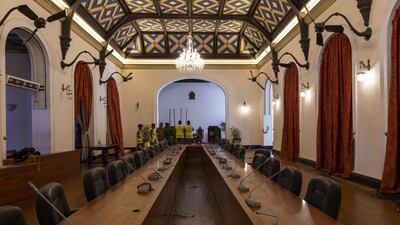
  • Police examine damage at a conference hall during an investigation at the President's Palace in Colombo, Sri Lanka. Bloomberg
    Police examine damage at a conference hall during an investigation at the President's Palace in Colombo, Sri Lanka. Bloomberg
  • Police officers during the investigation at the palace in Colombo. Bloomberg
    Police officers during the investigation at the palace in Colombo. Bloomberg
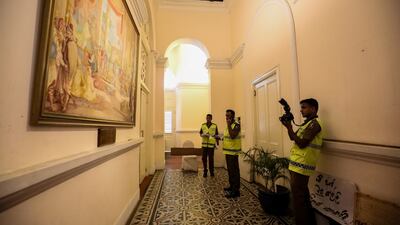
  • Crime investigation officers at the palace after protesters on July 14 left the premises, ending a five-day occupation of several official buildings. The parliament of Sri Lanka on July 15 accepted the resignation of Gotabaya Rajapaksa, who fled to Singapore after months of anti-government protests. Prime Minister Ranil Wickremesinghe was sworn in as interim president on July 15. EPA
    Crime investigation officers at the palace after protesters on July 14 left the premises, ending a five-day occupation of several official buildings. The parliament of Sri Lanka on July 15 accepted the resignation of Gotabaya Rajapaksa, who fled to Singapore after months of anti-government protests. Prime Minister Ranil Wickremesinghe was sworn in as interim president on July 15. EPA
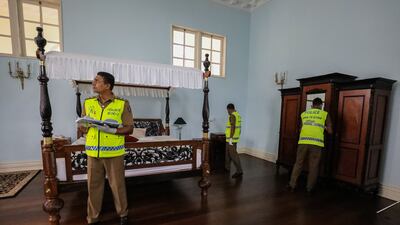
  • One of the bedrooms at the President's Palace after protesters vacated the site. EPA
    One of the bedrooms at the President's Palace after protesters vacated the site. EPA
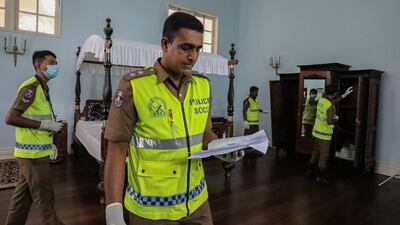
  • Crime investigation officers in the palace after the protesters' occupation. EPA
    Crime investigation officers in the palace after the protesters' occupation. EPA
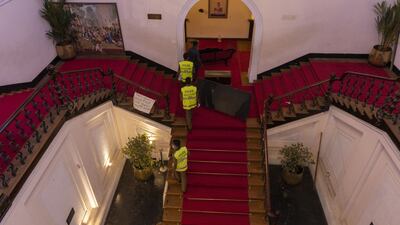
  • Officers inspect the palace for damage. EPA
    Officers inspect the palace for damage. EPA
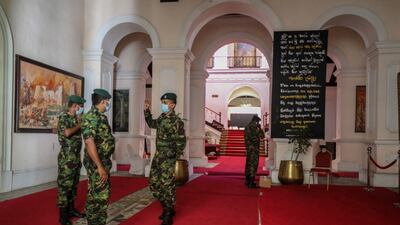
  • Sri Lankan special task force soldiers on duty in the palace. EPA
    Sri Lankan special task force soldiers on duty in the palace. EPA
  • Crime investigation officers in one of the bedrooms at the palace. EPA
    Crime investigation officers in one of the bedrooms at the palace. EPA
  • The occupation of the palace followed months of anti-government protests fuelled by the economic crisis in Sri Lanka. EPA
    The occupation of the palace followed months of anti-government protests fuelled by the economic crisis in Sri Lanka. EPA

A report from a UN panel of experts said at least 40,000 ethnic minority Tamil civilians were killed in the final months of the fighting alone.

Tamil Tiger rebels fought to create an independent state for ethnic minority Tamils.

The country’s ethnic Sinhala majority credited Mr Rajapaksa and his elder brother Mahinda Rajapaksa with the war victory, cementing the family’s political dominance.

Efforts to investigate allegations of war crimes were largely suppressed under the Rajapaksas.

After Gotabaya Rajapaksa fled the country earlier this month, politicians elected Ranil Wickremesinghe to serve the remainder of his presidential term.

He declared a state of emergency with broad powers to act to ensure law and order, and a day after he was sworn in, hundreds of armed troops raided a protest camp outside the president’s office, attacking demonstrators with batons.

Rights groups have urged Mr Wickremesinghe to immediately order troops and police to cease using force and said last week's display seemed to follow a pattern of Sri Lankan authorities forcefully responding to dissent.

The political turmoil has threatened Sri Lanka’s potential for economic recovery.

Mr Wickremesinghe recently said bailout talks with the IMF were nearing a conclusion.

Ferrari 12Cilindri specs

Engine: naturally aspirated 6.5-liter V12

Power: 819hp

Torque: 678Nm at 7,250rpm

Price: From Dh1,700,000

Available: Now

Ten tax points to be aware of in 2026

1. Domestic VAT refund amendments: request your refund within five years

If a business does not apply for the refund on time, they lose their credit.

2. E-invoicing in the UAE

Businesses should continue preparing for the implementation of e-invoicing in the UAE, with 2026 a preparation and transition period ahead of phased mandatory adoption. 

3. More tax audits

Tax authorities are increasingly using data already available across multiple filings to identify audit risks. 

4. More beneficial VAT and excise tax penalty regime

Tax disputes are expected to become more frequent and more structured, with clearer administrative objection and appeal processes. The UAE has adopted a new penalty regime for VAT and excise disputes, which now mirrors the penalty regime for corporate tax.

5. Greater emphasis on statutory audit

There is a greater need for the accuracy of financial statements. The International Financial Reporting Standards standards need to be strictly adhered to and, as a result, the quality of the audits will need to increase.

6. Further transfer pricing enforcement

Transfer pricing enforcement, which refers to the practice of establishing prices for internal transactions between related entities, is expected to broaden in scope. The UAE will shortly open the possibility to negotiate advance pricing agreements, or essentially rulings for transfer pricing purposes. 

7. Limited time periods for audits

Recent amendments also introduce a default five-year limitation period for tax audits and assessments, subject to specific statutory exceptions. While the standard audit and assessment period is five years, this may be extended to up to 15 years in cases involving fraud or tax evasion. 

8. Pillar 2 implementation 

Many multinational groups will begin to feel the practical effect of the Domestic Minimum Top-Up Tax (DMTT), the UAE's implementation of the OECD’s global minimum tax under Pillar 2. While the rules apply for financial years starting on or after January 1, 2025, it is 2026 that marks the transition to an operational phase.

9. Reduced compliance obligations for imported goods and services

Businesses that apply the reverse-charge mechanism for VAT purposes in the UAE may benefit from reduced compliance obligations. 

10. Substance and CbC reporting focus

Tax authorities are expected to continue strengthening the enforcement of economic substance and Country-by-Country (CbC) reporting frameworks. In the UAE, these regimes are increasingly being used as risk-assessment tools, providing tax authorities with a comprehensive view of multinational groups’ global footprints and enabling them to assess whether profits are aligned with real economic activity. 

Contributed by Thomas Vanhee and Hend Rashwan, Aurifer


About Takalam

Date started: early 2020

Founders: Khawla Hammad and Inas Abu Shashieh

Based: Abu Dhabi

Sector: HealthTech and wellness

Number of staff: 4

Funding to date: Bootstrapped

Updated: July 25, 2022, 7:37 AM