Ali Abu Dashish is an expert in Egyptian antiquities and a member of the Egyptian Archaeologists Union
June 17, 2022
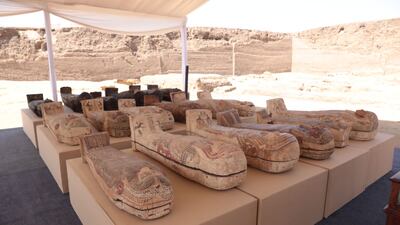
The major recent archaeological discoveries in Egypt, most notably a series of coffins discovered at Saqqara, just outside Cairo, in May, are evidence of the genius of this generation of Egyptian archaeologists, restorers and Egyptologists. It is fitting that the objects they are unearthing and studying are particularly remarkable. Each new discovery ― and there have been many recently ― sheds more light on how the ancient Egyptians lived and excelled in the sciences, including medicine, engineering, astronomy, arithmetic, pharmacology and mummification, which until now has been a baffling secret.
Discovering burial sites, of course, is nothing new for the country. Even the pharaohs themselves were at points excavating Egyptian antiquities from earlier periods. After all, the term “Ancient Egypt” encompasses a period of more than 3,000 years. And not all of the “excavations” during that time were friendly. For millennia thieves have targeted tombs. This is why the pharaohs were always looking for a safe place to bury their dead, and helps to explain the existence of epic sites such as Saqqara, which was used as a burial site from prehistoric times until the Islamic era.
But the unearthing and preservation of Egypt’s cultural heritage, fortunately, takes far more constructive forms today, thanks to the careful work of the country’s archaeologists, Egyptologists and historians. And keeping the discipline vibrant is in large part about training the right people and generating in-country expertise.
When the Egyptian archaeologist Zahi Hawass took over the Ministry of Antiquities in 2011, his main concern was just that: for Egyptian archaeologists to learn the art of excavation and restoration. He set up excavation schools and taught more than 500 Egyptian archaeologists the arts of research and excavation until they reached the same level of ability as foreign expertrs, even surpassing them.
The best evidence of this fact is today’s trove of recent discoveries. They have dazzled the world and were uncovered entirely by Egyptian hands. They include the aforementioned findings at Saqqara and the discovery by Dr Hawass of the tombs of workers who built the pyramids and the lost golden city in Luxor. The history of the city dates back to the reign of King Amenhotep III, 3,000 years ago. He also discovered the pyramid of Queen Nate in Saqqara and the Valley of the Golden Mummies in the Bahariya Oasis in the depths of the Western Desert.
When Mustafa Waziri became head of the Supreme Council of Antiquities, he immediately led missions to excavate Egyptian antiquities throughout the country and began working at the Saqqara necropolis, where many of the kings and queens of ancient Egypt, senior statesmen and priests were buried.
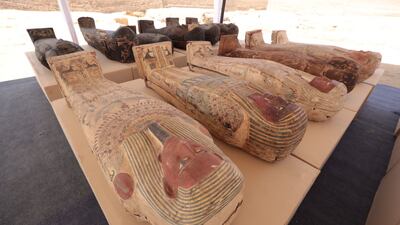
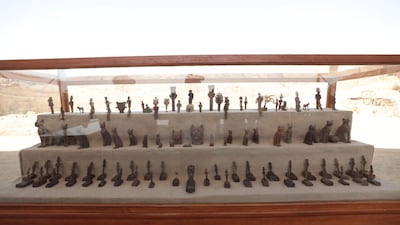
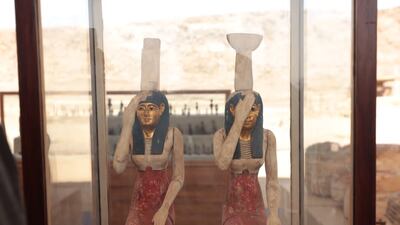
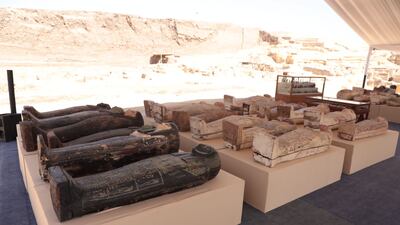
Recent discoveries at Saqqara, Egypt. Photo: Ali Abu Dashish
A recent trove of discoveries dazzled the world and was uncovered entirely by Egyptian hands
In 2018, Dr Waziri announced the discovery of the tomb of "Wahti", a high-ranking employee in Saqqara from the era of Niferirkara from the late Fifth Dynasty of the Old Kingdom, about 4,400 years old. That tomb was untouched and characterised by wonderful colours and the most amazing inscriptions, because they represented daily life, not, as is often the case in tombs, high ceremony.
To the north-west of the pyramid of King Marinara in Saqqara, several tombs were discovered for a person named "Eri", a senior statesman, containing seven oil pots and a huge sarcophagus.
A second tomb belongs to the wife of a person named “Yart” ― we know this because of its proximity to his tomb ― and the third belongs to a person called “Bi Nafarfayi”, who held several positions, including the supervisor of the Great House, the royal palace. The fourth tomb was consecrated for a woman called "Betty", who bore the titles of the only king and priestess of the goddess Hathor. The fifth tomb belongs to a person named “Hannu” who was the supervisor of the royal palace and the hereditary prince.
As for the latest discoveries led by Dr Waziri, the first and largest cache was announced in the excavation area at Saqqara, south of Giza, which includes 150 bronze statues and 250 wooden coffins, dating back to the late era. This cache belongs to a number of ancient Egyptian deities, including Anubis, Amun-Min, Osiris, Isis, Nefertum, Bastet and Hathor, in addition to a group of bronze vessels related to the rituals of the goddess Isis and a headless bronze statue of the engineer “Imhotep”.
Perhaps the greatest artefact that was found was a sealed and untouched papyrus, which was transferred to the Egyptian Museum, central Cairo, for further study and restoration to its original condition.
That papyrus was called “Waziri”. Its length is estimated to be nine metres and contains chapters from the Book of the Dead, which is a group of funerary texts consisting of incantations used by the Egyptians to guide the dead through the underworld.
All these great discoveries highlight the greatness and beauty of the unique ancient Egyptian civilisation. Perhaps the biggest modern event in Egypt’s ongoing mission to honour its past is the building of the Grand Egyptian Museum, which includes the artefacts of King Tutankhamun, the golden pharaoh, which the world will celebrate on November 4, the centenary of the discovery of his tomb by the British archaeologist Howard Carter in Luxor. Festivities will be held in all the cities of the world, and Dr Hawass has even composed an opera ― The Opera of Tutankhamun ― which describes the story of the king's life, full of mystery and magic.
For 10 years, Carter worked at the site of the tomb, where almost 5,400 artefacts were discovered. Of course, what most people do not know about the excavation is that much of the real credit should go to a 12-year-old boy named Hussein Abdel Rasoul. His task was to transport water to workers at the site. He discovered the opening of the cemetery when lowering a water container from the back of a donkey. There is a photo of him wearing a necklace from the tomb. Later, the Ministry of Antiquities transformed his house in Luxor into an open museum. His discovery was indicative of a process, the results of which can be seen today. At that time, archaeology was limited to foreigners, but the workers who helped them were Egyptians, and they were quietly learning the discipline from foreigners.
People such as Howard Carter are and always will be integral. But he belongs to a bygone colonial era. Now, Egyptians are stepping up like never before.
Egypt’s heritage is a world-renowned source of wonder, which enchants visitors from all over the world. But while an important part of Egyptology’s identity is global, it is still positive that today Egypt is seeing the fruits of the hard work of figures such as Dr Hawass and Dr Waziri, in the form not just of new wonders, but a new generation of Egyptian experts.

Squid Game season two
Director: Hwang Dong-hyuk
Stars: Lee Jung-jae, Wi Ha-joon and Lee Byung-hun
Rating: 4.5/5
EA Sports FC 25
Developer: EA Vancouver, EA Romania Publisher: EA Sports Consoles: Nintendo Switch, PlayStation 4&5, Xbox One and Xbox Series X/S Rating: 3.5/5
MATCH INFO
Uefa Champions League, Group C
Liverpool v Red Star Belgrade
Anfield, Liverpool
Wednesday, 11pm (UAE)
Reading List
Practitioners of mindful eating recommend the following books to get you started:
Savor: Mindful Eating, Mindful Life by Thich Nhat Hanh and Dr Lilian Cheung
How to Eat by Thich Nhat Hanh
The Mindful Diet by Dr Ruth Wolever
Mindful Eating by Dr Jan Bays
How to Raise a Mindful Eaterby Maryann Jacobsen
Results
5pm: Maiden (PA) Dh80,000 (Turf) 1,000mm, Winners: Mumayaza, Fabrice Veron (jockey), Eric Lemartinel (trainer)
5.30pm: Wathba Stallions Cup Handicap (PA) Dh70,000 (T) 2,200m, Winners: Sharkh, Pat Cosgrave, Helal Al Alawi
6pm: The President’s Cup Prep - Conditions (PA) Dh100,000 (T) 2,200m, Winner: Somoud, Richard Mullen, Jean de Roualle
6.30pm: Handicap (PA) Dh90,000 (T) 1,600m, Winner: Harrab, Ryan Curatolo, Jean de Roualle
7pm: Abu Dhabi Equestrian Gold Cup - Prestige (PA) Dh125,000 (T) 1,600m, Winner: Hameem, Adrie de Vries, Abdallah Al Hammadi
7.30pm: Al Ruwais – Group 3 (PA) Dh300,000 (T) 1,200m, Winner: AF Alwajel, Tadhg O’Shea, Ernst Oertel
8pm: Maiden (TB) Dh80,000 (T) 1,400m, Winner: Nibras Passion, Bernardo Pinheiro, Ismail Mohammed
The specs
Engine: 3.0-litre six-cylinder turbo
Power: 398hp from 5,250rpm
Torque: 580Nm at 1,900-4,800rpm
Transmission: Eight-speed auto
Fuel economy, combined: 6.5L/100km
On sale: December
Price: From Dh330,000 (estimate)
UAE’s revised Cricket World Cup League Two schedule
August, 2021: Host - United States; Teams - UAE, United States and Scotland
Between September and November, 2021 (dates TBC): Host - Namibia; Teams - Namibia, Oman, UAE
December, 2021: Host - UAE; Teams - UAE, Namibia, Oman
February, 2022: Hosts - Nepal; Teams - UAE, Nepal, PNG
June, 2022: Hosts - Scotland; Teams - UAE, United States, Scotland
September, 2022: Hosts - PNG; Teams - UAE, PNG, Nepal
February, 2023: Hosts - UAE; Teams - UAE, PNG, Nepal
TOURNAMENT INFO
Women’s World Twenty20 Qualifier
Jul 3- 14, in the Netherlands
The top two teams will qualify to play at the World T20 in the West Indies in November
FlyDubai flies direct from Dubai to Skopje in five hours from Dh1,314 return including taxes. Hourly buses from Skopje to Ohrid take three hours.
The tours
English-speaking guided tours of Ohrid town and the surrounding area are organised by Cultura 365; these cost €90 (Dh386) for a one-day trip including driver and guide and €100 a day (Dh429) for two people.
The hotels
Villa St Sofija in the old town of Ohrid, twin room from $54 (Dh198) a night.
St Naum Monastery, on the lake 30km south of Ohrid town, has updated its pilgrims' quarters into a modern 3-star hotel, with rooms overlooking the monastery courtyard and lake. Double room from $60 (Dh 220) a night.
Global events: Much of the UK’s economic woes were blamed on “increased global uncertainty”, which can be interpreted as the economic impact of the Ukraine war and the uncertainty over Donald Trump’s tariffs.
Growth forecasts: Cut for 2025 from 2 per cent to 1 per cent. The OBR watchdog also estimated inflation will average 3.2 per cent this year
Welfare: Universal credit health element cut by 50 per cent and frozen for new claimants, building on cuts to the disability and incapacity bill set out earlier this month
Spending cuts: Overall day-to day-spending across government cut by £6.1bn in 2029-30
Tax evasion: Steps to crack down on tax evasion to raise “£6.5bn per year” for the public purse
Defence: New high-tech weaponry, upgrading HM Naval Base in Portsmouth
Housing: Housebuilding to reach its highest in 40 years, with planning reforms helping generate an extra £3.4bn for public finances
Scorecard
Scotland 220
K Coetzer 95, J Siddique 3-49, R Mustafa 3-35
UAE 224-3 in 43,5 overs
C Suri 67, B Hameed 63 not out
Lexus LX700h specs
Engine: 3.4-litre twin-turbo V6 plus supplementary electric motor
Mark Chahwan, co-founder and chief executive of robo-advisory firm Sarwa, forecasts that Generation Alpha (born between 2010 and 2024) will start investing in their teenage years and therefore benefit from compound interest.
“Technology and education should be the main drivers to make this happen, whether it’s investing in a few clicks or their schools/parents stepping up their personal finance education skills,” he adds.
Mr Chahwan says younger generations have a higher capacity to take on risk, but for some their appetite can be more cautious because they are investing for the first time. “Schools still do not teach personal finance and stock market investing, so a lot of the learning journey can feel daunting and intimidating,” he says.
He advises millennials to not always start with an aggressive portfolio even if they can afford to take risks. “We always advise to work your way up to your risk capacity, that way you experience volatility and get used to it. Given the higher risk capacity for the younger generations, stocks are a favourite,” says Mr Chahwan.
Highlighting the role technology has played in encouraging millennials and Gen Z to invest, he says: “They were often excluded, but with lower account minimums ... a customer with $1,000 [Dh3,672] in their account has their money working for them just as hard as the portfolio of a high get-worth individual.”
Goalkeepers: Ali Khaseif, Fahad Al Dhanhani, Mohammed Al Shamsi, Adel Al Hosani
Defenders: Bandar Al Ahbabi, Shaheen Abdulrahman, Walid Abbas, Mahmoud Khamis, Mohammed Barghash, Khalifa Al Hammadi, Hassan Al Mahrami, Yousef Jaber, Mohammed Al Attas
Midfielders: Ali Salmeen, Abdullah Ramadan, Abdullah Al Naqbi, Majed Hassan, Abdullah Hamad, Khalfan Mubarak, Khalil Al Hammadi, Tahnoun Al Zaabi, Harib Abdallah, Mohammed Jumah
Forwards: Fabio De Lima, Caio Canedo, Ali Saleh, Ali Mabkhout, Sebastian Tagliabue
How to help
Send “thenational” to the following numbers or call the hotline on: 0502955999
2289 – Dh10
2252 – Dh 50
6025 – Dh20
6027 – Dh 100
6026 – Dh 200
Earth under attack: Cosmic impacts throughout history
- 4.5 billion years ago: Mars-sized object smashes into the newly-formed Earth, creating debris that coalesces to form the Moon
- 66 million years ago: 10km-wide asteroid crashes into the Gulf of Mexico, wiping out over 70 per cent of living species – including the dinosaurs.
- 50,000 years ago: 50m-wide iron meteor crashes in Arizona with the violence of 10 megatonne hydrogen bomb, creating the famous 1.2km-wide Barringer Crater
- 1490: Meteor storm over Shansi Province, north-east China when large stones “fell like rain”, reportedly leading to thousands of deaths.
- 1908: 100-metre meteor from the Taurid Complex explodes near the Tunguska river in Siberia with the force of 1,000 Hiroshima-type bombs, devastating 2,000 square kilometres of forest.
- 1998: Comet Shoemaker-Levy 9 breaks apart and crashes into Jupiter in series of impacts that would have annihilated life on Earth.
-2013: 10,000-tonne meteor burns up over the southern Urals region of Russia, releasing a pressure blast and flash that left over 1600 people injured.
Mercer, the investment consulting arm of US services company Marsh & McLennan, expects its wealth division to at least double its assets under management (AUM) in the Middle East as wealth in the region continues to grow despite economic headwinds, a company official said.
Mercer Wealth, which globally has $160 billion in AUM, plans to boost its AUM in the region to $2-$3bn in the next 2-3 years from the present $1bn, said Yasir AbuShaban, a Dubai-based principal with Mercer Wealth.
“Within the next two to three years, we are looking at reaching $2 to $3 billion as a conservative estimate and we do see an opportunity to do so,” said Mr AbuShaban.
Mercer does not directly make investments, but allocates clients’ money they have discretion to, to professional asset managers. They also provide advice to clients.
“We have buying power. We can negotiate on their (client’s) behalf with asset managers to provide them lower fees than they otherwise would have to get on their own,” he added.
Mercer Wealth’s clients include sovereign wealth funds, family offices, and insurance companies among others.
From its office in Dubai, Mercer also looks after Africa, India and Turkey, where they also see opportunity for growth.
Wealth creation in Middle East and Africa (MEA) grew 8.5 per cent to $8.1 trillion last year from $7.5tn in 2015, higher than last year’s global average of 6 per cent and the second-highest growth in a region after Asia-Pacific which grew 9.9 per cent, according to consultancy Boston Consulting Group (BCG). In the region, where wealth grew just 1.9 per cent in 2015 compared with 2014, a pickup in oil prices has helped in wealth generation.
BCG is forecasting MEA wealth will rise to $12tn by 2021, growing at an annual average of 8 per cent.
Drivers of wealth generation in the region will be split evenly between new wealth creation and growth of performance of existing assets, according to BCG.
Another general trend in the region is clients’ looking for a comprehensive approach to investing, according to Mr AbuShaban.
“Institutional investors or some of the families are seeing a slowdown in the available capital they have to invest and in that sense they are looking at optimizing the way they manage their portfolios and making sure they are not investing haphazardly and different parts of their investment are working together,” said Mr AbuShaban.
Some clients also have a higher appetite for risk, given the low interest-rate environment that does not provide enough yield for some institutional investors. These clients are keen to invest in illiquid assets, such as private equity and infrastructure.
“What we have seen is a desire for higher returns in what has been a low-return environment specifically in various fixed income or bonds,” he said.
“In this environment, we have seen a de facto increase in the risk that clients are taking in things like illiquid investments, private equity investments, infrastructure and private debt, those kind of investments were higher illiquidity results in incrementally higher returns.”
The Abu Dhabi Investment Authority, one of the largest sovereign wealth funds, said in its 2016 report that has gradually increased its exposure in direct private equity and private credit transactions, mainly in Asian markets and especially in China and India. The authority’s private equity department focused on structured equities owing to “their defensive characteristics.”
Favourite piece of music: Verdi’s Requiem. It’s awe-inspiring.
Biggest inspiration: My father, as I grew up in a house where music was constantly played on a wind-up gramophone. I had amazing music teachers in primary and secondary school who inspired me to take my music further. They encouraged me to take up music as a profession and I follow in their footsteps, encouraging others to do the same.
Favourite book: Ian McEwan’s Atonement – the ending alone knocked me for six.
Favourite holiday destination: Italy - music and opera is so much part of the life there. I love it.