

Life is becoming increasingly hard for Afghan women. Since the extremist Taliban group staged a takeover last August, they have mounted an all-out assault on women’s rights, imposing arcane restrictions on women’s movement, ability to work and dress.
Despite promising to respect women’s rights, including the right to work and education, the Taliban have repeatedly created hurdles for women’s access to high schools and workplaces.
“Women professionals from most sectors have been sent back home or were forced to quit because of the restriction. Apart from that, the private sector, which had more than 3,500 small and medium businesswomen, has been reduced to few tens,” said Nargis Nehan, a women’s rights activist and former minister of mines.
Last week, the group said women must wear face coverings, known as burqas, or their male guardians would be punished.
Fayeza, 23, a student from Kabul, donned her first burqa this week. As a practising Muslim, she had always worn a hijab, but never wanted to wear the burqa that her mother and older sister wore during the previous Taliban regime.
“But then the Taliban took over Kabul and my mother rushed to the market to buy me a burqa out of fear that they might target me. I still refused because I can’t breathe under it,” she told The National.
However, after the latest decree, Fayeza gave in.
“I had no option or else they would punish my family members,” she added, dejectedly.
The decree also said that female government employees who breach the burqa rule would be fired.
Women banned from the workplace
But even keeping your job doesn’t guarantee you will actually be allowed to work.
Najila Ahmad, 32, has been not been allowed into her office in the heart of Kabul for nine months. Her last day at work was August 15, when the Taliban seized the Afghan capital and took control of the country.
Technically, she is still employed by an Afghan government ministry, where she held a prestigious position as the manager of a department that provided services to women.
“I still receive a reduced salary, but they [the Taliban] will not let me resume my work. They tell me, ‘We are paying you, what else do you need?’ but money is not everything,” said Ms Ahmad, a pseudonym to protect her identity.
Ms Ahmad said she has not been provided with any justification on why she’s being denied entry to her office.
In September, last year, a Taliban representative told journalists that the group would permit women employees to resume work in government offices. However, very few have been allowed back, reports say.
In a traditionally patriarchal society, Ms Ahmad worked extremely hard to get to the position she was in before the Taliban takeover, taking night classes to finish her education despite her family commitments.
Her hard work paid off and she rose through the ranks.
“We worked with other women and helped Afghan women to get better access to our services. I loved my job because I got to serve people, particularly the women,” she said.
But now as the Taliban tighten restrictions on women, Ms Ahmad’s hopes of ever returning to her job are slowly fading away.
Ms Nehan has been collecting data on the impact of the Taliban takeover on women’s livelihoods.
Many sectors including civil society, health, education have been affected to various degrees, she said.
“The Taliban have made it very difficult and expensive for offices to hire women. For instance, they order that there should be gender-segregated spaces for women to work, there is no support within departments for women, and women should not be allowed without a mahram,” she explained.
“Added to that, women aren’t allowed to represent the organisation in meetings, or conduct outdoor activities such as purchasing and processing documents. So you can see why an organisation will not want to hire women.”
Afghanistan’s economy suffers as half of workforce disappear
-
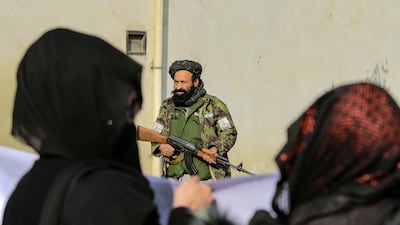
Taliban soldiers stand guard as women carry placards during a rally in Kabul, Afghanistan. All photos: EPA -
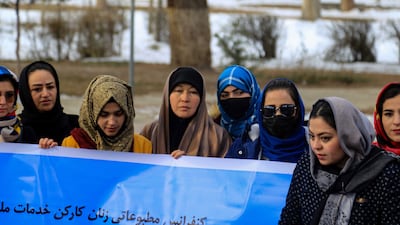
Afghan women activists demand food, jobs and education for girls during a protest in Kabul. -
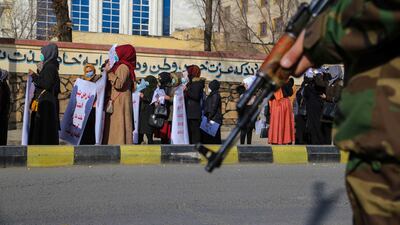
Afghan women demonstrate during a rally in Kabul, Afghanistan. -

The Taliban have banned women from work and girls from secondary schools. EPA -
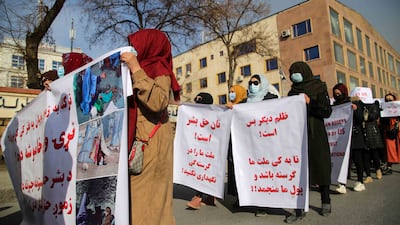
Women carry placards during a rally in Kabul. -
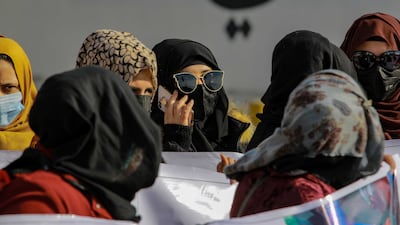
Afghan women have intensified their anti-Taliban protests despite the group's harsh crackdown on demonstrations. -
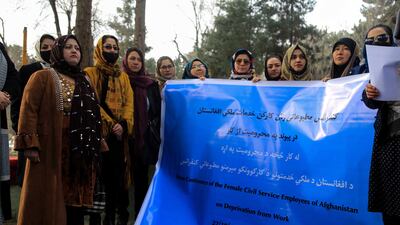
In the last three months of their rule, the Taliban have suppressed several women's protests in Kabul and other Afghan provinces. -
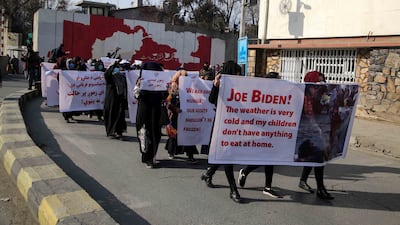
The Taliban have used violence against protesters, including using pepper spray.


The lack of women’s participation has contributed to the deteriorating condition of the Afghan economy, Ms Nehan said.
“When their entire focus is on controlling women and interfering in private families matters, it can be detrimental to the economy. There have been no development projects, or infrastructure, or social welfare in the last few months,” she pointed out.
Restricting women from participating in economic and public activities will also have a dire impact on the economy, a UN report cautioned last December.
This new socio-economic assessment on Afghanistan estimates that restricting women from working could result in an immediate economic loss of up to US$1 billion — or up to five per cent of the country’s GDP, said Achim Steiner, administrator at the UN Development Programme.
Meanwhile, businesses catering to working women have also reported a decline in clients since the Taliban takeover. Hasib Anwari, 25, used to run an e-commerce business selling women’s jewellery.
“Young, educated and working women were our primary target audience. But business was badly hit after the takeover, as many of our women customers lost purchasing power,” he said.
But Anwari and his partners, one of whom is a businesswoman, adapted quickly. He moved his business away from jewellery to selling burqas online.
“In September itself, we speculated that such a ban might be enforced and started selling burqas. And today we are selling almost 20 pieces a day,” he said. Prices of burqas they sell have risen from 600 Afghanis (about $7) in September to AFN 1500 ($17) as of now.
“The business is doing well. We even provide home delivery so women don’t have to worry about having a mahram,” he added.
Life without a male guardian
As hard as it is for Afghan women right now, it is harder for women-led households.
“The Taliban killed my only mahram [male guardian] in an attack years ago, and now they are ruling that I cannot leave the house or chose how I dress without one. So should I borrow a mahram for them to punish me?” Marzia, 50, a university professor told The National, referring to the newer decree that punishes male guardians of women who do not wear the burqa.
Ms Marzia said she is often stopped on her way to work by the Taliban, who reprimand her for travelling without a mahram.
“They have no respect for me as a university professor, and have ordered the drivers to abandon me in the middle of the roads," she said.
"Where in Islam is such an undignified act against women allowed?”
Ms Nehan echoes her sentiment.
“We’ve had war for more than forty years, and lost millions of lives, disrupting families," she said.
"Some estimates say there are at least two million households where women are breadwinners. Who do they expect will take responsibility of these families if they are stopped from working?”
Afghan women, however, continue to resist and are protesting against the new decree. Despite threats, arrests and harassment, many women took out a demonstration on May 10 — to express their discontent over the rulings dictating women's clothes and movements.

