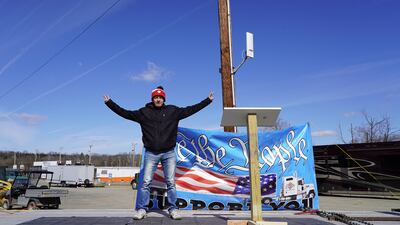
Donny Thomas poked his head into a small tent pitched on a hillside by a car-racing track in rural Maryland, about 90 minutes' drive outside Washington, DC.
Inside, a half dozen blankets filled the small space. They’ve kept Mr Thomas, 45, warm despite frigid conditions for much of the last month, as he and hundreds of others set up camp in the small city of Hagerstown to protest against Covid-19 vaccine mandates and what they perceive as government overreach.
“I don't want to tell anybody how to think and I don't want to be told how to think,” Mr Thomas said.
He is part of the People’s Convoy, America’s response to Canada’s Freedom Convoy that paralysed the Canadian capital Ottawa for several weeks and shut down North America’s busiest border crossing in February.
But while the Freedom Convoy was able to grab the world’s attention, its US counterpart has not found the same success.
With states and cities dropping vaccine and mask mandates as the pandemic recedes, the convoy's main point of contention has lost some of its resonance.
Mr Thomas blames the media for the group’s inability to gain any serious traction.
“I think it's the spin of the story,” he told The National. “The media is not covering us and when they do cover us, it's negative. They're calling us racists and what have you.”
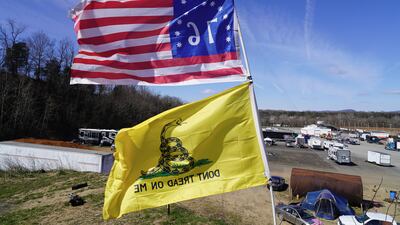
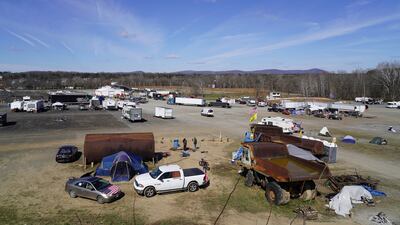
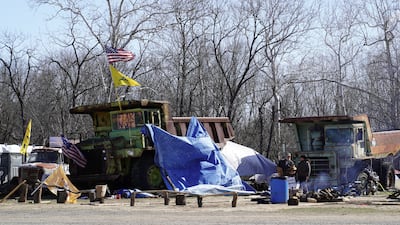
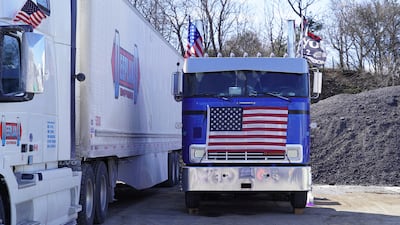
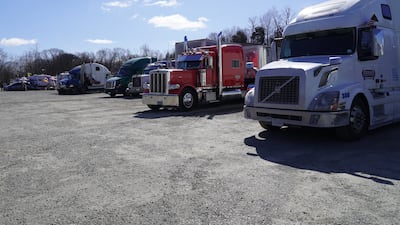
At the Hagerstown Speedway earlier this week, a few dozen big-rig lorries were scattered across the large parking lot. Tents and campsites like Mr Thomas’s filled the woods lining the property.
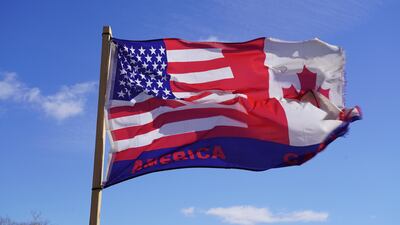
US and Canadian flags fluttered in the cold breeze and anti-government rhetoric was plastered on car windows and the doors of recreational vehicles.
Marek Niewiarowski, a lorry driver from Montreal, Canada, drove all the way down to lend his support.
“The same spirit from Ottawa has come over here with the people that are fighting for freedom,” Mr Niewiarowski said.
Still hurting from the government’s tough action against protesters in Ottawa, Mr Niewiarowski was hopeful that the Canadian movement would find a way to continue. “We have to regroup in Canada,” he told The National.
For weeks, the People’s Convoy has been circling Interstate 395, also known as the Beltway, causing traffic headaches in and around Washington.
But their tactics, while disruptive, have not accomplished any of their objectives, which include bringing an end to the national emergency declaration declared under former president Donald Trump and extended under President Joe Biden. The measure gives the federal government broad powers to deal with Covid-19.
Convoy leaders managed to secure a face-to-face meeting with Republican Senator Ted Cruz, but they have not made serious inroads into the capital.
Part of that is because the convoy’s permit to set up camp on the National Mall was rejected, but Sara Aniano, a graduate student at Monmouth University, whose research focuses on the far-right's use of social media, said it was also the result of bad planning.
“They didn't meet their goals, even though they keep saying that it was a huge success,” Ms Aniano told The National.
“It obviously wasn't. But I think without a leader with a clear plan, and without an actual goal and a deadline and a place to meet. I think people just got exhausted,”
After nearly a month of camping out in Hagerstown, most of the group decided to pack up and head west.
They were chased out by the cold and a calendar conflict with the Hagerstown Speedway, who had leased the group the land but needed it back by April 7 for a series of races in the following days.
“We’re not done here,” said organiser Mike Landis on a livestream on Sunday.
“We’ll go to California and raise awareness along the way and hopefully get more people like we did on our way here.”
The group plans to protest against 10 state bills that it believes “will change everything for people who want to live, work or learn in the state of CA while exercising their right to medical freedom”, according to a statement on the People’s Convoy website.
As the weeks dragged on and it became clear the movement wasn’t having its desired effect, the mood in the camp started to sour.
“The atmosphere at camp has been tumultuous,” Mr Thomas said. “Because we've had people that were bad actors trying to cause agitation and problems.”
That tension has manifested online, Ms Aniano said. “There's been more dissent among the streamers, even with each other,” she said.
But despite the division and the decision to leave the Washington area, Ms Aniano does not think this is the end of the People’s Convoy.
“They've been instructed by the so-called leaders of this convoy to work at a more state or even hyper local level to try and get their message across and their messages are rooted in far-right ideologies,” she said.

The Library: A Catalogue of Wonders
Stuart Kells, Counterpoint Press
Gothia Cup 2025
4,872 matches
1,942 teams
116 pitches
76 nations
26 UAE teams
15 Lebanese teams
2 Kuwaiti teams
more from Janine di Giovanni
READ MORE ABOUT CORONAVIRUS
Small%20Things%20Like%20These
%3Cp%3EDirector%3A%20Tim%20Mielants%3Cbr%3ECast%3A%20Cillian%20Murphy%2C%20Emily%20Watson%2C%20Eileen%20Walsh%3Cbr%3ERating%3A%204%2F5%3C%2Fp%3E%0A
Mercer, the investment consulting arm of US services company Marsh & McLennan, expects its wealth division to at least double its assets under management (AUM) in the Middle East as wealth in the region continues to grow despite economic headwinds, a company official said.
Mercer Wealth, which globally has $160 billion in AUM, plans to boost its AUM in the region to $2-$3bn in the next 2-3 years from the present $1bn, said Yasir AbuShaban, a Dubai-based principal with Mercer Wealth.
“Within the next two to three years, we are looking at reaching $2 to $3 billion as a conservative estimate and we do see an opportunity to do so,” said Mr AbuShaban.
Mercer does not directly make investments, but allocates clients’ money they have discretion to, to professional asset managers. They also provide advice to clients.
“We have buying power. We can negotiate on their (client’s) behalf with asset managers to provide them lower fees than they otherwise would have to get on their own,” he added.
Mercer Wealth’s clients include sovereign wealth funds, family offices, and insurance companies among others.
From its office in Dubai, Mercer also looks after Africa, India and Turkey, where they also see opportunity for growth.
Wealth creation in Middle East and Africa (MEA) grew 8.5 per cent to $8.1 trillion last year from $7.5tn in 2015, higher than last year’s global average of 6 per cent and the second-highest growth in a region after Asia-Pacific which grew 9.9 per cent, according to consultancy Boston Consulting Group (BCG). In the region, where wealth grew just 1.9 per cent in 2015 compared with 2014, a pickup in oil prices has helped in wealth generation.
BCG is forecasting MEA wealth will rise to $12tn by 2021, growing at an annual average of 8 per cent.
Drivers of wealth generation in the region will be split evenly between new wealth creation and growth of performance of existing assets, according to BCG.
Another general trend in the region is clients’ looking for a comprehensive approach to investing, according to Mr AbuShaban.
“Institutional investors or some of the families are seeing a slowdown in the available capital they have to invest and in that sense they are looking at optimizing the way they manage their portfolios and making sure they are not investing haphazardly and different parts of their investment are working together,” said Mr AbuShaban.
Some clients also have a higher appetite for risk, given the low interest-rate environment that does not provide enough yield for some institutional investors. These clients are keen to invest in illiquid assets, such as private equity and infrastructure.
“What we have seen is a desire for higher returns in what has been a low-return environment specifically in various fixed income or bonds,” he said.
“In this environment, we have seen a de facto increase in the risk that clients are taking in things like illiquid investments, private equity investments, infrastructure and private debt, those kind of investments were higher illiquidity results in incrementally higher returns.”
The Abu Dhabi Investment Authority, one of the largest sovereign wealth funds, said in its 2016 report that has gradually increased its exposure in direct private equity and private credit transactions, mainly in Asian markets and especially in China and India. The authority’s private equity department focused on structured equities owing to “their defensive characteristics.”
The%20specs%20
%3Cp%3E%3Cstrong%3EEngine%3A%20%3C%2Fstrong%3E2.0-litre%204cyl%20turbo%0D%3Cbr%3E%3Cstrong%3EPower%3A%20%3C%2Fstrong%3E261hp%20at%205%2C500rpm%0D%3Cbr%3E%3Cstrong%3ETorque%3A%20%3C%2Fstrong%3E400Nm%20at%201%2C750-4%2C000rpm%0D%3Cbr%3E%3Cstrong%3ETransmission%3A%20%3C%2Fstrong%3E7-speed%20dual-clutch%20auto%0D%3Cbr%3E%3Cstrong%3EFuel%20consumption%3A%20%3C%2Fstrong%3E10.5L%2F100km%0D%3Cbr%3E%3Cstrong%3EOn%20sale%3A%20%3C%2Fstrong%3ENow%0D%3Cbr%3E%3Cstrong%3EPrice%3A%20%3C%2Fstrong%3EFrom%20Dh129%2C999%20(VX%20Luxury)%3B%20from%20Dh149%2C999%20(VX%20Black%20Gold)%3C%2Fp%3E%0A
HIJRA
Starring: Lamar Faden, Khairiah Nathmy, Nawaf Al-Dhufairy
Director: Shahad Ameen
Rating: 3/5
Results:
5pm: Maiden (PA) | Dh80,000 | 1,200 metres
Winner: Jabalini, Szczepan Mazur (jockey), Younis Kalbani (trainer)
5.30pm: UAE Arabian Derby (PA) | Prestige | Dh150,000 | 2,200m
Winner: Octave, Gerald Avranche, Abdallah Al Hammadi
6pm: Arabian Triple Crown Round 3 (PA) | Group 3 Dh300,000 | 2,200m
Winner: Harrab, Richard Mullen, Mohamed Ali
6.30pm: Emirates Championship (PA) | Group 1 | Dh1million | 2,200m
Winner: BF Mughader, Szczepan Mazur, Younis Al Kalbani
7pm: Abu Dhabi Championship (TB) | Group 3 | Dh380,000 | 2,200m
Winner: GM Hopkins, Patrick Cosgrave, Jaber Ramadhan
7.30pm: Wathba Stallions Cup (PA) | Conditions | Dh70,000 | 1,600m
Winner: AF La’Asae, Tadhg O’Shea, Ernst Oertel
More from Rashmee Roshan Lall
A cryptocurrency primer for beginners
Cryptocurrency Investing for Dummies – by Kiana Danial
There are several primers for investing in cryptocurrencies available online, including e-books written by people whose credentials fall apart on the second page of your preferred search engine.
Ms Danial is a finance coach and former currency analyst who writes for Nasdaq. Her broad-strokes primer (2019) breaks down investing in cryptocurrency into baby steps, while explaining the terms and technologies involved.
Although cryptocurrencies are a fast evolving world, this book offers a good insight into the game as well as providing some basic tips, strategies and warning signs.
Begin your cryptocurrency journey here.
Available at Magrudy’s , Dh104
Tewellah by Nawal Zoghbi is out now.
What vitamins do we know are beneficial for living in the UAE
Vitamin D: Highly relevant in the UAE due to limited sun exposure; supports bone health, immunity and mood.
Vitamin B12: Important for nerve health and energy production, especially for vegetarians, vegans and individuals with absorption issues.
Iron: Useful only when deficiency or anaemia is confirmed; helps reduce fatigue and support immunity.
Omega-3 (EPA/DHA): Supports heart health and reduces inflammation, especially for those who consume little fish.
What can victims do?
Always use only regulated platforms
Stop all transactions and communication on suspicion
Save all evidence (screenshots, chat logs, transaction IDs)
Report to local authorities
Warn others to prevent further harm
Courtesy: Crystal Intelligence
%3Cp%3E%3Cstrong%3EDirector%3A%3C%2Fstrong%3E%20Nag%20Ashwin%3C%2Fp%3E%0A%3Cp%3E%3Cstrong%3EStarring%3A%20%3C%2Fstrong%3EPrabhas%2C%20Saswata%20Chatterjee%2C%20Deepika%20Padukone%2C%20Amitabh%20Bachchan%2C%20Shobhana%3C%2Fp%3E%0A%3Cp%3E%3Cstrong%3ERating%3A%20%3C%2Fstrong%3E%E2%98%85%E2%98%85%E2%98%85%E2%98%85%3C%2Fp%3E%0A
Abu Dhabi traffic facts
Drivers in Abu Dhabi spend 10 per cent longer in congested conditions than they would on a free-flowing road
The highest volume of traffic on the roads is found between 7am and 8am on a Sunday.
Travelling before 7am on a Sunday could save up to four hours per year on a 30-minute commute.
The day was the least congestion in Abu Dhabi in 2019 was Tuesday, August 13.
The highest levels of traffic were found on Sunday, November 10.
Drivers in Abu Dhabi lost 41 hours spent in traffic jams in rush hour during 2019