


The war in Afghanistan is over. The world lost a great deal to get to this point, and Afghans lost even more.
There is much to be desired in the country’s current state of affairs. Even so, the violence committed against Afghans by the Taliban today, as condemnable as it is, pales in comparison to the hundreds dying daily to the two-decade-long war. The conclusion of the war was not the one so many Afghans envisioned. Though most of them stood for a reconciliation process that integrated the Taliban into the democratic political system, the end result was a total victory for the group. This was in part because of the failures of Afghanistan’s republic and those of US policy, but also the understandable fatigue of the larger population.
And yet, visible tension between the Taliban and its dissidents continues, owing to the vastly different visions they had – and still have – for Afghanistan. They are different on nearly every level, from the traditionalist and autocratic views the Taliban hold to the extent of the state’s intrusion into the private sphere, not to mention the role of women in society, pluralism, dissent and freedom of speech. The non-Taliban urban elite of Afghanistan are forced to live in a new reality. Faced with such challenges, the dissidents have to choose their path between nonviolent action or armed conflict.
But the war is over, and it must stay so. The objective reality is that Afghans are already suffering enough, with sanctions against the de-facto government pushing the economy into a freefall. With that in mind, it is worth asking what kind of resistance and reform remains possible – which methods will actually work to create a better future. Which path stands up to the burden of proof?
An anti-Taliban resistance led by Ahmed Shah Massoud kept the Taliban from controlling all of Afghanistan in the 1990s. In the Taliban’s second coming last year, Massoud’s followers, led by his son, made their last stand in Panjshir province. A month after the fall of Kabul, they were defeated. While the attention paid to them in western capitals has died down, they and their followers, at home and abroad, continue to advocate for armed resistance loudly.
-
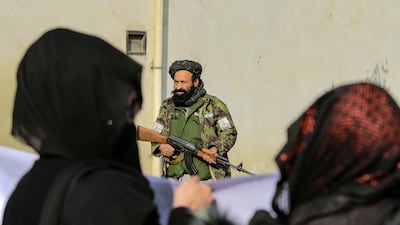
Taliban soldiers stand guard as women carry placards during a rally in Kabul, Afghanistan. All photos: EPA -
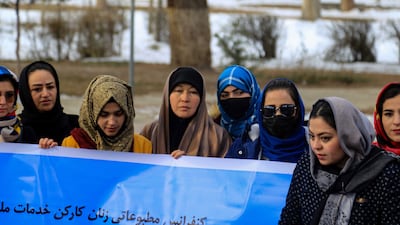
Afghan women activists demand food, jobs and education for girls during a protest in Kabul. -
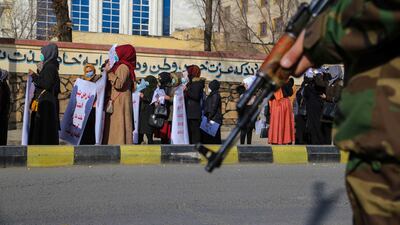
Afghan women demonstrate during a rally in Kabul, Afghanistan. -

The Taliban have banned women from work and girls from secondary schools. EPA -
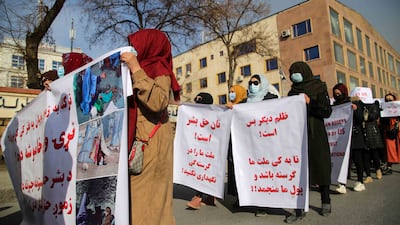
Women carry placards during a rally in Kabul. -
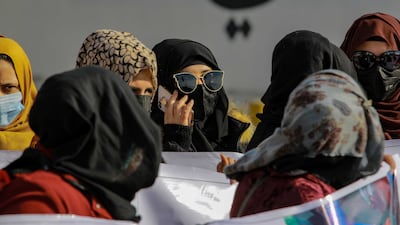
Afghan women have intensified their anti-Taliban protests despite the group's harsh crackdown on demonstrations. -
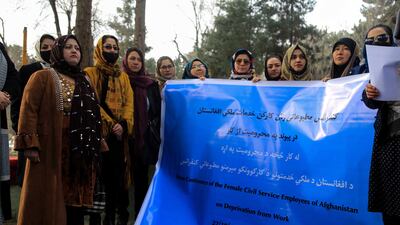
In the last three months of their rule, the Taliban have suppressed several women's protests in Kabul and other Afghan provinces. -
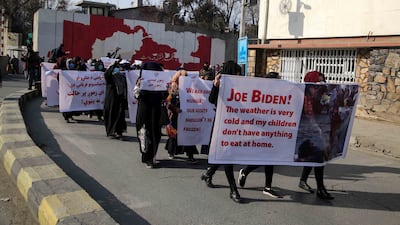
The Taliban have used violence against protesters, including using pepper spray.


But there is another group – one that stands by nonviolent political action and refuses to endorse further violence given everything Afghans have had to endure. Calling for armed resistance would escalate the levels of suffering faced by the population. Any effort to restart the war would have to justify not only the reintroduction of greater suffering, but the uncertainty that would ensue. Most movements that have aspired to change any given regime in Afghanistan and then transform society have focused more on the first part and had few ideas when they arrived at the second. It is worth remembering that many of those calling for disposing the Taliban militarily held major roles in the 20-year republic, and would have to prove how the same failures would not be repeated again.
There has, of course, never been a successful nonviolent resistance to power in Afghanistan. This might be why those unfamiliar with such a method dismiss it as passive and submissive. But other countries that have wielded nonviolent resistance successfully know how courageous it is, because it is genuinely difficult to resist the urge to imitate the tyranny it opposes. It requires a great deal of self-sacrifice – as opposed to a reliance on sacrificing the lives of others – in the short term to achieve long-term change. Much of the world has also seen how achievable that long-term change can be, through nonviolent methods.
The American political scientist Gene Sharp, one of the world’s preeminent experts on nonviolent action, compiled a list of 198 methods to bring about change without war. There is space within Afghan society for much of this – for resistance to the Taliban, in spite of the group’s intolerance for dissent, without picking up arms and reigniting years of bloodshed. At their core, true nonviolent movements attempt to challenge the structural violence that keeps certain strata of society locked out of the system and its benefits. Those who would propose alternative visions for Afghanistan can, if it is within their means to do so, provide essential services the Taliban is incapable of providing. They could also create local programmes within rural areas to encourage development and political participation. Such actions would make these individuals and groups indispensable. They can, without having to sacrifice their core principles, push the Taliban to engage in dialogue with them.

The Taliban has also used social media to great effect – and implicit within that is the group’s acceptance that others can and will do the same. Dissent on media platforms, including social media, will create the impetus for larger public discourse.
The litmus test for any path forward – Taliban or non-Taliban, violent or not – will be who can manage to transform the lives of the common Afghan politically and personally. Importantly, it will also depend on how much any effort comes from within the country. Foreign imposed and funded solutions would always be short-lived in Afghanistan.
Any desire to continue fighting – physically as well as mentally – is understandable, for Afghans as well as their allies abroad. The core motivations driving that desire should, however, be harnessed towards a path that truly diminishes suffering. At the same time, it is possible for those who advocate for armed resistance to respect and understand those who do not. Right now, there is a dangerous tendency in Afghanistan’s political discourse for anyone advocating nonviolence to be labelled an ethnic partisan or Taliban sympathiser. This creates the risk of a dangerous cycle of polarisation.
But ultimately, neither path will succeed if it cannot mobilise the larger population. History does not lie. Globally, the past 120 years have proven nonviolent movements to be twice as successful and their effects much longer-lasting than violent ones. Afghanistan has tried and tested the path of violence for over four decades. Maybe it really is time to try things differently.

