


Live updates: SpaceX Crew-6 land safely on Earth
UAE astronaut Sultan Al Neyadi will take part in a special recovery programme to help his body readapt to gravity after spending six months aboard the International Space Station.
Dr Al Neyadi, 42, and his three colleagues landed back on Earth on Monday morning, with a splashdown off the coast of Florida.
Astronauts experience several side effects from the environment of space, particularly on extended missions.
Hanan Al Suwaidi, an Emirati physician who looks after Dr Al Neyadi's health, said that the astronaut will undergo the same recovery programme in Houston, Texas, that all Nasa astronauts go through after long-duration missions.
“Overall, Sultan's health has been maintained through the prescribed protocols in terms of an exercise regimen and nutritional requirements during his mission in the past six months,” Dr Al Suwaidi said during a virtual media briefing on Sunday.
“He was maintaining this very well and we had no concerns during the whole mission.
“When the crew will come back they will have known few symptoms like some nausea, some challenges in adapting to gravity, but this is usually overcome quickly in the first few hours.”
Astronauts in space are required to exercise for at least two hours a day to ensure their bones and muscles stay strong.
Their bones and muscles can grow weaker over time if they do not get the necessary amount of exercise, resulting in loss of muscle mass, which makes it difficult to readapt to gravity once back on Earth.
Salem Al Marri, director general of the Mohammed bin Rashid Space Centre, which oversees the UAE's astronaut programme, said that the recovery plan will help Dr Al Neyadi get used to gravity again.
“He'll go through physiotherapy and rehabilitation,” he said.
“They're trying to make sure that he can walk easily and get his vestibular system back into working condition so that you have all that balance.
“There's a lot of resistance training to make sure all the muscles are working well. There's a lot of stretching involved.”
Dr Al Neyadi also experienced some temporary side effects of microgravity when he was aboard the station, including a phenomenon called “Moon face”.
This is caused by a shift in body fluids, leading to facial swelling.
But astronauts who have stayed longer in space have faced more permanent side effects.
Nasa astronaut Scott Kelly spent a total of 520 days on the ISS, with a consecutive 340 days in 2015 and 2016.
His health was compared with that of his twin brother on Earth.
It was found that Mr Kelly's eyesight, height and overall health had been dramatically affected by zero gravity.
His heart had shrunk by 25 per cent, and after one year aboard the ISS, Nasa researchers found he had grown five centimetres and was taller than his identical twin brother Mark, who is also an astronaut.
Mr Al Marri said Dr Al Neyadi will return to the UAE soon to take part in celebrations being held in his honour.
He will then return to the US for a longer stay with more mission debriefing, including finishing the experiments he took part in while in space.
Sultan Al Neyadi in space – in pictures
-
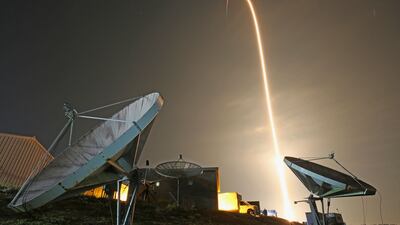
Lift-off from Nasa's Kennedy Space Centre in Cape Canaveral, Florida, early on March 2, 2023. AFP -
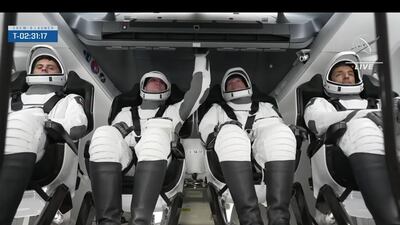
The crew-6 board the Dragon spacecraft to take them to the International Space Station. Photo: Nasa screengrab -
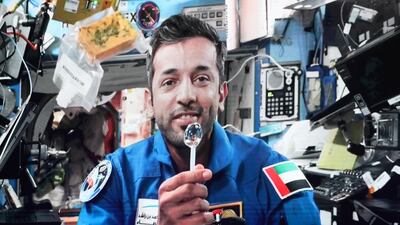
Sultan Al Neyadi's first A Call with Space video chat with the public, held at Dubai Opera on March 21. Pawan Singh / The National -
Dr Al Neyadi captured an image of his hometown of Umm Ghafa in Al Ain on April 12. Photo: Sultan Al Neyadi / X -
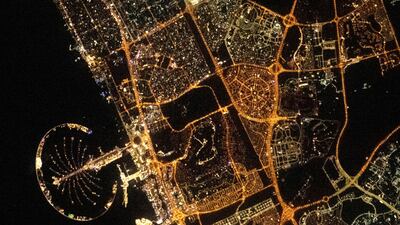
This photo from space shows The Palm Jumeirah, Jebel Ali Industrial area and residential areas in Dubai. Photo: Sultan Al Neyadi / X -
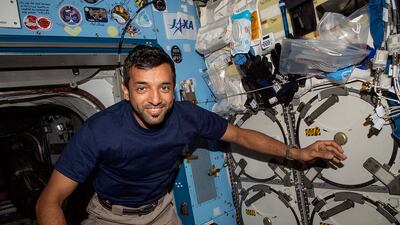
Dr Al Neyadi on March 4, a day after arriving on the ISS. Photo: MBRSC -
Dr Al Neyadi takes a selfie from inside the ISS. Photo: Sultan Al Neyadi / X -

The eye of Cyclone Biparjoy in footage captured by the UAE astronaut on June 13. Photo: Sultan Al Neyadi -

Holding small tomatoes grown on the ISS. Photo: Nasa -
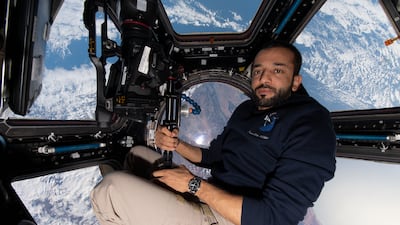
Dr Al Neyadi in front of the ISS cupola on March 14. Photo: Nasa -
The astronaut captured a massive sandstorm sweeping across the Sahara on March 30. Photo: Sultan Al Neyadi -
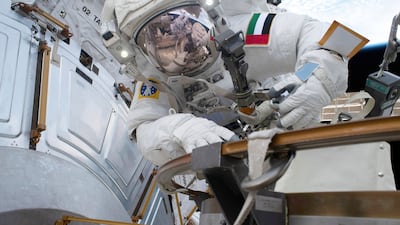
On April 28 he became the first Arab to perform a spacewalk. Photo: Sultan Al Neyadi / X -
He captured a stunning image of the Eye of Sahara - a geological structure made up of ancient rocks - from the ISS on May 4. Sultan Al Neyadi / X -
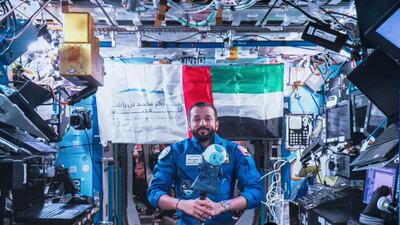
Speaking to students at UAE University in Al Ain on a live call from the ISS on May 23. Ryan Lim / The National -
An image of the UAE and Oman taken by the Emirati astronaut on May 24. Photo: Sultan Al Neyadi / X -

Sultan Al Neyadi called Sheikh Mohammed bin Rashid, Vice President and Ruler of Dubai, from the ISS on July 3. Photo: Dubai Media Office



