Public transport use will only grow as the Dubai population increases. Pawan Singh / The National

Alibaba and RTA team up to monitor Dubai public transport


Nick Webster
  • English
  • Arabic

A new partnership with Chinese retail company Alibaba will help the Roads and Transport Authority to monitor passenger movements and improve public transport systems.

The authority will use the online shopping company’s artificial intelligence platform to help develop Dubai’s expanding public transport system.

An agreement was signed at the Dubai World Congress for Self Driving Transport on Wednesday.

Data collection will begin with bus users and then be extended to include taxis and "last-mile" mobility solutions such as e-scooters and bikes.

We want to capture as much data from people and passenger movements to help us plan and respond to the needs of commuters in the city
Ahmed Bahrozyan,
executive at Dubai's Roads and Transport Authority

“Alibaba already has a sophisticated platform specifically for mobility and transport,” said Ahmed Bahrozyan, head of the public transport agency at the authority.

“We want to capture as much data from people and passenger movements to help us plan and respond to the needs of commuters in the city. It is very promising technology.”

Data collection and Alibaba’s AI software will tell the authority where people need stations and bus stops by monitoring the flow of passengers.

The deal came after Dubai put in motion its 2040 Urban Plan, which predicts that the population will rise from 3.3 million to 5.8 million in 20 years.

Driverless cars allowed on Dubai roads by 2023

An agreement was also signed with logistics services company Evocargo to aid distribution within specified areas.

Although Evocargo's driverless delivery vehicles are not designed for open roads, they can be used at airports, manufacturing sites and ports.

It is the latest step in Dubai to increase the use of self-driving transport, with 25 per cent of all journeys expected to be self-driving by 2030.

  • The Mercedes Vision AVTR car.
    The Mercedes Vision AVTR car.
  • The Mercedes Vision AVTR car on display at Etisalat's stand on the second day of Gitex.
    The Mercedes Vision AVTR car on display at Etisalat's stand on the second day of Gitex.
  • Visitors at the Huawei stand on the second day of Gitex at Dubai's World Trade Centre. All photos: Leslie Pableo / The National
    Visitors at the Huawei stand on the second day of Gitex at Dubai's World Trade Centre. All photos: Leslie Pableo / The National
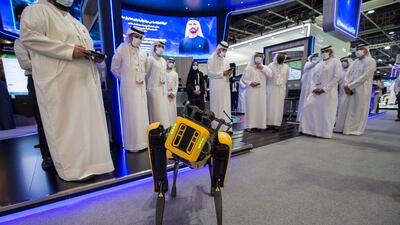
  • A four-legged robot at a Dubai Government stand on the second day of Gitex.
    A four-legged robot at a Dubai Government stand on the second day of Gitex.
  • The Dell Technology stand at Gitex.
    The Dell Technology stand at Gitex.
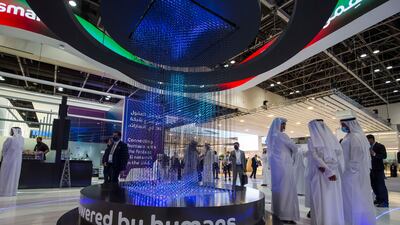
  • A light and laser display on the second day of Gitex.
    A light and laser display on the second day of Gitex.
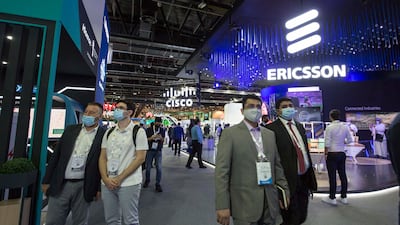
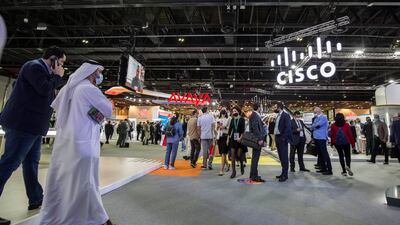
  • Gitex was busy with visitors and delegates on the second day.
    Gitex was busy with visitors and delegates on the second day.
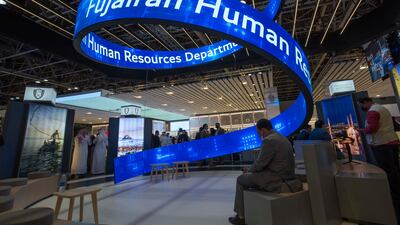
  • Fujairah's stand at Gitex Technology, on day two.
    Fujairah's stand at Gitex Technology, on day two.
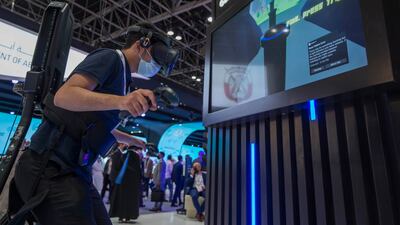
  • A man using an AR headset at the Du stand on the second day of Gitex.
    A man using an AR headset at the Du stand on the second day of Gitex.
  • Visitors explore the tech stands in the Dubai World Trade Centre.
    Visitors explore the tech stands in the Dubai World Trade Centre.
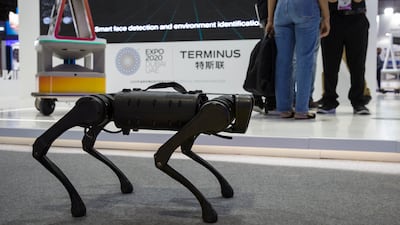
  • A four-legged robot at the Terminus stand on the second day of Gitex.
    A four-legged robot at the Terminus stand on the second day of Gitex.
  • Mercedes' futuristic car on the Etisalat stand.
    Mercedes' futuristic car on the Etisalat stand.
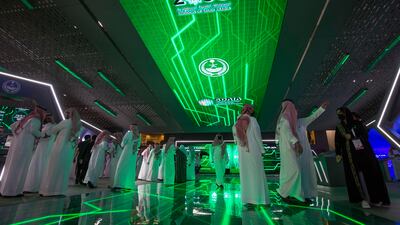
  • Saudi Arabia's stand.
    Saudi Arabia's stand.

In April, the authority signed an agreement with US company Cruise to introduce self-driving taxis in Dubai by 2023.

Cruise Origin taxis operate without a driver and they don't have a steering wheel. The 15-year agreement will start small before being expanded to eventually include thousands of taxis in Dubai.

“As a government, we must issue regulations that allow these vehicles to be used,” said Mr Bahrozyan.

“By 2023 these vehicles will be allowed to operate on the street. We can develop these regulations relatively quickly, it is why these companies want to work with us.

“We can already conduct full trials on roads; the next step is for actual commercial operations and we are at quite an advanced stage with all the authorities. I expect it to be in place by next year.”

China and Russia win self-driving delivery competition

During the conference, Chinese company Neolix and Yandex from Russia were declared joint winners of a year-long competition to design delivery robots for use in the city.

The competition, which was backed by the authority, called on private enterprises and universities to develop autonomous logistics solutions.

Entries were tested at Dubai Silicon Oasis under different weather to assess how they navigate obstacles and road obstructions.

The Neolix bot is a vending machine on wheels that can also deliver goods. It won the industry pioneers category.

Neolix machines are already widely used in Beijing and Shanghai, but the first driverless delivery vehicles are now being used by Noon in the Dubai Mall Fountains area.

Another vehicle will be used at the Rochester Institute of Technology in Dubai from January.

“Neolix has three functions – retail as is being done by Noon, as a food delivery bot as it can heat and cool food and also for security patrols,” said Jason Wang, Neolix's country manager.

The Neolix delivery bot at the Roads and Transport Authority stand at Gitex. Photo: Dubai World Trade Centre

“They have been very successful in China. The car is surrounded by sensors and has an auto-braking system.

“It takes about three to four hours for a full charge and it can operated for up to 10 hours.

“It has a maximum speed of 55 kilometres per hour but it is limited to around 20kph, and it can travel as far as 150km.”

Dubai’s autonomous strategy aims to slash transport costs by Dh900 million a year and save Dh1.5 billion annually by reducing environmental pollution by 12 per cent.

Speaking at the event, Sebastian Thrun, Stanford University professor, founder of Google X and chief executive of drone delivery company Kittyhawk, said Dubai was leading the way in autonomous transport.

“It is exciting to see the RTA in Dubai open the regulatory pathways to adopt this technology for the benefit of people,” he said.

“Traffic is a journey and it evolves through technologists and regulators. There is nothing more important to a growing an economy than transport.”


Why your domicile status is important

Your UK residence status is assessed using the statutory residence test. While your residence status – ie where you live - is assessed every year, your domicile status is assessed over your lifetime.

Your domicile of origin generally comes from your parents and if your parents were not married, then it is decided by your father. Your domicile is generally the country your father considered his permanent home when you were born. 

UK residents who have their permanent home ("domicile") outside the UK may not have to pay UK tax on foreign income. For example, they do not pay tax on foreign income or gains if they are less than £2,000 in the tax year and do not transfer that gain to a UK bank account.

A UK-domiciled person, however, is liable for UK tax on their worldwide income and gains when they are resident in the UK.

Tamkeen's offering
  • Option 1: 70% in year 1, 50% in year 2, 30% in year 3
  • Option 2: 50% across three years
  • Option 3: 30% across five years 
Groom and Two Brides

Director: Elie Semaan

Starring: Abdullah Boushehri, Laila Abdallah, Lulwa Almulla

Rating: 3/5

PROFILE OF HALAN

Started: November 2017

Founders: Mounir Nakhla, Ahmed Mohsen and Mohamed Aboulnaga

Based: Cairo, Egypt

Sector: transport and logistics

Size: 150 employees

Investment: approximately $8 million

Investors include: Singapore’s Battery Road Digital Holdings, Egypt’s Algebra Ventures, Uber co-founder and former CTO Oscar Salazar

Ten tax points to be aware of in 2026

1. Domestic VAT refund amendments: request your refund within five years

If a business does not apply for the refund on time, they lose their credit.

2. E-invoicing in the UAE

Businesses should continue preparing for the implementation of e-invoicing in the UAE, with 2026 a preparation and transition period ahead of phased mandatory adoption. 

3. More tax audits

Tax authorities are increasingly using data already available across multiple filings to identify audit risks. 

4. More beneficial VAT and excise tax penalty regime

Tax disputes are expected to become more frequent and more structured, with clearer administrative objection and appeal processes. The UAE has adopted a new penalty regime for VAT and excise disputes, which now mirrors the penalty regime for corporate tax.

5. Greater emphasis on statutory audit

There is a greater need for the accuracy of financial statements. The International Financial Reporting Standards standards need to be strictly adhered to and, as a result, the quality of the audits will need to increase.

6. Further transfer pricing enforcement

Transfer pricing enforcement, which refers to the practice of establishing prices for internal transactions between related entities, is expected to broaden in scope. The UAE will shortly open the possibility to negotiate advance pricing agreements, or essentially rulings for transfer pricing purposes. 

7. Limited time periods for audits

Recent amendments also introduce a default five-year limitation period for tax audits and assessments, subject to specific statutory exceptions. While the standard audit and assessment period is five years, this may be extended to up to 15 years in cases involving fraud or tax evasion. 

8. Pillar 2 implementation 

Many multinational groups will begin to feel the practical effect of the Domestic Minimum Top-Up Tax (DMTT), the UAE's implementation of the OECD’s global minimum tax under Pillar 2. While the rules apply for financial years starting on or after January 1, 2025, it is 2026 that marks the transition to an operational phase.

9. Reduced compliance obligations for imported goods and services

Businesses that apply the reverse-charge mechanism for VAT purposes in the UAE may benefit from reduced compliance obligations. 

10. Substance and CbC reporting focus

Tax authorities are expected to continue strengthening the enforcement of economic substance and Country-by-Country (CbC) reporting frameworks. In the UAE, these regimes are increasingly being used as risk-assessment tools, providing tax authorities with a comprehensive view of multinational groups’ global footprints and enabling them to assess whether profits are aligned with real economic activity. 

Contributed by Thomas Vanhee and Hend Rashwan, Aurifer

Company%20profile
%3Cp%3E%3Cstrong%3ECompany%20name%3A%20%3C%2Fstrong%3EHakbah%0D%3Cbr%3E%3Cstrong%3EStarted%3A%20%3C%2Fstrong%3E2018%0D%3Cbr%3E%3Cstrong%3EFounder%3A%20%3C%2Fstrong%3ENaif%20AbuSaida%0D%3Cbr%3E%3Cstrong%3EBased%3A%20%3C%2Fstrong%3ESaudi%20Arabia%0D%3Cbr%3E%3Cstrong%3ESector%3A%20%3C%2Fstrong%3EFinTech%0D%3Cbr%3E%3Cstrong%3ECurrent%20number%20of%20staff%3A%20%3C%2Fstrong%3E22%20%0D%3Cbr%3E%3Cstrong%3EInitial%20investment%3A%20%3C%2Fstrong%3E%24200%2C000%0D%3Cbr%3E%3Cstrong%3EInvestment%20stage%3A%20%3C%2Fstrong%3Epre-Series%20A%0D%3Cbr%3E%3Cstrong%3EInvestors%3A%20%3C%2Fstrong%3EGlobal%20Ventures%20and%20Aditum%20Investment%20Management%0D%3Cbr%3E%3Cbr%3E%3C%2Fp%3E%0A
Polarised public

31% in UK say BBC is biased to left-wing views

19% in UK say BBC is biased to right-wing views

19% in UK say BBC is not biased at all

Source: YouGov

Company%C2%A0profile
%3Cp%3E%3Cstrong%3ECompany%20name%3A%20%3C%2Fstrong%3ELeap%0D%3Cbr%3E%3Cstrong%3EStarted%3A%20%3C%2Fstrong%3EMarch%202021%0D%3Cbr%3E%3Cstrong%3EFounders%3A%3C%2Fstrong%3E%20Ziad%20Toqan%20and%20Jamil%20Khammu%0D%3Cbr%3E%3Cstrong%3EBased%3A%3C%2Fstrong%3E%20Dubai%0D%3Cbr%3E%3Cstrong%3ESector%3A%20%3C%2Fstrong%3EFinTech%0D%3Cbr%3E%3Cstrong%3EInvestment%20stage%3A%20%3C%2Fstrong%3EPre-seed%0D%3Cbr%3E%3Cstrong%3EFunds%20raised%3A%3C%2Fstrong%3E%20Undisclosed%0D%3Cbr%3E%3Cstrong%3ECurrent%20number%20of%20staff%3A%20%3C%2Fstrong%3ESeven%3C%2Fp%3E%0A

Founders: Ines Mena, Claudia Ribas, Simona Agolini, Nourhan Hassan and Therese Hundt

Date started: January 2017, app launched November 2017

Based: Dubai, UAE

Sector: Private/Retail/Leisure

Number of Employees: 18 employees, including full-time and flexible workers

Funding stage and size: Seed round completed Q4 2019 - $1m raised

Funders: Oman Technology Fund, 500 Startups, Vision Ventures, Seedstars, Mindshift Capital, Delta Partners Ventures, with support from the OQAL Angel Investor Network and UAE Business Angels

Mercer, the investment consulting arm of US services company Marsh & McLennan, expects its wealth division to at least double its assets under management (AUM) in the Middle East as wealth in the region continues to grow despite economic headwinds, a company official said.

Mercer Wealth, which globally has $160 billion in AUM, plans to boost its AUM in the region to $2-$3bn in the next 2-3 years from the present $1bn, said Yasir AbuShaban, a Dubai-based principal with Mercer Wealth.

Within the next two to three years, we are looking at reaching $2 to $3 billion as a conservative estimate and we do see an opportunity to do so,” said Mr AbuShaban.

Mercer does not directly make investments, but allocates clients’ money they have discretion to, to professional asset managers. They also provide advice to clients.

“We have buying power. We can negotiate on their (client’s) behalf with asset managers to provide them lower fees than they otherwise would have to get on their own,” he added.

Mercer Wealth’s clients include sovereign wealth funds, family offices, and insurance companies among others.

From its office in Dubai, Mercer also looks after Africa, India and Turkey, where they also see opportunity for growth.

Wealth creation in Middle East and Africa (MEA) grew 8.5 per cent to $8.1 trillion last year from $7.5tn in 2015, higher than last year’s global average of 6 per cent and the second-highest growth in a region after Asia-Pacific which grew 9.9 per cent, according to consultancy Boston Consulting Group (BCG). In the region, where wealth grew just 1.9 per cent in 2015 compared with 2014, a pickup in oil prices has helped in wealth generation.

BCG is forecasting MEA wealth will rise to $12tn by 2021, growing at an annual average of 8 per cent.

Drivers of wealth generation in the region will be split evenly between new wealth creation and growth of performance of existing assets, according to BCG.

Another general trend in the region is clients’ looking for a comprehensive approach to investing, according to Mr AbuShaban.

“Institutional investors or some of the families are seeing a slowdown in the available capital they have to invest and in that sense they are looking at optimizing the way they manage their portfolios and making sure they are not investing haphazardly and different parts of their investment are working together,” said Mr AbuShaban.

Some clients also have a higher appetite for risk, given the low interest-rate environment that does not provide enough yield for some institutional investors. These clients are keen to invest in illiquid assets, such as private equity and infrastructure.

“What we have seen is a desire for higher returns in what has been a low-return environment specifically in various fixed income or bonds,” he said.

“In this environment, we have seen a de facto increase in the risk that clients are taking in things like illiquid investments, private equity investments, infrastructure and private debt, those kind of investments were higher illiquidity results in incrementally higher returns.”

The Abu Dhabi Investment Authority, one of the largest sovereign wealth funds, said in its 2016 report that has gradually increased its exposure in direct private equity and private credit transactions, mainly in Asian markets and especially in China and India. The authority’s private equity department focused on structured equities owing to “their defensive characteristics.”

The rules on fostering in the UAE

A foster couple or family must:

  • be Muslim, Emirati and be residing in the UAE
  • not be younger than 25 years old
  • not have been convicted of offences or crimes involving moral turpitude
  • be free of infectious diseases or psychological and mental disorders
  • have the ability to support its members and the foster child financially
  • undertake to treat and raise the child in a proper manner and take care of his or her health and well-being
  • A single, divorced or widowed Muslim Emirati female, residing in the UAE may apply to foster a child if she is at least 30 years old and able to support the child financially
The years Ramadan fell in May

1987

1954

1921

1888

The%C2%A0specs%20
%3Cp%3E%3Cstrong%3EEngine%3A%20%3C%2Fstrong%3Etwo%20permanent%20magnet%20synchronous%20motors%3Cbr%3E%3Cstrong%3ETransmission%3A%20%3C%2Fstrong%3Etwo-speed%3Cbr%3E%3Cstrong%3EPower%3A%20%3C%2Fstrong%3E625hp%3Cbr%3E%3Cstrong%3ETorque%3A%20%3C%2Fstrong%3E850Nm%3Cbr%3E%3Cstrong%3ERange%3A%20%3C%2Fstrong%3E456km%3Cbr%3E%3Cstrong%3EPrice%3A%20%3C%2Fstrong%3Efrom%20Dh737%2C480%3Cbr%3E%3Cstrong%3EOn%20sale%3A%20%3C%2Fstrong%3Enow%3C%2Fp%3E%0A
The National Archives, Abu Dhabi

Founded over 50 years ago, the National Archives collects valuable historical material relating to the UAE, and is the oldest and richest archive relating to the Arabian Gulf.

Much of the material can be viewed on line at the Arabian Gulf Digital Archive - https://www.agda.ae/en

The%20Roundup%20%3A%20No%20Way%20Out
%3Cp%3E%3Cstrong%3EDirector%3A%3C%2Fstrong%3E%20Lee%20Sang-yong%3Cbr%3E%3Cstrong%3EStars%3A%3C%2Fstrong%3E%20Don%20Lee%2C%20Lee%20Jun-hyuk%2C%20Munetaka%20Aoki%3Cbr%3E%3Cstrong%3ERating%3A%20%3C%2Fstrong%3E3%2F5%3Cbr%3E%3Cbr%3E%3C%2Fp%3E%0A
COMPANY PROFILE

Company name: SimpliFi

Started: August 2021

Founder: Ali Sattar

Based: UAE

Industry: Finance, technology

Investors: 4DX, Rally Cap, Raed, Global Founders, Sukna and individuals

Gran Gala del Calcio 2019 winners

Best Player: Cristiano Ronaldo (Juventus)
Best Coach: Gian Piero Gasperini (Atalanta)
Best Referee: Gianluca Rocchi
Best Goal: Fabio Quagliarella (Sampdoria vs Napoli)
Best Team: Atalanta​​​​​​​
Best XI: Samir Handanovic (Inter); Aleksandar Kolarov (Roma), Giorgio Chiellini (Juventus), Kalidou Koulibaly (Napoli), Joao Cancelo (Juventus*); Miralem Pjanic (Juventus), Josip Ilicic (Atalanta), Nicolo Barella (Cagliari*); Fabio Quagliarella (Sampdoria), Cristiano Ronaldo (Juventus), Duvan Zapata (Atalanta)
Serie B Best Young Player: Sandro Tonali (Brescia)
Best Women’s Goal: Thaisa (Milan vs Juventus)
Best Women’s Player: Manuela Giugliano (Milan)
Best Women’s XI: Laura Giuliani (Milan); Alia Guagni (Fiorentina), Sara Gama (Juventus), Cecilia Salvai (Juventus), Elisa Bartoli (Roma); Aurora Galli (Juventus), Manuela Giugliano (Roma), Valentina Cernoia (Juventus); Valentina Giacinti (Milan), Ilaria Mauro (Fiorentina), Barbara Bonansea (Juventus)

Guardians%20of%20the%20Galaxy%20Vol%203
%3Cp%3E%3Cstrong%3EDirector%3A%20%3C%2Fstrong%3EJames%20Gunn%3C%2Fp%3E%0A%3Cp%3E%3Cstrong%3EStars%3A%3C%2Fstrong%3E%20Chris%20Pratt%2C%20Zoe%20Saldana%2C%20Dave%20Bautista%2C%20Vin%20Diesel%2C%20Bradley%20Cooper%3C%2Fp%3E%0A%3Cp%3E%3Cstrong%3ERating%3A%3C%2Fstrong%3E%204%2F5%3C%2Fp%3E%0A
Updated: October 28, 2021, 4:06 AM