

A senior Facebook official warned people to think long and hard about what they post and share online.
Fares Akkad, director of regional media partnership growth markets news for Facebook, said individuals should be wary of sharing something online that does not come from a reliable source.
People should research correctly and find the truth before they share it with their friends and followers, he said.
“If you share a hoax on your page this is a direct reflection on you,” Mr Akkad said.
“It is up to us to provide the tools you can reference to educate yourself on where the information is coming from and if it is correct.
“But it’s also on you to make the decision to think before you share and decide what you want to put out there.”
Misinformation and fake news, including content shared through social media, increased during the Covid-19 pandemic.
Mr Akkad said video consumption went up by 50 per cent since the outbreak began and messages shared online more than doubled.
Facebook took down 40 million posts for sharing misinformation and fake news in March, when the coronavirus started spreading.
He said the company was investing in resources to control the spread of false information since the pandemic began.
“We recognise the responsibility that comes with being probably the largest communication platform in the history of humanity,”,” he said.
“At the same time, we also recognise the responsibility of society and this is one of those things we are tackling.

“We start with the premise that it is everyone’s responsibility to think before they share. We provide the tools to help guide the misguided segment of society that is falling into that trap.”
Mr Akkad said Facebook is funding a network of fact checkers all over the world to deal with the problem.
“We work with over 60 fact-checking organisations in 50 languages,” he said.
“In the Middle East region, we have teams fact checking in Arabic, English and French.”
The organisation also launched a website thinkbeforeyoushare.com, to educate people on the authenticity of posts they want to share.
Fake news goes viral because it has a much broader appeal than real information.
A 2018 study from Massachusetts Institute of Technology revealed that a false story will spread faster than a real one.
The study said fake news reached 1,500 people six times quicker than true stories and that such posts were 70 per cent more likely to be retweeted.
Fake news travels faster on Facebook than on any other platform, according to a study published this year by the journal Nature: Human Behaviour.
“The lack of information during the pandemic made people gravitate towards any information, which is risky in some cases,” Mr Akkad said. “We recognise the potential damage it can cause.
“It is very difficult to monitor conversations that take place at a hyperlocal level around the world.”
He said it was important for Facebook to create a balance between freedom of speech and ensuring the safety of users.
-
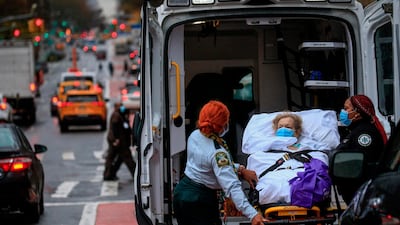
A patient is transported outside of Tisch Hospital in New York, US. AFP -

Workers build up a outdoor area outside a restaurant in New York, US. AFP -

House members participate in a ceremonial swearing-in ceremony at the state Capitol in Oklahoma City, US. AP -
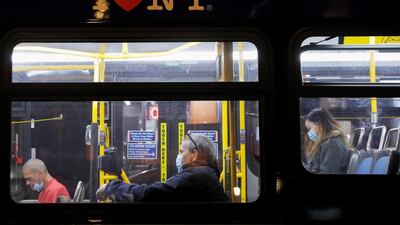
Passengers ride a bus along 1st Avenue in Manhattan, New York, US. Reuters -
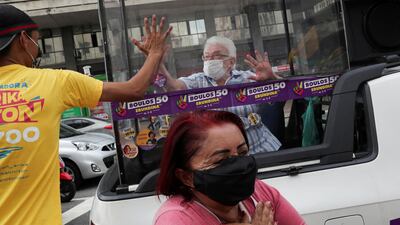
Luiza Erundina, 85, a candidate for vice-mayor, holds her hand to a man's from inside the "cata voto" (Vote Catcher), a car with a plastic booth, in Sao Paulo, Brazil. Reuters -
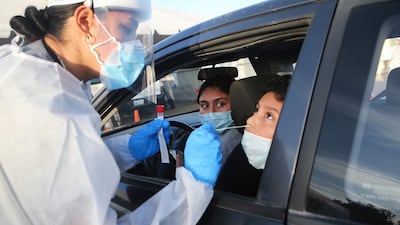
A healthcare worker administers a nasal swab in El Paso, US. AFP -
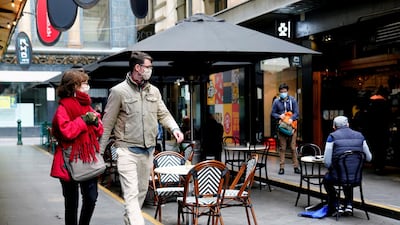
People walk past a cafe in Melbourne, Australia. Reuters -

A woman sanitises the entrance of the Casa San Bernardo hotel, in Rome, Italy. AP -

A doctor teaches on a mannequin how to treat a coronavirus patient during a training session for nurses at the Nouvel Hopital Civil of Strasbourg, eastern Franc. AP -
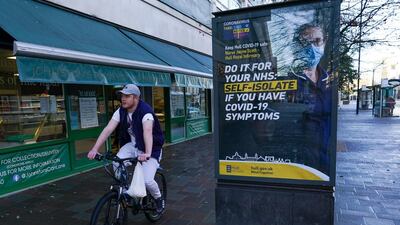
A cyclist rides past a billboard in Hull, UK. Getty


“We have a global set of standards but a lot of governments have different views on what should and should not be allowed,” he said.
“With the pandemic, people had a thirst for knowledge about Covid-19, and by not getting the information they wanted, conspiracy theories and rumours started filling that void.”
To combat the spread of false information, Facebook directed users to the World Health Organisation website.
“We went with the most trusted organisations and anyone who clicked for information about the coronavirus would be directed to the WHO page,” he said.
“Close to 600 million clicked on that to get more information.
“We don’t fact check politicians on political speech, people need to hear from their politicians but there are some red lines when it comes to the safety of users.
“The president of Brazil (Jair Bolsonaro) posted about a cure for Covid-19 and that was taken down.
“Donald Trump was making statements about the results of the election. Those were also flagged as not entirely accurate.”
To fight misinformation, the WHO was compelled to issue a joint statement with the UN, Unicef and other agencies in September.
“Misinformation costs lives. Without the appropriate trust and correct information, diagnostic tests go unused, immunisation campaigns (or campaigns to promote effective vaccines) will not meet their targets, and the virus will continue to thrive,” the statement read.
Even as Facebook fights the spread of false information, Mr Akkad said social media was a blessing during the pandemic because it connected people across the world.
“Incredibly positive stories happened during this time,” he said.
“People were able to stay in touch with friends and family, particularly the elderly. You saw the support system of the community, and our platform became an integral part of that.
“I hate to think what would have happened if these platforms did not operate at the scale and efficiency they do.”

