A black hole located approximately 1,500 light years from our solar system, discovered in the constellation Monoceros, pulls at a nearby red giant star, distorting its light in an undated illustration. Ohio State illustration/Handout via Reuters
A black hole located approximately 1,500 light years from our solar system, discovered in the constellation Monoceros, pulls at a nearby red giant star, distorting its light in an undated illustration

'Unicorn' black hole may be galaxy's smallest


  • English
  • Arabic

Scientists discovered what may be the smallest-known black hole in the Milky Way galaxy and the closest to our solar system – an object so curious they nicknamed it the Unicorn.

The researchers said the black hole is about three times the mass of the Sun, testing the lower limits of size for these extraordinarily dense objects that possess gravitational pulls so strong not even light can escape. A luminous star called a red giant orbits with the black hole in a so-called binary star system named V723 Mon.

The black hole is about 1,500 light years – the distance light travels in a year, 9.5 trillion kilometres – from Earth. While it may be the closest one to us, it is still far away. By way of comparison, the closest star to our solar system, Proxima Centauri, is four light years away.

Black holes like this one form when massive stars die and their cores collapse.

"We nicknamed this black hole 'the Unicorn' partly because V723 Mon is in the Monoceros constellation – which translates to unicorn – and partly because it is a very unique system" in terms of the black hole's mass and relative closeness to Earth, said Ohio State University astronomy doctoral student Tharindu Jayasinghe. He is the lead author of the study published this week in the journal Monthly Notices of the Royal Astronomical Society.

There are three categories of black holes. The smallest, like the Unicorn, are so-called stellar mass black holes formed by the gravitational collapse of a single star.

There are gargantuan supermassive black holes like the one at our galaxy's centre, 26,000 light years from Earth, which is four million times the Sun's mass. A few intermediate-mass black holes have been found with masses somewhere in between.

"It is clear that nature makes black holes of a wide range of masses. But a three-solar-mass black hole is a big surprise. There are no very good models for how to make such a black hole, but I am sure people will work on that more now," said Ohio State University astronomy professor and study co-author Kris Stanek.

The Unicorn falls into what the researchers called a "mass gap" between the largest-known neutron stars – objects similarly formed by a large star's collapse – at about 2.2 times the mass of the Sun and what previously had been considered the smallest black holes at about five times the Sun's mass.

"'The Unicorn' is truly one of the smallest black holes possible," Mr Jayasinghe said.

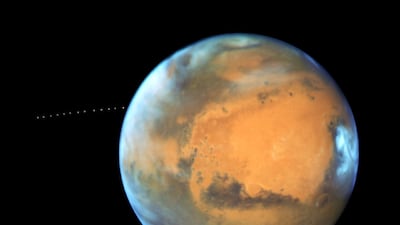
  • Nasa's Hubble Space Telescope captured the tiny moon Phobos during its orbital trek around Mars. Because the moon is so small, it appears star-like in the Hubble pictures. The Hubble observations were intended to photograph Mars, and the moon's cameo appearance was a bonus. Phobos is one of the smallest moons in the solar system. It is so tiny that it would fit comfortably inside the Washington, DC. Courtesy: Nasa
    Nasa's Hubble Space Telescope captured the tiny moon Phobos during its orbital trek around Mars. Because the moon is so small, it appears star-like in the Hubble pictures. The Hubble observations were intended to photograph Mars, and the moon's cameo appearance was a bonus. Phobos is one of the smallest moons in the solar system. It is so tiny that it would fit comfortably inside the Washington, DC. Courtesy: Nasa
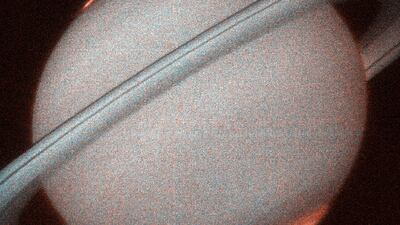
  • This is the first image of Saturn's ultraviolet aurora taken by the Space Telescope Imaging Spectrograph (STIS) on board the Hubble Space Telescope (HST) in October 1998, when Saturn was a distance of 810 million miles (1.3 billion km) from Earth. Courtesy: Nasa
    This is the first image of Saturn's ultraviolet aurora taken by the Space Telescope Imaging Spectrograph (STIS) on board the Hubble Space Telescope (HST) in October 1998, when Saturn was a distance of 810 million miles (1.3 billion km) from Earth. Courtesy: Nasa
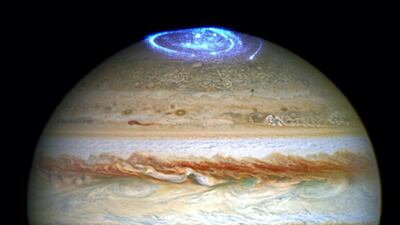
  • Astronomers are using the Nasa / ESA Hubble Space Telescope to study auroras — stunning light shows in a planet’s atmosphere — on the poles of the largest planet in the solar system, Jupiter. Courtesy: Nasa
    Astronomers are using the Nasa / ESA Hubble Space Telescope to study auroras — stunning light shows in a planet’s atmosphere — on the poles of the largest planet in the solar system, Jupiter. Courtesy: Nasa
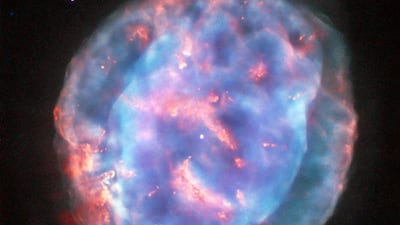
  • This colourful bubble is a planetary nebula called NGC 6818, also known as the Little Gem Nebula. It is located in the constellation of Sagittarius (The Archer), roughly 6000 light-years away from us. Courtesy: Nasa
    This colourful bubble is a planetary nebula called NGC 6818, also known as the Little Gem Nebula. It is located in the constellation of Sagittarius (The Archer), roughly 6000 light-years away from us. Courtesy: Nasa
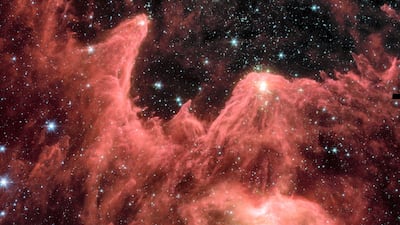
  • This majestic false-colour image from Nasa's Spitzer Space Telescope shows 'mountains' where stars are born. These towering pillars of cool gas and dust are illuminated at their tips with light from warm embryonic stars. Courtesy: Nasa
    This majestic false-colour image from Nasa's Spitzer Space Telescope shows 'mountains' where stars are born. These towering pillars of cool gas and dust are illuminated at their tips with light from warm embryonic stars. Courtesy: Nasa
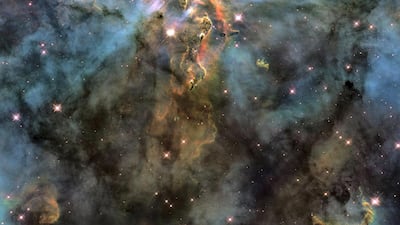
  • This Nasa Hubble Space Telescope photograph captures the chaotic activity atop a three-light-year-tall pillar of gas and dust that is being eaten away by the brilliant light from nearby bright stars. The pillar is also being assaulted from within, as infant stars buried inside it fire off jets of gas that can be seen streaming from towering peaks. This turbulent cosmic pinnacle lies within a tempestuous stellar nursery called the Carina Nebula, located 7,500 light-years away in the southern constellation Carina. Courtesy: Nasa
    This Nasa Hubble Space Telescope photograph captures the chaotic activity atop a three-light-year-tall pillar of gas and dust that is being eaten away by the brilliant light from nearby bright stars. The pillar is also being assaulted from within, as infant stars buried inside it fire off jets of gas that can be seen streaming from towering peaks. This turbulent cosmic pinnacle lies within a tempestuous stellar nursery called the Carina Nebula, located 7,500 light-years away in the southern constellation Carina. Courtesy: Nasa
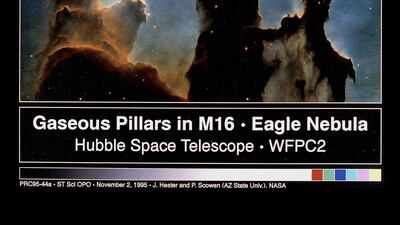
  • These eerie, dark, pillar-like structures are actually columns of cool interstellar hydrogen gas and dust that are also incubators for new stars. The pillars protrude from the interior wall of a dark molecular cloud like stalagmites from the floor of a cavern. They are part of the Eagle Nebula (also called M16), a nearby star-forming region 7,000 light-years away, in the constellation Serpens. Courtesy: Nasa
    These eerie, dark, pillar-like structures are actually columns of cool interstellar hydrogen gas and dust that are also incubators for new stars. The pillars protrude from the interior wall of a dark molecular cloud like stalagmites from the floor of a cavern. They are part of the Eagle Nebula (also called M16), a nearby star-forming region 7,000 light-years away, in the constellation Serpens. Courtesy: Nasa
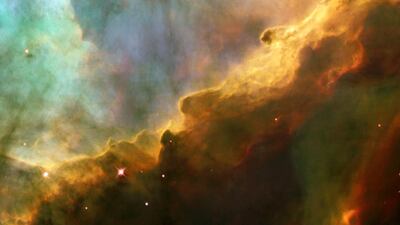
  • In this image provided by the Hubble Space Telescope (HST), the Omega Nebula (M17) resembles the fury of a raging sea, showing a bubbly ocean of glowing hydrogen gas and small amounts of other elements such as oxygen and sulphur. The nebula, also known as the Swan Nebula, is a hotbed of newly born stars residing 5,500 light-years away in the constellation Sagittarius. Courtesy: Nasa
    In this image provided by the Hubble Space Telescope (HST), the Omega Nebula (M17) resembles the fury of a raging sea, showing a bubbly ocean of glowing hydrogen gas and small amounts of other elements such as oxygen and sulphur. The nebula, also known as the Swan Nebula, is a hotbed of newly born stars residing 5,500 light-years away in the constellation Sagittarius. Courtesy: Nasa
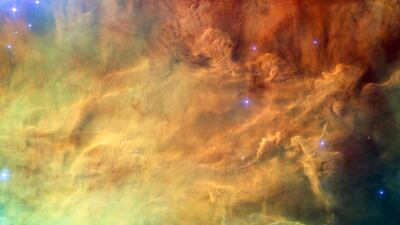
  • Nasa / ESA Hubble Space Telescope image reveals the heart of the Lagoon Nebula. Courtesy: Nasa
    Nasa / ESA Hubble Space Telescope image reveals the heart of the Lagoon Nebula. Courtesy: Nasa
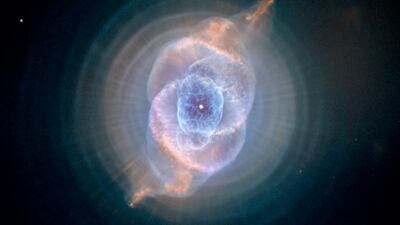
  • The Cat's Eye Nebula, one of the first planetary nebulae discovered, also has one of the most complex forms known to this kind of nebula. Eleven rings, or shells, of gas make up the Cat's Eye. Courtesy: Nasa
    The Cat's Eye Nebula, one of the first planetary nebulae discovered, also has one of the most complex forms known to this kind of nebula. Eleven rings, or shells, of gas make up the Cat's Eye. Courtesy: Nasa
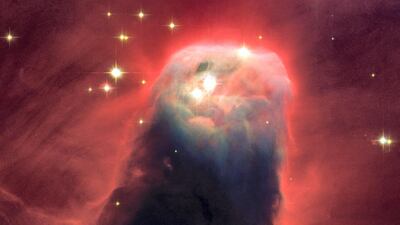
  • The Cone Nebula resides 2,500 light-years away in the constellation Monoceros. Radiation from hot, young stars (located beyond the top of the image) has slowly eroded the nebula over millions of years. Courtesy: Nasa
    The Cone Nebula resides 2,500 light-years away in the constellation Monoceros. Radiation from hot, young stars (located beyond the top of the image) has slowly eroded the nebula over millions of years. Courtesy: Nasa
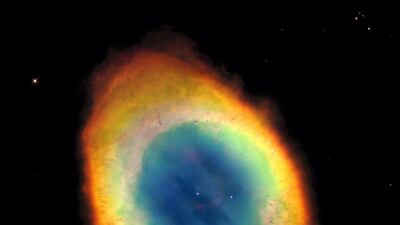
  • This planetary nebula's simple, graceful appearance is thought to be due to perspective: our view from Earth looking straight into what is actually a barrel-shaped cloud of gas shrugged off by a dying central star. Hot blue gas near the energising central star gives way to progressively cooler green and yellow gas at greater distances with the coolest red gas along the outer boundary. Courtesy: Nasa
    This planetary nebula's simple, graceful appearance is thought to be due to perspective: our view from Earth looking straight into what is actually a barrel-shaped cloud of gas shrugged off by a dying central star. Hot blue gas near the energising central star gives way to progressively cooler green and yellow gas at greater distances with the coolest red gas along the outer boundary. Courtesy: Nasa
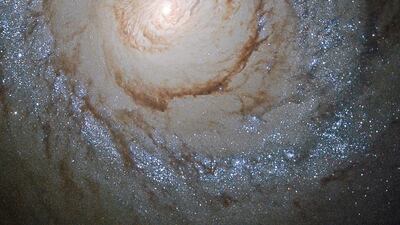
  • This image shows the galaxy Messier 94, which lies in the small northern constellation of the Hunting Dogs, about 16 million light-years away. Within the bright ring around Messier 94 new stars are forming at a high rate and many young, bright stars are present within it – thanks to this, this feature is called a starburst ring. The cause of this peculiarly shaped star-forming region is likely a pressure wave going outwards from the galactic centre, compressing the gas and dust in the outer region. Courtesy: Nasa
    This image shows the galaxy Messier 94, which lies in the small northern constellation of the Hunting Dogs, about 16 million light-years away. Within the bright ring around Messier 94 new stars are forming at a high rate and many young, bright stars are present within it – thanks to this, this feature is called a starburst ring. The cause of this peculiarly shaped star-forming region is likely a pressure wave going outwards from the galactic centre, compressing the gas and dust in the outer region. Courtesy: Nasa

Its strong gravity alters the shape of its companion star in a phenomenon known as tidal distortion, making it elongated rather than spherical and causing its light to change as it moves along its orbital path. It was these effects on the companion star, observed using Earth-based and orbiting telescopes, that indicated the black hole's presence.

"Black holes are electromagnetically dark and so they are difficult to find," Mr Jayasinghe said.

Unlike some other black holes orbiting with a star, this one was not observed to be drawing material from its companion, which is 173 times more luminous than the Sun.

The only smaller potential black hole is one with a mass 2.6 times that of the Sun that was spotted in another galaxy, Mr Jayasinghe said.

Another team of scientists last year described a black hole about 1,000 light years from Earth, but other researchers questioned whether it is a black hole.

The%20specs
%3Cp%3E%3Cstrong%3EEngine%3A%3C%2Fstrong%3E%201.5-litre%204-cylinder%3Cbr%3E%3Cstrong%3ETransmission%3A%20%3C%2Fstrong%3ECVT%3Cbr%3E%3Cstrong%3EPower%3A%20%3C%2Fstrong%3E119bhp%3Cbr%3E%3Cstrong%3ETorque%3A%20%3C%2Fstrong%3E145Nm%3Cbr%3E%3Cstrong%3EPrice%3A%20%3C%2Fstrong%3EDh%2C89%2C900%20(%2424%2C230)%3Cbr%3E%3Cstrong%3EOn%20sale%3A%20%3C%2Fstrong%3Enow%3C%2Fp%3E%0A
Who is Mohammed Al Halbousi?

The new speaker of Iraq’s parliament Mohammed Al Halbousi is the youngest person ever to serve in the role.

The 37-year-old was born in Al Garmah in Anbar and studied civil engineering in Baghdad before going into business. His development company Al Hadeed undertook reconstruction contracts rebuilding parts of Fallujah’s infrastructure.

He entered parliament in 2014 and served as a member of the human rights and finance committees until 2017. In August last year he was appointed governor of Anbar, a role in which he has struggled to secure funding to provide services in the war-damaged province and to secure the withdrawal of Shia militias. He relinquished the post when he was sworn in as a member of parliament on September 3.

He is a member of the Al Hal Sunni-based political party and the Sunni-led Coalition of Iraqi Forces, which is Iraq’s largest Sunni alliance with 37 seats from the May 12 election.

He maintains good relations with former Prime Minister Nouri Al Maliki’s State of Law Coaliton, Hadi Al Amiri’s Badr Organisation and Iranian officials.

INDIA'S%20TOP%20INFLUENCERS
%3Cp%3E%3Cstrong%3EBhuvan%20Bam%3C%2Fstrong%3E%3Cbr%3E%3Ca%20href%3D%22https%3A%2F%2Fwww.instagram.com%2Fbhuvan.bam22%2F%3Fhl%3Den%22%20target%3D%22_self%22%3EInstagram%3C%2Fa%3E%20followers%3A%2016.1%20million%3Cbr%3EBhuvan%20Bam%20is%20a%2029-year-old%20comedian%20and%20actor%20from%20Delhi%2C%20who%20started%20out%20with%20YouTube%20channel%2C%20%E2%80%9CBB%20Ki%20Vines%E2%80%9D%20in%202015%2C%20which%20propelled%20the%20social%20media%20star%20into%20the%20limelight%20and%20made%20him%20sought-after%20among%20brands.%3Cbr%3E%3Cstrong%3EKusha%20Kapila%3C%2Fstrong%3E%3Cbr%3E%3Ca%20href%3D%22https%3A%2F%2Fwww.instagram.com%2Fkushakapila%2F%3Fhl%3Den%22%20target%3D%22_self%22%3EInstagram%3C%2Fa%3E%20followers%3A%203.1%20million%3Cbr%3EKusha%20Kapila%20is%20a%20fashion%20editor%20and%20actress%2C%20who%20has%20collaborated%20with%20brands%20including%20Google.%20She%20focuses%20on%20sharing%20light-hearted%20content%20and%20insights%20into%20her%20life%20as%20a%20rising%20celebrity.%3Cbr%3E%3Cstrong%3EDiipa%20Khosla%3C%2Fstrong%3E%3Cbr%3E%3Ca%20href%3D%22https%3A%2F%2Fwww.instagram.com%2Fdiipakhosla%2F%3Fhl%3Den%22%20target%3D%22_self%22%3EInstagram%3C%2Fa%3E%20followers%3A%201.8%20million%3Cbr%3EDiipa%20Khosla%20started%20out%20as%20a%20social%20media%20manager%20before%20branching%20out%20to%20become%20one%20of%20India's%20biggest%20fashion%20influencers%2C%20with%20collaborations%20including%20MAC%20Cosmetics.%3Cbr%3E%3Cstrong%3EKomal%20Pandey%3Cbr%3E%3C%2Fstrong%3E%3Ca%20href%3D%22https%3A%2F%2Fwww.instagram.com%2Fkomalpandeyofficial%2F%3Fhl%3Den%22%20target%3D%22_self%22%3EInstagram%3C%2Fa%3E%20followers%3A%201.8%20million%3Cbr%3EKomal%20Pandey%20is%20a%20fashion%20influencer%20who%20has%20partnered%20with%20more%20than%20100%20brands%2C%20including%20Olay%20and%20smartphone%20brand%20Vivo%20India.%3Cbr%3E%3Cstrong%3ENikhil%20Sharma%3C%2Fstrong%3E%3Cbr%3E%3Ca%20href%3D%22https%3A%2F%2Fwww.instagram.com%2Fnikkkhil%2F%3Fhl%3Den%22%20target%3D%22_self%22%3EInstagram%3C%2Fa%3E%20followers%3A%201.4%20million%3Cbr%3ENikhil%20Sharma%20from%20Mumbai%20began%20his%20online%20career%20through%20vlogs%20about%20his%20motorcycle%20trips.%20He%20has%20become%20a%20lifestyle%20influencer%20and%20has%20created%20his%20own%20clothing%20line.%3Cbr%3E%3Cem%3ESource%3A%20Hireinfluence%2C%20various%3C%2Fem%3E%3Cbr%3E%3C%2Fp%3E%0A