
A project to attract the brightest Arab scientists, inventors and researchers to work in the space sector has seen a rush of applications within two weeks.
A total of 37,000 people from the region applied to join Arab Space Pioneers - a three-year intensive training programme based in the Emirates.
Sheikh Mohammed bin Rashid, Vice President and Ruler of Dubai, announced the initiative this month as the UAE prepared to launch the Hope probe launch to Mars.
Arab Space Pioneer trainees will work on current space projects with the opportunity to graduate into jobs in a growing space sector.
More applications came from Egypt than any other country, with 19,391 applicants to the www.arabstospace.com website.
That was followed by Iraq (6,447), Algeria (4,836), Morocco (3,107), the UAE (692), Jordan (681), Palestine (422), Syria (406), Tunisia (370) and Saudi Arabia (361).
Registration is now closed for the first round. A committee of scientists, researchers and other experts will evaluate applicants based on their qualifications, achievements and skills potential.
Ahmad Al Falasi, chairman of the UAE Space Agency, said the project "reflects an investment in the growing vital sectors like space science and advanced technologies".
"This long-term investment will strengthen the overall development of the Arab world," he said.
"The scientific momentum that the Arab Space Pioneers programme has created in its first round helps transform the underlying creative talents in the Arab world into on-ground scientific achievements."
Trainees in the Arab Space Pioneers programme will receive a number of benefits including a fully-covered three-year residency in the UAE, an opportunity to build advanced satellites and access to scholarships and other financial incentives.
Admission to the programme also increases the opportunity to join teams of Emirati researchers, engineers and experts in a number of space projects.
The intensive course combines theoretical and hands-on practical training by enabling participants to contribute to the UAE Space Agency’s present and future projects. In the long run, it aims to ensure the growing space sector has a pool of young Arab experts and specialists equipped with the right skills.
“We strive to prepare the next generation of Arab astronomers and space scientists as part of our wider mission to revive the Arab civilisation’s status in the scientific sphere," Sheikh Mohammed said earlier this month.
UAE Mars Mission - in pictures
-
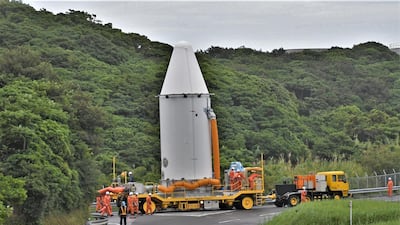
The Hope probe was placed inside this payload fairing last week and was transferred to building where the rocket is kept. Courtesy: Shoma Watanbe -
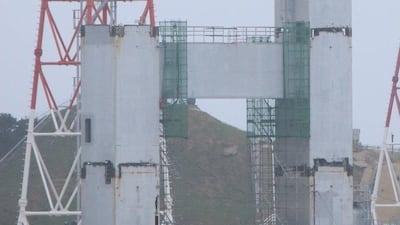
The launch pad is ready to receive the H-IIA rocket, which will deliver the Hope probe to space. It will take 30 to 40-minutes for the rocket to be transported to the launch pad. Courtesy: Yoshiaki Sakita -
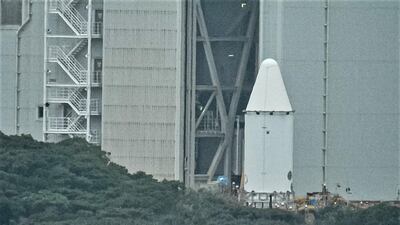
The payload fairing, which is holding the spacecraft, has been mounted on top of the rocket. The structure is meant to protect the probe from dynamic pressure and aerodynamic heating it experiences during its launch into an atmosphere. Courtesy: Shoma Watanbe -
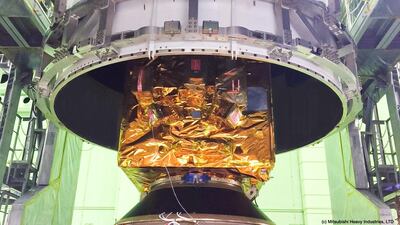
The probe was already fuelled with 800kgs of hydrogen for its seven-month-long journey to Mars. Courtesy: Emirates Mars Mission -
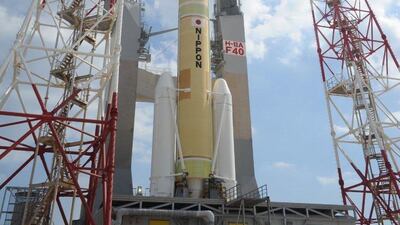
The H-IIA rocket that will carry the Hope probe into space. Dubai Twitter account -
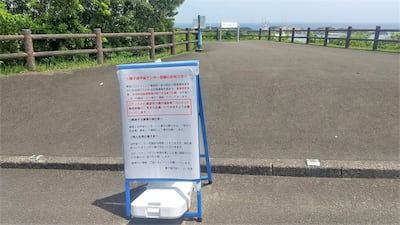
All launch viewing events in Tanegashima have been suspended as part of the Covid-19 safety measures. Signs have been up in all of popular spots, asking the public to keep a 3km distance from the Tanegashima Space Centre on launch day. Courtesy: Yoshiaki Sakita -
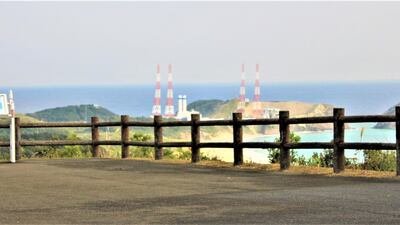
The most popular launch viewing site is the Rocket Hill. It is a five-minute drive from the main building of the Tangashima Space Centre and offers a clear view of the launch. It remains closed to the public. The National -

The free bus tour and exhibition at the Tanegashima Space Centre has also been suspended in efforts to contain the Covid-19 spread. Signs were placed outside of the centre, alerting the public. Courtesy: Yoshiaki Sakita -
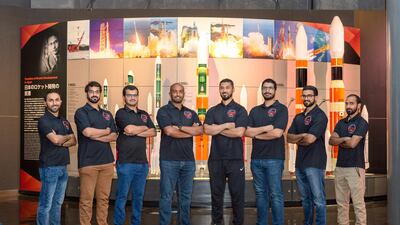
Engineers at the launch site in Tanegashima island, Japan. Courtesy: Emirates Mars Mission -

The completed Hope spacecraft. It will study the lower and upper atmosphere of Mars. Courtesy: Emirates Mars Mission



