


The UAE’s Hope probe will reach Mars in about 30 days.
The spacecraft is expected to enter orbit on February 9, at 7.42pm Gulf Standard Time.
If successful, the Emirates will become the fifth nation worldwide to accomplish the feat.
The probe will initiate an automated entry sequence, but there will be a 20-minute communication delay with mission control because of the distance.
This means Emirati engineers will know if it has been captured into orbit only after contact has been restored.
“Even before reaching its orbit, the Emirates Mars Mission’s Hope probe has succeeded in instilling a new culture in the hearts and minds of this nation’s men and women – a culture that prioritises science in shaping our future and reiterates our nation’s limitless ambitions after successfully entering space,” Sheikh Mohammed bin Rashid, Prime Minister and Ruler of Dubai, had said in November.
“We have become the first Arab country to succeed in exploring a planet, and our nation joins an exclusive group of only seven countries that have explored Mars.”
-
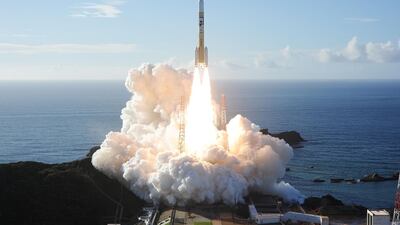
The Hope probe launches from Japan's Tanegashima Space Centre on July 20. AFP -
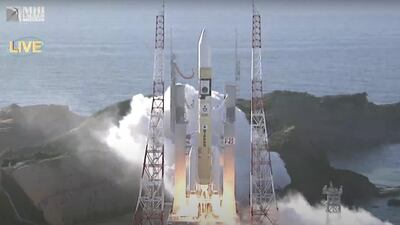
It will take the spacecraft, which later detached from the rocket, about 200 days to reach the Red Planet, arriving in February 2021. Courtesy: Mitsubishi Heavy Industries -

The launch of the rocket is captured on video at Japan's Tanegashima Space Centre. Courtesy: Mitsubishi Heavy Industries -
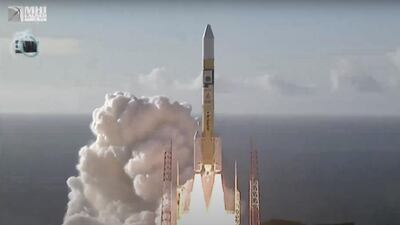
The first homegrown Arab space mission drew in interest from across the globe. Courtesy: Mitsubishi Heavy Industries -
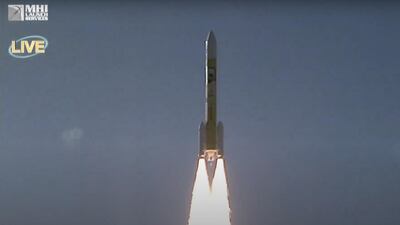
The launch of the rocket from Japan's Tanegashima Space Centre. Courtesy: Mitsubishi Heavy Industries -

Waiting for the launch in the morning light. MHI Launch Services twitter -

Emirati journalists clap as they watch the launch of the Hope space probe at Mohammed bin Rashid Space Centre in Dubai. AP -
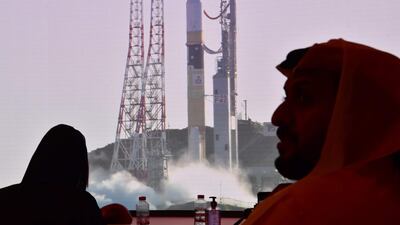
A broadcasting of the launch of the Hope Mars probe at the Mohammed Bin Rashid Space Centre in Dubai. AFP -

An Emirati man wipes a tear away with his face mask while watching the launch of the Hope space probe at Mohammed bin Rashid Space Centre in Dubai. AP -
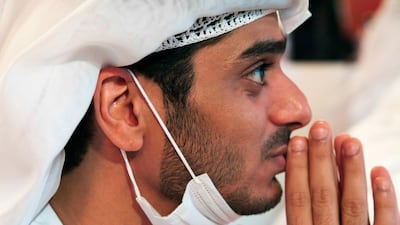
Mohammed Al Mannaee, an announcer with Dubai TV, reacts as he watches the launch. AP -

Sarah Al Ameeri and the UAE team watch the launch at at the Tanegashima Space Centre -
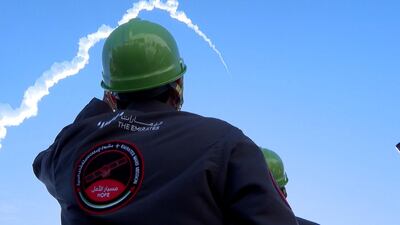
The UAE team watch the launch of the Mars Hope probe at at the Tanegashima Space Centre. -

Sarah Al Ameeri and the UAE team watch the launch at at the Tanegashima Space Centre -
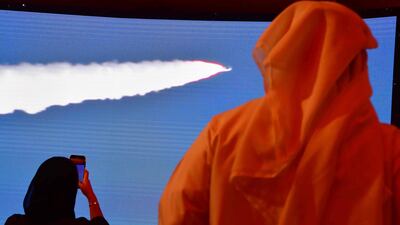
A screen broadcasts the launch of the Mars probe at Mohammed bin Rashid Space Centre in Dubai. AFP -
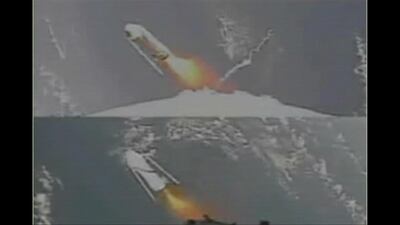
Solid rocket booster (SRB-A) was separated after burnout during the launch of the H-2A rocket carrying the Hope Probe, developed by the Mohammed Bin Rashid Space Centre (MBRSC) in the United Arab Emirates (UAE) for the Mars explore, are recorded by cameras onboard the rocket after the lauch from Tanegashima Space Center on the island of Tanegashima, Japan. REUTERS -
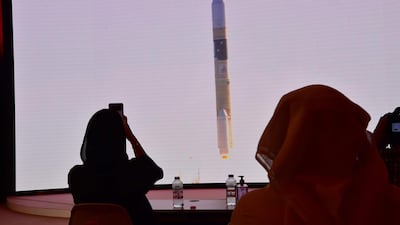
A screen broadcasts the launch of the Mars probe at Mohammed bin Rashid Space Centre in Dubai. AFP -
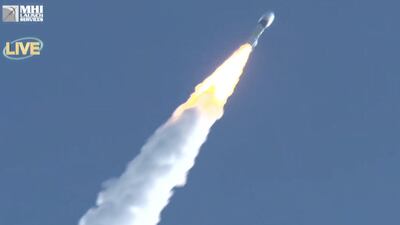
The launch of the rocket from Japan's Tanegashima Space Centre. Courtesy: MHI Launch Services -
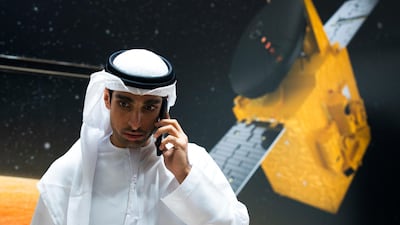
Omran Sharaf, the project director for the Hope space probe, speaks on his mobile phone at Mohammed bin Rashid Space Centre in Dubai. AP -
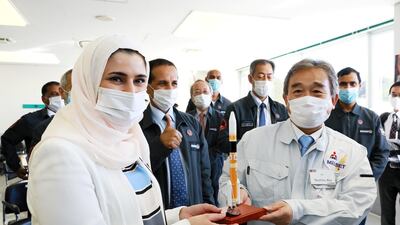
Sarah Al Ameeri, Minister of State for Advanced Sciences of United Arab Emirates, celebrates with Naohiko Abe, Mitsubishi Heavy Industries (MHI) Senior Vice President, Head of Integrated Defence and Space Systems, after the successful launch of the H-2A rocket carrying the Hope Probe, developed by the Mohammed Bin Rashid Space Centre (MBRSC) in the United Arab Emirates (UAE) for the Mars explore, at Tanegashima Space Center on the island of Tanegashima, Japan. REUTERS -
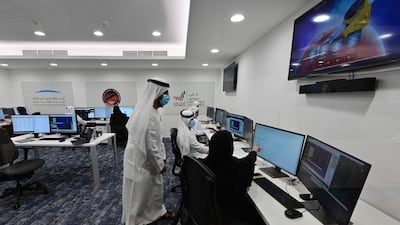
Emiratis are pictured at the Mohammed Bin Rashid Space Centre in Dubai ahead of the expected launch of the "Hope" Mars probe from Japan. AFP -
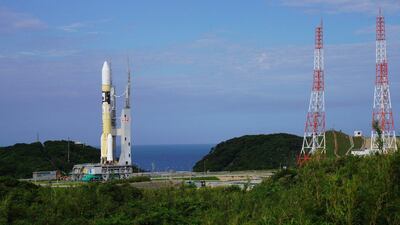
The weather was clear over Tanegashima Island in southern Japan on Sunday after weeks of rain and cloudy conditions. Courtesy: Dubai Media Office -
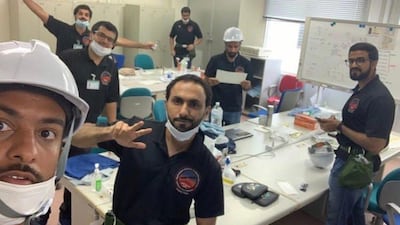
Emirati engineers wave in a picture taken on Sunday from Japan's Tanegashima Space Centre. Courtesy: Emirates Mars Mission / UAE Space Agency -
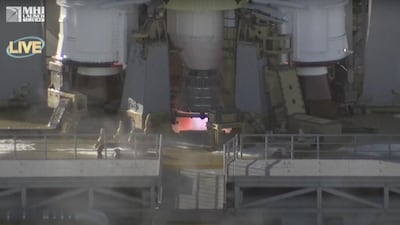
The launch of the rocket from Japan's Tanegashima Space Centre. Screengrab courtesy MHI Launch Services


The journey so far
Hope was launched aboard a Japanese Mitsubishi rocket on July 20, from the Tanegashima Space Centre.
It will spend two years orbiting the Red Planet, capturing data on the lower and upper atmosphere using three scientific instruments. The mission is expected to help scientists learn why hydrogen and oxygen are leaking from the atmosphere, which is causing the planet’s unstable climate.
One of the probe’s scientific instruments, the ultraviolet spectrometer, will capture photos of Mars to analyse gases around it.
Engineers at mission control have been monitoring the spacecraft’s health since it was launched into space. Out of the 493.5 million kilometres total journey, less than 62.3 million kilometres remains.
A navigational camera known as a star tracker has helped ensure Hope stays on the correct path to Mars.
It was also used to measure interplanetary dust between Earth and the Red Planet as part of an additional scientific mission.
Mars orbit insertion
Entering Mars’ orbit is one of the most challenging parts of the mission.
Nearly half of the spacecraft’s fuel will be used during this stage. It will fire its thrusters for 30 minutes to reduce its speed from 121,000kph to 18,000kph.
If it goes too fast or too slow, it could either crash on Mars or miss it entirely.
Once it arrives just short of Mars, the spacecraft will be captured into a long, looping orbit, where it will first spend about 40 hours. The elliptical orbit will take the Hope probe as close as 1,000km above Mars’ surface and 49,380km away from it.
The first image of Mars from the probe’s scientific instruments will be taken at this stage.
A series of manoeuvres will then ensure the spacecraft is positioned correctly for a transfer into the science orbit. It will stay here for two years.
The science orbit is an elliptical orbit in which the probe will carry out its science operations. It ranges between 22,000 to 43,000 km and one revolution will take 55 hours to complete.
The Hope probe’s strategic placement will allow it to take the first global photo of the planet. This means it will capture Mars’ atmospheric dynamics and weather patterns in different times of the day – a feat that has never been done before.
Emirati engineers will stay in contact with Hope twice a week for six to eight hours each time.
All of the data will be available for free online on a website that will be launched soon by the mission team.
It is believed Mars contained ancient life - in pictures
-
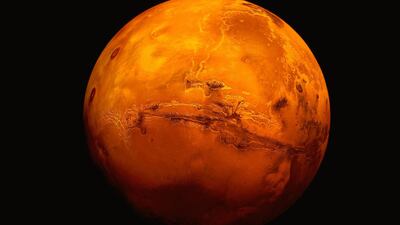
A new study suggests that conditions on Mars nearly 4 billion years ago may have made ancient life there more likely. -
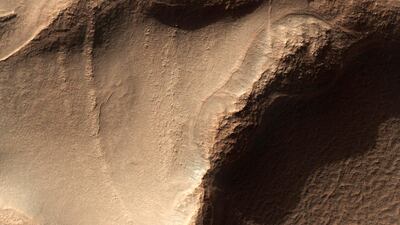
The surface of Mars. NASA -

Collage showing Mars’s Maumee valleys (top half) superimposed with channels on Devon Island in Nunavut (bottom half) The share of the channels, as well as the overall network appears almost identical. Courtesy Cal-Tech CTX mosaic and MAXAR/Esri -
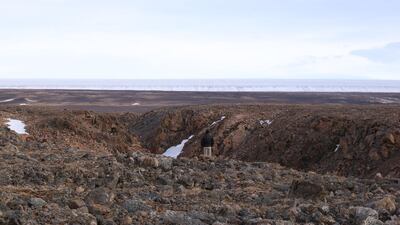
Co-author Mark Jellinek of UBC looking towards the Devon ice cap, standing on rocks that are more than a million years old. Courtesy Anna Grau Galofre -
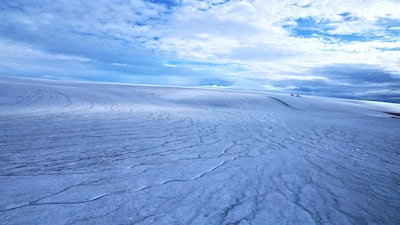
UBC researchers have concluded that the early Martian landscape probably looked similar to this image of the Devon ice cap in the Canadian Arctic. Courtesy Anna Grau Galofre



