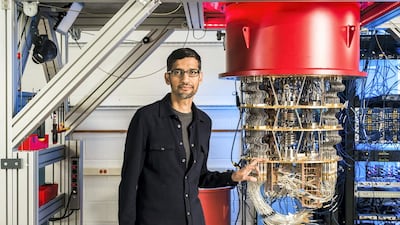
The quest to build the ultimate computer has taken a big step forward following breakthroughs in ensuring its answers can be trusted.
Known as a quantum computer, such a machine exploits bizarre effects in the sub-atomic world to perform calculations beyond the reach of conventional computers.
First proposed almost 40 years ago, tech giants Microsoft, Google and IBM are among those racing to exploit the power of quantum computing, which is expected to transform fields ranging from weather forecasting and drug design to artificial intelligence.
The power of quantum computers comes from their use of so-called qubits, the quantum equivalent of the 1s and 0s – “bits” – used by conventional number-crunchers.
Unlike bits, qubits exploit a quantum effect allowing them to be both 1s and 0s at the same time. The impact on processing power is astonishing. Instead of processing, say, 100 bits in one go, a quantum computer could crunch 100 qubits, equivalent to 2 to the power 100, or a million trillion trillion bits.
At least, that is the theory. The problem is that the property of qubits that gives them their abilities – known as quantum superposition – is very unstable.
Once created, even the slightest vibration, temperature shift or electromagnetic signal can disturb the qubits, causing errors in calculations. Unless the superposition can be maintained long enough, the quantum computer either does a few calculations well or a vast amount badly.
For years, the biggest achievement of any quantum computer involved using a few qubits to find the prime factors of 15 (which every schoolchild knows are 3 and 5).
Using complex shielding methods, researchers can now stabilise around 50 qubits long enough to perform impressive calculations.
Last October, Google claimed to have built a quantum computer that solved in 200 seconds a maths problem that would have taken an ultra-fast conventional computer more than 10,000 years.
Yet even this billion-fold speed-up is just a shadow of what would be possible if qubits could be kept stable for longer. At present, many of the qubits have their powers wasted being used to spot and fix errors.
Now two teams of researchers have independently found new ways of tackling the error problem.
Physicists at the University of Chicago have found a way of keeping qubits stable for longer not by blocking disturbances, but by blurring them.
It is like sitting on a merry-go-round with people yelling all around you
In some quantum computers, the qubits take the form of electrons whose direction of spin is a superposition of both up and down. By adding a constantly flipping magnetic field, the team found that the electrons rotated so quickly that they barely noticed outside disturbances. The researchers explain the trick with an analogy: “It's like sitting on a merry-go-round with people yelling all around you,” says team member Dr Kevin Miao. “When the ride is still, you can hear them perfectly, but if you're rapidly spinning, the noise blurs into a background.”
Describing their work in the journal Science, the team reported keeping the qubits working for about 1/50th of a second - around 10,000 times longer than their lifetime if left unshielded. According to the team, the technique is simple to use but effective against all the standard sources of disturbance. Meanwhile, researchers at the University of Sydney have come up with an algorithm that allows a quantum computer to work out how its qubits are being affected by disturbances and fix the resulting errors. Reporting their discovery in Nature Physics, the team says their method is ready for use with current quantum computers, and could work with up to 100 qubits.
These breakthroughs come at a key moment for quantum computing. Even without them, the technology is already spreading beyond research laboratories.
In June, the title of world’s most powerful quantum computer was claimed not by a tech giant but by Honeywell – a company perhaps best known for central heating thermostats.
Needless to say, the claim is contested by some, not least because the machine is reported to have only six qubits. But Honeywell points out that it has focused its research on making those qubits ultra-stable – which allows them to work reliably for far longer than rival systems. Numbers of qubits alone, in other words, are not everything.
And the company insists this is just the start. It plans to boost the performance of its quantum computer ten-fold each year for the next five years, making it 100,000 times more powerful still.
But apart from bragging rights, why is a company like Honeywell trying to take on the tech giants in the race for the ultimate computer ?
A key clue can be found in remarks made by Honeywell insiders to Forbes magazine earlier this month. These reveal that the company wants to use quantum computers to discover new kinds of materials.
Doing this involves working out how different molecules interact together to form materials with the right properties. That’s something conventional computers are already used for. But quantum computers won’t just bring extra number-crunching power to bear. Crucially, like molecules themselves, their behaviour reflects the bizarre laws of quantum theory. And this makes them ideal for creating accurate simulations of quantum phenomena – like the creation of new materials.
This often-overlooked feature of quantum computers was, in fact, the original motivation of the brilliant American physicist Richard Feynman, who first proposed their development in 1981.
Honeywell already has plans to use quantum computers to identify better refrigerants. These compounds were once notorious for attacking the Earth’s ozone layer, but replacements still have unwanted environmental effects. Being relatively simple chemicals, the search for better refrigerants is already within the reach of current quantum computers.
But Honeywell sees a time when far more complex molecules such as drugs will also be discovered using the technology.
For the time being, no quantum computer can match the all-round number-crunching power of standard computers. Just as Honeywell made its claim, the Japanese computer maker Fujitsu unveiled a supercomputer capable of over 500 million billion calculations a second.
Even so, the quantum computer is now a reality – and before long it will make even the fastest supercomputer seem like an abacus.
Robert Matthews is Visiting Professor of Science at Aston University, Birmingham, UK

Revival
Eminem
Interscope
Info
What: 11th edition of the Mubadala World Tennis Championship
When: December 27-29, 2018
Confirmed: men: Novak Djokovic, Rafael Nadal, Kevin Anderson, Dominic Thiem, Hyeon Chung, Karen Khachanov; women: Venus Williams
Tickets: www.ticketmaster.ae, Virgin megastores or call 800 86 823
Who's who in Yemen conflict
Houthis: Iran-backed rebels who occupy Sanaa and run unrecognised government
Yemeni government: Exiled government in Aden led by eight-member Presidential Leadership Council
Southern Transitional Council: Faction in Yemeni government that seeks autonomy for the south
Habrish 'rebels': Tribal-backed forces feuding with STC over control of oil in government territory
10 tips for entry-level job seekers
- Have an up-to-date, professional LinkedIn profile. If you don’t have a LinkedIn account, set one up today. Avoid poor-quality profile pictures with distracting backgrounds. Include a professional summary and begin to grow your network.
- Keep track of the job trends in your sector through the news. Apply for job alerts at your dream organisations and the types of jobs you want – LinkedIn uses AI to share similar relevant jobs based on your selections.
- Double check that you’ve highlighted relevant skills on your resume and LinkedIn profile.
- For most entry-level jobs, your resume will first be filtered by an applicant tracking system for keywords. Look closely at the description of the job you are applying for and mirror the language as much as possible (while being honest and accurate about your skills and experience).
- Keep your CV professional and in a simple format – make sure you tailor your cover letter and application to the company and role.
- Go online and look for details on job specifications for your target position. Make a list of skills required and set yourself some learning goals to tick off all the necessary skills one by one.
- Don’t be afraid to reach outside your immediate friends and family to other acquaintances and let them know you are looking for new opportunities.
- Make sure you’ve set your LinkedIn profile to signal that you are “open to opportunities”. Also be sure to use LinkedIn to search for people who are still actively hiring by searching for those that have the headline “I’m hiring” or “We’re hiring” in their profile.
- Prepare for online interviews using mock interview tools. Even before landing interviews, it can be useful to start practising.
- Be professional and patient. Always be professional with whoever you are interacting with throughout your search process, this will be remembered. You need to be patient, dedicated and not give up on your search. Candidates need to make sure they are following up appropriately for roles they have applied.
Arda Atalay, head of Mena private sector at LinkedIn Talent Solutions, Rudy Bier, managing partner of Kinetic Business Solutions and Ben Kinerman Daltrey, co-founder of KinFitz
UAE currency: the story behind the money in your pockets
The past winners
2009 - Sebastian Vettel (Red Bull)
2010 - Sebastian Vettel (Red Bull)
2011 - Lewis Hamilton (McLaren)
2012 - Kimi Raikkonen (Lotus)
2013 - Sebastian Vettel (Red Bull)
2014 - Lewis Hamilton (Mercedes)
2015 - Nico Rosberg (Mercedes)
2016 - Lewis Hamilton (Mercedes)
2017 - Valtteri Bottas (Mercedes)
Brief scores:
Toss: Sindhis, elected to field first
Kerala Knights 103-7 (10 ov)
Parnell 59 not out; Tambe 5-15
Sindhis 104-1 (7.4 ov)
Watson 50 not out, Devcich 49
Benefits of first-time home buyers' scheme
- Priority access to new homes from participating developers
- Discounts on sales price of off-plan units
- Flexible payment plans from developers
- Mortgages with better interest rates, faster approval times and reduced fees
- DLD registration fee can be paid through banks or credit cards at zero interest rates
What%20is%20cystic%20fibrosis%3F
%3Cul%3E%0A%3Cli%3ECystic%20fibrosis%20is%20a%20genetic%20disorder%20that%20affects%20the%20lungs%2C%20pancreas%20and%20other%20organs.%3C%2Fli%3E%0A%3Cli%3EIt%20causes%20the%20production%20of%20thick%2C%20sticky%20mucus%20that%20can%20clog%20the%20airways%20and%20lead%20to%20severe%20respiratory%20and%20digestive%20problems.%3C%2Fli%3E%0A%3Cli%3EPatients%20with%20the%20condition%20are%20prone%20to%20lung%20infections%20and%20often%20suffer%20from%20chronic%20coughing%2C%20wheezing%20and%20shortness%20of%20breath.%3C%2Fli%3E%0A%3Cli%3ELife%20expectancy%20for%20sufferers%20of%20cystic%20fibrosis%20is%20now%20around%2050%20years.%3C%2Fli%3E%0A%3C%2Ful%3E%0A
How to get there
Emirates (www.emirates.com) flies directly to Hanoi, Vietnam, with fares starting from around Dh2,725 return, while Etihad (www.etihad.com) fares cost about Dh2,213 return with a stop. Chuong is 25 kilometres south of Hanoi.
ULTRA PROCESSED FOODS
- Carbonated drinks, sweet or savoury packaged snacks, confectionery, mass-produced packaged breads and buns
- margarines and spreads; cookies, biscuits, pastries, cakes, and cake mixes, breakfast cereals, cereal and energy bars;
- energy drinks, milk drinks, fruit yoghurts and fruit drinks, cocoa drinks, meat and chicken extracts and instant sauces
- infant formulas and follow-on milks, health and slimming products such as powdered or fortified meal and dish substitutes,
- many ready-to-heat products including pre-prepared pies and pasta and pizza dishes, poultry and fish nuggets and sticks, sausages, burgers, hot dogs, and other reconstituted meat products, powdered and packaged instant soups, noodles and desserts.
The%20BaaS%20ecosystem
%3Cp%3EThe%20BaaS%20value%20chain%20consists%20of%20four%20key%20players%3A%3C%2Fp%3E%0A%3Cp%3E%3Cstrong%3EConsumers%3A%3C%2Fstrong%3E%20End-users%20of%20the%20financial%20product%20delivered%3C%2Fp%3E%0A%3Cp%3E%3Cstrong%3EDistributors%3A%3C%2Fstrong%3E%20Also%20known%20as%20embedders%2C%20these%20are%20the%20firms%20that%20embed%20baking%20services%20directly%20into%20their%20existing%20customer%20journeys%3C%2Fp%3E%0A%3Cp%3E%3Cstrong%3EEnablers%3A%3C%2Fstrong%3E%20Usually%20Big%20Tech%20or%20FinTech%20companies%20that%20help%20embed%20financial%20services%20into%20third-party%20platforms%3C%2Fp%3E%0A%3Cp%3E%3Cstrong%3EProviders%3A%3C%2Fstrong%3E%20Financial%20institutions%20holding%20a%20banking%20licence%20and%20offering%20regulated%20products%3C%2Fp%3E%0A
Real estate tokenisation project
Dubai launched the pilot phase of its real estate tokenisation project last month.
The initiative focuses on converting real estate assets into digital tokens recorded on blockchain technology and helps in streamlining the process of buying, selling and investing, the Dubai Land Department said.
Dubai’s real estate tokenisation market is projected to reach Dh60 billion ($16.33 billion) by 2033, representing 7 per cent of the emirate’s total property transactions, according to the DLD.
Key findings of Jenkins report
- Founder of the Muslim Brotherhood, Hassan al Banna, "accepted the political utility of violence"
- Views of key Muslim Brotherhood ideologue, Sayyid Qutb, have “consistently been understood” as permitting “the use of extreme violence in the pursuit of the perfect Islamic society” and “never been institutionally disowned” by the movement.
- Muslim Brotherhood at all levels has repeatedly defended Hamas attacks against Israel, including the use of suicide bombers and the killing of civilians.
- Laying out the report in the House of Commons, David Cameron told MPs: "The main findings of the review support the conclusion that membership of, association with, or influence by the Muslim Brotherhood should be considered as a possible indicator of extremism."
Moral education needed in a 'rapidly changing world'
Moral education lessons for young people is needed in a rapidly changing world, the head of the programme said.
Alanood Al Kaabi, head of programmes at the Education Affairs Office of the Crown Price Court - Abu Dhabi, said: "The Crown Price Court is fully behind this initiative and have already seen the curriculum succeed in empowering young people and providing them with the necessary tools to succeed in building the future of the nation at all levels.
"Moral education touches on every aspect and subject that children engage in.
"It is not just limited to science or maths but it is involved in all subjects and it is helping children to adapt to integral moral practises.
"The moral education programme has been designed to develop children holistically in a world being rapidly transformed by technology and globalisation."
Killing of Qassem Suleimani
Bawaal%20
%3Cp%3E%3Cstrong%3EDirector%3A%3C%2Fstrong%3E%20Nitesh%20Tiwari%3C%2Fp%3E%0A%3Cp%3E%3Cstrong%3EStars%3A%3C%2Fstrong%3E%20Varun%20Dhawan%2C%20Janhvi%20Kapoor%3C%2Fp%3E%0A%3Cp%3E%3Cstrong%3ERating%3A%3C%2Fstrong%3E%201%2F5%3C%2Fp%3E%0A
