Eid prayers were held in mosques across the country for the first time in two years.
In scenes reminiscent of years gone by, worshippers lined up at mosques to mark the start of the second Eid Al Fitr holiday affected by the pandemic.
But instead of being tightly packed together, shoulder to shoulder, as they would have been before, worshippers left space between their prayer mats to respect precautions to curb the spread of Covid-19.
Approved mosques were permitted to open 15 minutes before the beginning of prayers, which were limited to 15 minutes.
People aged 60 and over and under the age of 12 were not permitted to attend.
Earlier, UAE leaders shared greetings on social media, wishing citizens, residents and the rest of the Muslim world a happy and blessed Eid Al Fitr.
Sheikh Mohammed bin Rashid, Vice President and Ruler of Dubai, wished happiness, health and peace to all.
"Eid Mubarak to the people of the UAE and the rest of the Muslim world. May the days ahead bring us blessings, peace and prosperity," he said in a tweet.
Sheikh Mohamed bin Zayed, Crown Prince of Abu Dhabi and Deputy Supreme Commander of the Armed Forces, prayed for "peace, prosperity and happiness".
"Eid Mubarak to the UAE President and Vice President, the Rulers of the Emirates, and the UAE people," he tweeted.
"We pray that this blessed time brings peace, prosperity and happiness to the people of our nation, the region and the world."
Last year's Eid Al Fitr fell during the early days of the pandemic, forcing mosques to close completely and people to worship at home.
Sending virtual Eid greetings to friends became the norm.
This year, although mosques are allowed to open, authorities are urging people to still celebrate at home with immediate family to stem the spread of the virus.
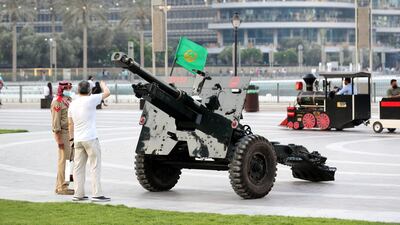
The last Ramadan 2021 cannon fires in Dubai – in pictures
Ten tax points to be aware of in 2026
1. Domestic VAT refund amendments: request your refund within five years
If a business does not apply for the refund on time, they lose their credit.
2. E-invoicing in the UAE
Businesses should continue preparing for the implementation of e-invoicing in the UAE, with 2026 a preparation and transition period ahead of phased mandatory adoption.
3. More tax audits
Tax authorities are increasingly using data already available across multiple filings to identify audit risks.
4. More beneficial VAT and excise tax penalty regime
Tax disputes are expected to become more frequent and more structured, with clearer administrative objection and appeal processes. The UAE has adopted a new penalty regime for VAT and excise disputes, which now mirrors the penalty regime for corporate tax.
5. Greater emphasis on statutory audit
There is a greater need for the accuracy of financial statements. The International Financial Reporting Standards standards need to be strictly adhered to and, as a result, the quality of the audits will need to increase.
6. Further transfer pricing enforcement
Transfer pricing enforcement, which refers to the practice of establishing prices for internal transactions between related entities, is expected to broaden in scope. The UAE will shortly open the possibility to negotiate advance pricing agreements, or essentially rulings for transfer pricing purposes.
7. Limited time periods for audits
Recent amendments also introduce a default five-year limitation period for tax audits and assessments, subject to specific statutory exceptions. While the standard audit and assessment period is five years, this may be extended to up to 15 years in cases involving fraud or tax evasion.
8. Pillar 2 implementation
Many multinational groups will begin to feel the practical effect of the Domestic Minimum Top-Up Tax (DMTT), the UAE's implementation of the OECD’s global minimum tax under Pillar 2. While the rules apply for financial years starting on or after January 1, 2025, it is 2026 that marks the transition to an operational phase.
9. Reduced compliance obligations for imported goods and services
Businesses that apply the reverse-charge mechanism for VAT purposes in the UAE may benefit from reduced compliance obligations.
10. Substance and CbC reporting focus
Tax authorities are expected to continue strengthening the enforcement of economic substance and Country-by-Country (CbC) reporting frameworks. In the UAE, these regimes are increasingly being used as risk-assessment tools, providing tax authorities with a comprehensive view of multinational groups’ global footprints and enabling them to assess whether profits are aligned with real economic activity.
Contributed by Thomas Vanhee and Hend Rashwan, Aurifer
Ain Dubai in numbers
126: The length in metres of the legs supporting the structure
1 football pitch: The length of each permanent spoke is longer than a professional soccer pitch
16 A380 Airbuses: The equivalent weight of the wheel rim.
9,000 tonnes: The amount of steel used to construct the project.
5 tonnes: The weight of each permanent spoke that is holding the wheel rim in place
192: The amount of cable wires used to create the wheel. They measure a distance of 2,4000km in total, the equivalent of the distance between Dubai and Cairo.