


Three enterprising Emirati sisters are embracing the UAE's rich falconry traditions to help their business dreams take flight.
Afra, Mariam and Salma Al Dhaheri got their family-run company, Al Sharagha Falconry, off the ground last year and are hoping one of the country's biggest cultural events will be a springboard for further success.
They have joined more than 1,200 exhibitors from 65 countries at the 20th Abu Dhabi International Hunting and Equestrian Exhibition, taking place this week at the Abu Dhabi National Exhibition Centre.
The siblings, from Salahah Island, 160km west of Abu Dhabi, initially crafted falconry equipment before they decided to start selling the prized birds of prey too.
Afra believes they are the first Emirati women to open their own falconry business.
“First, we were sewing falconry hoods at our home in Abu Dhabi. Now our business thrives, and we are selling falcons,” she told The National.
One of their falcons on show at the exhibition is valued at about Dh235,000 ($64,000).
Championing tradition
The sisters are proud to be championing a sport steeped in Emirati history.
For 4,000 years, Bedouin in the UAE and wider Arabian Peninsula have practised falconry as a form of hunting.
It remains a popular sport and pastime and is a key feature of the UAE’s identity.
“We are immensely proud to be Emirati women contributing to the preservation and promotion of falconry in the UAE,” said Afra.
Their company offers a range of services, including falcon training and educational programmes for enthusiasts of all levels.
Despite being born on an island and more familiar with maritime culture, the sisters found their passion while visiting their relatives in Liwa Oasis.
Adihex 2023 - in pictures
-

Riders and their horses on show during the Abu Dhabi International Hunting and Equestrian Exhibition (Adihex) in the UAE capital. AFP -
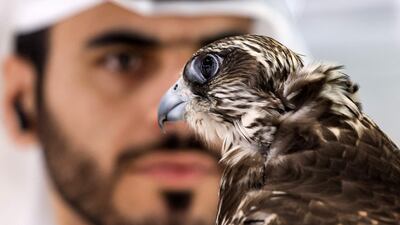
Falcons and falconry, both symbols of the UAE's heritage, are popular with visitors to this year's Adihex. AFP -

An auctioneer presents a falcon to bidders during Adihex. AFP -

MacQueen's bustards on show at Adihex. The birds are a protected species in the UAE and until the turn of the century were a sub-species of houbara bustards. AFP -

Falah Alblooshi looks down the sight of a Liwa Arms Chayeh Z20 on the first day of the Abu Dhabi International Hunting and Equestrian Exhibition, or Adihex 2023, at Adnec in Abu Dhabi. Chris Whiteoak / The National -

A falcon, the symbol of national pride and prestige, on display at Adihex in Abu Dhabi. Chris Whiteoak / The National -

A visitor to the Bynuna stand casts his eye over a rifle. Chris Whiteoak / The National -

An Alaskan Malamute competes in the mix breed dog show at Adihex 2023. Chris Whiteoak / The National -

A Belgian Shepherd, part of the Abu Dhabi Police K9 team, enjoys a little adoration at Adihex 2023. Chris Whiteoak / The National -

Lujain strokes one of the horses on show at Adihex. Chris Whiteoak / The National -

Fayez Al Habsi tests a pair of binoculars. Chris Whiteoak / The National -

Jack Lee's portraits of UAE Founding Father, the late Sheikh Zayed bin Sultan Al Nahyan, and President Sheikh Mohamed at Adihex. Chris Whiteoak / The National -

A falcon and an admirer at Adihex. Chris Whiteoak / The National -

The Emirates Heritage Club has a presence at Adihex. Chris Whiteoak / The National -

Children pose with a Saluki at Adihex. Victor Besa / The National -

Offroad 4x4 vehicles on display at Adihex. Victor Besa / The National -

Falconers wave UAE flag at Adihex. Victor Besa / The National -

Portraits on display at Adihex. Victor Besa / The National -

Afrikan Tanning and Taxidermy stall at Adihex. Victor Besa / The National -

Firearms on display at the Bynuna stand. Victor Besa / The National -

Woman pets horse at Adihex. Victor Besa / The National -
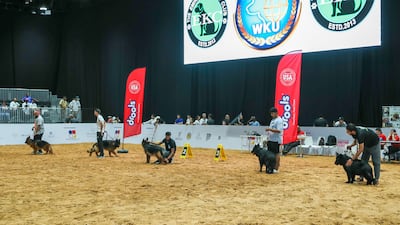
Hunting dogs participate in exhibition at Adihex. Victor Besa / The National -

Ruqaya Alblooshi of the Emirates Arabian Horse Society poses with a horse at Adihex. Victor Besa / The National -

International Fund for Houbara Conservation display area. Victor Besa / The National -

Saoud and brother Salem Al Shamsi check out the firepower at the exhibition. Victor Besa / The National -

(L-R) Ahmed Mansour and father, Jameel of UK Antiques Events stall at Abu Dhabi International Hunting and Equestrian Exhibition. Victor Besa / The National -
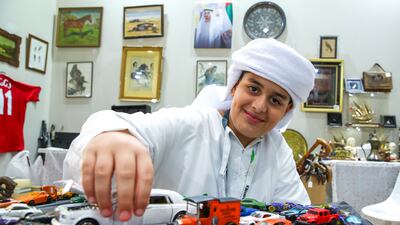
Ahmed Mansour at his father's UK Antiques Events stall at Adihex. Victor Besa / The National -

Photograph of Sheikh Zayed holding a hunting rifle on display at Adihex. Victor Besa / The National -

Colt Python revolver. Victor Besa / The National


“We loved the falconry. Our leaders care about it. It is part of our traditions that we have from our ancestors,” Afra said.
“Falconry is not just a sport, it's a way of life for many in our region. We want to ensure that this heritage is accessible to everyone, regardless of gender, and that it thrives for generations to come.”
Afra said they have been inspired to champion UAE heritage by UAE Founding Father, the late Sheikh Zayed bin Sultan Al Nahyan.
“Sheikh Zayed taught us that we should know our past and traditions to make a better future. His words echoed in our hearts, and we are determined to preserve and enrich the falconry traditions,” Afra said.
She said the sisters have been buoyed by the support they have received as they make their way in what is a typically male-dominated industry.
They are eager to pave the way for other women to follow in their path.
“It's encouraging to see the doors of opportunity opening for women in this field. We will welcome any Emirati woman wanting to be part of our business.”

