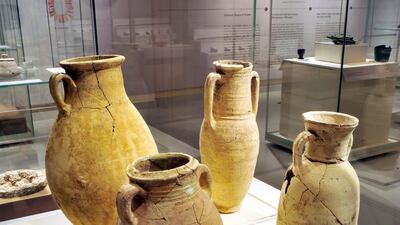
A study shows that people living at a site called Kalba 4 in present-day Sharjah exchanged copper for Mesopotamian ceramic vessels that may have contained fragrant oils or other valuable liquids. Photo: Daniel Eddisford
A study shows that people living at a site called Kalba 4 in present-day Sharjah exchanged copper for Mesopotamian ceramic vessels that may have contained fragrant oils or other valuable liquids. Phot

New artefacts offer glimpse into UAE life more than 4,000 years ago


Daniel Bardsley
  • English
  • Arabic

Turn the clock back more than 4,000 years and the area that is now the UAE was trading with some of the world’s great early civilisations.

This has been demonstrated to fascinating effect in a study which shows that people living at a site called Kalba 4 in present-day Sharjah on the UAE’s east coast exchanged copper for Mesopotamian ceramic vessels that may have contained fragrant oils or other valuable liquids.

People in south-east Arabia also received woollen clothing and other goods from Mesopotamia, the area in today’s Iraq where one of the world’s first civilisations developed.

Dr Daniel Eddisford, a British archaeologist, has painstakingly analysed thousands of pieces of pottery to build up a picture of the links the people at Kalba 4 had with other civilisations.

His research focuses on the Early Bronze Age civilisation in the UAE and Oman: the Hafit period, from about 3200 to 2800 BCE, which is named after distinctive tombs first excavated at Jebel Hafit near Al Ain; and the Umm an-Nar period, which lasted from about 2800 to 2000 BCE and is named after the island off Abu Dhabi where evidence for it was first discovered.

These societies existed when people were becoming more rooted to particular areas.

“There’s a shift from being much more mobile and herding sheep and goats to settling down and using agriculture,” Dr Eddisford said.

The pieces or sherds of pottery from Kalba 4 that Dr Eddisford used for his new study, published in the journal Arabian Archaeology and Epigraphy, were analysed during several trips — each between a month and six weeks — he made to the UAE.

Excavation site reveals link with Mesopotamia and Indus Valley

Kept in storage in Sharjah, the material had been collected by another archaeologist, Carl Philips, during excavations of the Kalba 4 site three decades ago, but was never fully analysed.

There were about 12,000 sherds of pottery in total, about 1,000 of which were from the Early Bronze Age and, of these, just under 30 per cent were imported.

An excavation site in Kalba shows a link to the Early Bronze Age. Photo: Daniel Eddisford

There was a wide range of imported ceramics at the site, including jars between about 40 centimetres and 60cm tall, with ribbed rims that appear to have been shaped to allow a cloth or leather cover to be placed over the jar and tied in place.

It had been thought that during the Early Bronze Age links with Mesopotamia dwindled and were instead replaced by trade with another great early civilisation, that of the Indus Valley, located on what is now the border between India and Pakistan.

However, Dr Eddisford’s analysis detected the continued presence of Mesopotamian pottery — made from distinctive clays deposited by the Euphrates and Tigris rivers and characterised by a yellow-brown colour — in south-east Arabia.

This indicates that, at least at some coastal sites such as Kalba 4, trading links with Mesopotamia persisted longer than previously thought. This new archaeological evidence supports written evidence from Mesopotamia of trading expeditions along the Gulf at this time.

Dr Eddisford, who is an honorary fellow at Durham University in the UK and runs the company Heritage International, which undertakes archaeological work in the region, said analysing these societies in the UAE was interesting because they had not been studied as much as some others.

“We’re very familiar with Mesopotamian archaeology, Egyptian archaeology, people have been visiting those regions, western researchers, for centuries, whereas the archaeology of the Emirates and GCC countries, it’s not as well known,” he said.

“It’s really only over the last maybe 40, 50 years that work has been going on, so there’s a lot of new things to find out.”

In the period under analysis, the first states were forming in Mesopotamia, where the world’s first empire developed during the Akkadian period from about 2350 BCE.

The pieces or sherds of pottery from Kalba 4 show Mesopotamian ceramic jars. Photo: Daniel Eddisford

“In the [areas] surrounding [Mesopotamia] you have non-state societies. What’s going on in those societies, it’s not as well known. Often it doesn’t have the same monumental architecture or sculptures,” Dr Eddisford said.

“Quite often they don’t use writing as extensively if at all, so we may lack written records, so archaeology is really important to understand what’s going on in those areas, and the relationship between the states and these surrounding non-state societies.”

The copper, mined in the Hajar mountains and exchanged with Mesopotamia, was used to make bronze, which was turned into weaponry, jewellery, items for display and more everyday objects.

Its use in farming is likely to have increased throughout the Early Bronze Age, which would have caused the demand for copper in Mesopotamia to grow.

Evidence of ceramic, wool and copper trade

As well as receiving ceramic jars and their contents in return for the copper, societies in south-east Arabia are likely to have accepted woollen clothing, all brought in by large boats sailing down the Gulf from Mesopotamia.

Unlike the pottery vessels, which last for thousands of years, the woollen clothing degraded over time and there are no direct traces remaining.

“Obviously they [the woollen garments] do not survive, we just don’t see them,” Dr Eddisford said.

“We only know them from the written records from Mesopotamia. Or possibly, occasionally in the graves, you find metal pins that were probably fastening these woollen garments.”

It is likely that boats originating from Mesopotamia and boats that originated from what is now the UAE were involved in this exchange of goods.

Like the woollen garments, these boats do not survive, but occasionally the bitumen that was used to cover their hulls does, with impressions of the wooden planks and reeds that were used to construct them.

Other evidence that the inhabitants of south-east Arabia were skilled sailors includes the fact that they caught a range of fish and larger sea creatures such as turtles and dugongs, as indicated by bones found at archaeological sites.

Dr Eddisford, whose links to UAE archaeology go back two decades, is still involved with archaeological excavations in the country and is currently working with the Department of Culture and Tourism — Abu Dhabi on sites in the emirate.

He said he was “very lucky” to be able to do work that offered a glimpse into how people lived thousands of years ago.

“I’m very privileged to do the job I do, I enjoy it very much,” he said.

“As an archaeologist, I’m often asked, ‘Have you found any gold, have you found any treasure?’ Very occasionally we might do that.

“What’s really amazing to me is to find these things that inform on what life was like, and to think about what it was like to set off on a journey to sail up to Mesopotamia. Or to be there when boats from Mesopotamia sailed down and you saw them on the horizon.”

Excavation findings at Sharjah Archaeology Museum — in pictures

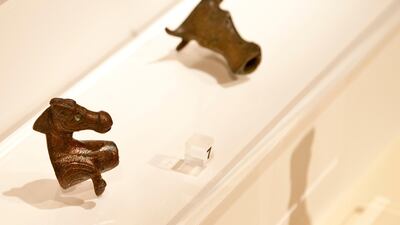
  • Horse shaped and cow head shaped copper alloy spouts, Mleiha, 150AD on display as part of the exhibit "Our Monuments Narrate Our History" at the Sharjah Archaeology Museum on Tuesday, April 16, 2013. All photos: Charles Crowell / The National
    Horse shaped and cow head shaped copper alloy spouts, Mleiha, 150AD on display as part of the exhibit "Our Monuments Narrate Our History" at the Sharjah Archaeology Museum on Tuesday, April 16, 2013. All photos: Charles Crowell / The National
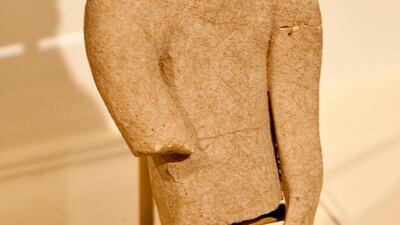
  • A human-shaped ceramic figurine, Mleiha, 100AD.
    A human-shaped ceramic figurine, Mleiha, 100AD.
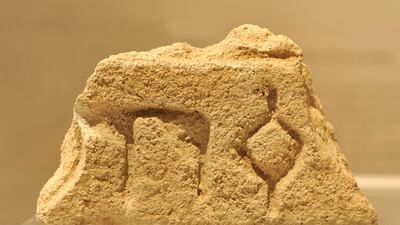
  • Head stone fragments inscribed with South Arabian letters, Mleiha, 150BC.
    Head stone fragments inscribed with South Arabian letters, Mleiha, 150BC.
  • A copper alloy bangle with animal head-shaped terminals (possibly leopard), Al Buhairs 1000-600BC.
    A copper alloy bangle with animal head-shaped terminals (possibly leopard), Al Buhairs 1000-600BC.
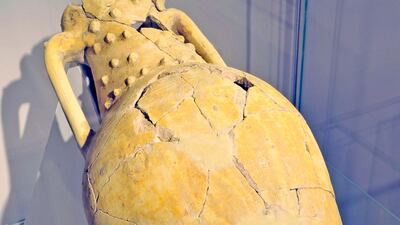
  • A yellow glased amphora with long neck & two handles, Dibba 100AD.
    A yellow glased amphora with long neck & two handles, Dibba 100AD.
  • A large stone incence-burner, Mleiha 100AD.
    A large stone incence-burner, Mleiha 100AD.
  • Glazed ceramic jars, Dibba 1st century.
    Glazed ceramic jars, Dibba 1st century.
  • Several items from Dibba 1st century.
    Several items from Dibba 1st century.
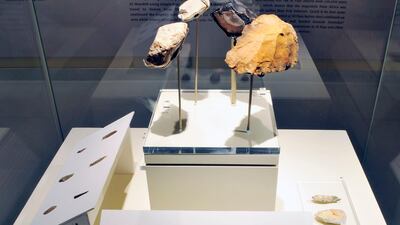
  • Ancient hand axes & knives stones.
    Ancient hand axes & knives stones.
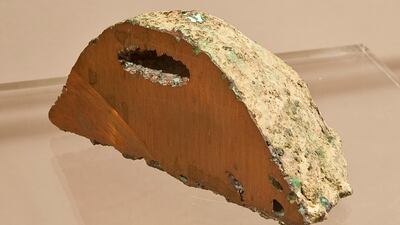
  • A copper ingot found in a workshop, Wadi Al Helo 3rd millennium BC.
    A copper ingot found in a workshop, Wadi Al Helo 3rd millennium BC.
The Details

Article 15
Produced by: Carnival Cinemas, Zee Studios
Directed by: Anubhav Sinha
Starring: Ayushmann Khurrana, Kumud Mishra, Manoj Pahwa, Sayani Gupta, Zeeshan Ayyub
Our rating: 4/5 

Mercer, the investment consulting arm of US services company Marsh & McLennan, expects its wealth division to at least double its assets under management (AUM) in the Middle East as wealth in the region continues to grow despite economic headwinds, a company official said.

Mercer Wealth, which globally has $160 billion in AUM, plans to boost its AUM in the region to $2-$3bn in the next 2-3 years from the present $1bn, said Yasir AbuShaban, a Dubai-based principal with Mercer Wealth.

Within the next two to three years, we are looking at reaching $2 to $3 billion as a conservative estimate and we do see an opportunity to do so,” said Mr AbuShaban.

Mercer does not directly make investments, but allocates clients’ money they have discretion to, to professional asset managers. They also provide advice to clients.

“We have buying power. We can negotiate on their (client’s) behalf with asset managers to provide them lower fees than they otherwise would have to get on their own,” he added.

Mercer Wealth’s clients include sovereign wealth funds, family offices, and insurance companies among others.

From its office in Dubai, Mercer also looks after Africa, India and Turkey, where they also see opportunity for growth.

Wealth creation in Middle East and Africa (MEA) grew 8.5 per cent to $8.1 trillion last year from $7.5tn in 2015, higher than last year’s global average of 6 per cent and the second-highest growth in a region after Asia-Pacific which grew 9.9 per cent, according to consultancy Boston Consulting Group (BCG). In the region, where wealth grew just 1.9 per cent in 2015 compared with 2014, a pickup in oil prices has helped in wealth generation.

BCG is forecasting MEA wealth will rise to $12tn by 2021, growing at an annual average of 8 per cent.

Drivers of wealth generation in the region will be split evenly between new wealth creation and growth of performance of existing assets, according to BCG.

Another general trend in the region is clients’ looking for a comprehensive approach to investing, according to Mr AbuShaban.

“Institutional investors or some of the families are seeing a slowdown in the available capital they have to invest and in that sense they are looking at optimizing the way they manage their portfolios and making sure they are not investing haphazardly and different parts of their investment are working together,” said Mr AbuShaban.

Some clients also have a higher appetite for risk, given the low interest-rate environment that does not provide enough yield for some institutional investors. These clients are keen to invest in illiquid assets, such as private equity and infrastructure.

“What we have seen is a desire for higher returns in what has been a low-return environment specifically in various fixed income or bonds,” he said.

“In this environment, we have seen a de facto increase in the risk that clients are taking in things like illiquid investments, private equity investments, infrastructure and private debt, those kind of investments were higher illiquidity results in incrementally higher returns.”

The Abu Dhabi Investment Authority, one of the largest sovereign wealth funds, said in its 2016 report that has gradually increased its exposure in direct private equity and private credit transactions, mainly in Asian markets and especially in China and India. The authority’s private equity department focused on structured equities owing to “their defensive characteristics.”

The specs

Engine: 4.0-litre V8

Power: 503hp at 6,000rpm

Torque: 685Nm at 2,000rpm

Transmission: 8-speed auto

Price: from Dh850,000

On sale: now

'C'mon C'mon'

Director:Mike Mills

Stars:Joaquin Phoenix, Gaby Hoffmann, Woody Norman

Rating: 4/5

Our family matters legal consultant

Name: Hassan Mohsen Elhais

Position: legal consultant with Al Rowaad Advocates and Legal Consultants.

SANCTIONED
  • Kirill Shamalov, Russia's youngest billionaire and previously married to Putin's daughter Katarina
  • Petr Fradkov, head of recently sanctioned Promsvyazbank and son of former head of Russian Foreign Intelligence, the FSB. 
  • Denis Bortnikov, Deputy President of Russia's largest bank VTB. He is the son of Alexander Bortnikov, head of the FSB which was responsible for the poisoning of political activist Alexey Navalny in August 2020 with banned chemical agent novichok.  
  • Yury Slyusar, director of United Aircraft Corporation, a major aircraft manufacturer for the Russian military.
  • Elena Aleksandrovna Georgieva, chair of the board of Novikombank, a state-owned defence conglomerate.
UAE currency: the story behind the money in your pockets
Milestones on the road to union

1970

October 26: Bahrain withdraws from a proposal to create a federation of nine with the seven Trucial States and Qatar. 

December: Ahmed Al Suwaidi visits New York to discuss potential UN membership.

1971

March 1:  Alex Douglas Hume, Conservative foreign secretary confirms that Britain will leave the Gulf and “strongly supports” the creation of a Union of Arab Emirates.

July 12: Historic meeting at which Sheikh Zayed and Sheikh Rashid make a binding agreement to create what will become the UAE.

July 18: It is announced that the UAE will be formed from six emirates, with a proposed constitution signed. RAK is not yet part of the agreement.

August 6:  The fifth anniversary of Sheikh Zayed becoming Ruler of Abu Dhabi, with official celebrations deferred until later in the year.

August 15: Bahrain becomes independent.

September 3: Qatar becomes independent.

November 23-25: Meeting with Sheikh Zayed and Sheikh Rashid and senior British officials to fix December 2 as date of creation of the UAE.

November 29:  At 5.30pm Iranian forces seize the Greater and Lesser Tunbs by force.

November 30: Despite  a power sharing agreement, Tehran takes full control of Abu Musa. 

November 31: UK officials visit all six participating Emirates to formally end the Trucial States treaties

December 2: 11am, Dubai. New Supreme Council formally elects Sheikh Zayed as President. Treaty of Friendship signed with the UK. 11.30am. Flag raising ceremony at Union House and Al Manhal Palace in Abu Dhabi witnessed by Sheikh Khalifa, then Crown Prince of Abu Dhabi.

December 6: Arab League formally admits the UAE. The first British Ambassador presents his credentials to Sheikh Zayed.

December 9: UAE joins the United Nations.

THE%20HOLDOVERS
%3Cp%3E%3Cstrong%3EDirector%3A%20%3C%2Fstrong%3EAlexander%20Payne%3C%2Fp%3E%0A%3Cp%3E%3Cstrong%3EStarring%3A%3C%2Fstrong%3E%20Paul%20Giamatti%2C%20Da'Vine%20Joy%20Randolph%2C%20Dominic%20Sessa%3C%2Fp%3E%0A%3Cp%3E%3Cstrong%3ERating%3A%3C%2Fstrong%3E%204.5%2F5%3C%2Fp%3E%0A
'My Son'

Director: Christian Carion

Starring: James McAvoy, Claire Foy, Tom Cullen, Gary Lewis

Rating: 2/5

Specs

Engine: 51.5kW electric motor

Range: 400km

Power: 134bhp

Torque: 175Nm

Price: From Dh98,800

Available: Now

Quick pearls of wisdom

Focus on gratitude: And do so deeply, he says. “Think of one to three things a day that you’re grateful for. It needs to be specific, too, don’t just say ‘air.’ Really think about it. If you’re grateful for, say, what your parents have done for you, that will motivate you to do more for the world.”

Know how to fight: Shetty married his wife, Radhi, three years ago (he met her in a meditation class before he went off and became a monk). He says they’ve had to learn to respect each other’s “fighting styles” – he’s a talk it-out-immediately person, while she needs space to think. “When you’re having an argument, remember, it’s not you against each other. It’s both of you against the problem. When you win, they lose. If you’re on a team you have to win together.” 

The specs

Engine: 2.0-litre 4-cyl turbo

Power: 247hp at 6,500rpm

Torque: 370Nm from 1,500-3,500rpm

Transmission: 10-speed auto

Fuel consumption: 7.8L/100km

Price: from Dh94,900

On sale: now

The Brutalist

Director: Brady Corbet

Stars: Adrien Brody, Felicity Jones, Guy Pearce, Joe Alwyn

Rating: 3.5/5

F1 drivers' standings

1. Lewis Hamilton, Mercedes 281

2. Sebastian Vettel, Ferrari 247

3. Valtteri Bottas, Mercedes 222

4. Daniel Ricciardo, Red Bull 177

5. Kimi Raikkonen, Ferrari 138

6. Max Verstappen, Red Bull 93

7. Sergio Perez, Force India 86

8. Esteban Ocon, Force India 56

The%20specs
%3Cp%3E%3Cstrong%3EEngine%3A%20%3C%2Fstrong%3E3.6-litre%2C%20V6%0D%3Cbr%3E%3Cstrong%3ETransmission%3A%20%3C%2Fstrong%3Eeight-speed%20auto%0D%3Cbr%3E%3Cstrong%3EPower%3A%20%3C%2Fstrong%3E285hp%0D%3Cbr%3E%3Cstrong%3ETorque%3A%20%3C%2Fstrong%3E353Nm%0D%3Cbr%3E%3Cstrong%3EPrice%3A%20%3C%2Fstrong%3EDh159%2C900%0D%3Cbr%3E%3Cstrong%3EOn%20sale%3A%20%3C%2Fstrong%3Enow%3C%2Fp%3E%0A
THE CLOWN OF GAZA

Director: Abdulrahman Sabbah 

Starring: Alaa Meqdad

Rating: 4/5

EA Sports FC 26

Publisher: EA Sports

Consoles: PC, PlayStation 4/5, Xbox Series X/S

Rating: 3/5

SPEC%20SHEET%3A%20SAMSUNG%20GALAXY%20S24%20ULTRA
%3Cp%3E%3Cstrong%3EDisplay%3A%3C%2Fstrong%3E%206.8%22%20quad-HD%2B%20dynamic%20Amoled%202X%2C%203120%20x%201440%2C%20505ppi%2C%20HDR10%2B%2C%20120Hz%3C%2Fp%3E%0A%3Cp%3E%3Cstrong%3EProcessor%3A%3C%2Fstrong%3E%204nm%20Qualcomm%20Snapdragon%208%20Gen%203%2C%2064-bit%20octa-core%3C%2Fp%3E%0A%3Cp%3E%3Cstrong%3EMemory%3A%3C%2Fstrong%3E%2012GB%20RAM%3C%2Fp%3E%0A%3Cp%3E%3Cstrong%3EStorage%3A%3C%2Fstrong%3E%20256%2F512GB%20%2F%201TB%3C%2Fp%3E%0A%3Cp%3E%3Cstrong%3EPlatform%3A%3C%2Fstrong%3E%20Android%2014%2C%20One%20UI%206.1%3C%2Fp%3E%0A%3Cp%3E%3Cstrong%3EMain%20camera%3A%3C%2Fstrong%3E%20quad%20200MP%20wide%20f%2F1.7%20%2B%2050MP%20periscope%20telephoto%20f%2F3.4%20with%205x%20optical%2F10x%20optical%20quality%20zoom%20%2B%2010MP%20telephoto%202.4%20with%203x%20optical%20zoom%20%2B%2012MP%20ultra-wide%20f%2F2.2%3B%20100x%20Space%20Zoom%3B%20auto%20HDR%2C%20expert%20RAW%3C%2Fp%3E%0A%3Cp%3E%3Cstrong%3EVideo%3A%3C%2Fstrong%3E%208K%4024%2F30fps%2C%204K%4030%2F60%2F120fps%2C%20full-HD%4030%2F60%2F240fps%2C%20full-HD%20super%20slo-mo%40960fps%3C%2Fp%3E%0A%3Cp%3E%3Cstrong%3EFront%20camera%3A%3C%2Fstrong%3E%2012MP%20f%2F2.2%3C%2Fp%3E%0A%3Cp%3E%3Cstrong%3EBattery%3A%3C%2Fstrong%3E%205000mAh%2C%20fast%20wireless%20charging%202.0%2C%20Wireless%20PowerShare%3C%2Fp%3E%0A%3Cp%3E%3Cstrong%3EConnectivity%3A%3C%2Fstrong%3E%205G%2C%20Wi-Fi%2C%20Bluetooth%205.3%2C%20NFC%3C%2Fp%3E%0A%3Cp%3E%3Cstrong%3EI%2FO%3A%3C%2Fstrong%3E%20USB-C%3B%20built-in%20Galaxy%20S%20Pen%3C%2Fp%3E%0A%3Cp%3E%3Cstrong%3EDurability%3A%3C%2Fstrong%3E%20IP68%2C%20up%20to%201.5m%20of%20freshwater%20up%20to%2030%20minutes%3B%20dust-resistant%26nbsp%3B%3C%2Fp%3E%0A%3Cp%3E%3Cstrong%3ESIM%3A%3C%2Fstrong%3E%20Nano%20%2B%20nano%20%2F%20nano%20%2B%20eSIM%20%2F%20dual%20eSIM%20(varies%20in%20different%20markets)%3C%2Fp%3E%0A%3Cp%3E%3Cstrong%3EColours%3A%3C%2Fstrong%3E%20Titanium%20black%2C%20titanium%20grey%2C%20titanium%20violet%2C%20titanium%20yellow%3C%2Fp%3E%0A%3Cp%3E%3Cstrong%3EIn%20the%20box%3A%20%3C%2Fstrong%3EGalaxy%20S24%20Ultra%2C%20USB-C-to-C%20cable%26nbsp%3B%3C%2Fp%3E%0A%3Cp%3E%3Cstrong%3EPrice%3A%3C%2Fstrong%3E%20Dh5%2C099%20for%20256GB%2C%20Dh5%2C599%20for%20512GB%2C%20Dh6%2C599%20for%201TB%3C%2Fp%3E%0A
Updated: July 04, 2022, 4:00 AM