


If you ask Khawla Al Blooshi what animal she would compare a camel to, her answer may come as a surprise. A big, cuddly cat, is her response.
“They love to be hugged, kissed, talked to and treated with respect,” she told The National.
But despite being born and raised in the UAE, the Emirati, 28, had never ridden a camel until four months ago.
It came about by chance after her friend saw a post online about a camel trek taking place across the desert in December last year.
camel rider
Now, only months after making her debut on board one of the UAE’s most adored animals, Ms Al Blooshi competes alongside men in the heritage sport of camel racing.
“I was not looking to get into camel racing, it just found me,” she said.
“My friend and I are really outdoorsy. We do a lot of hiking and diving and she saw a post online about the camel trek so I registered for it. It was so random and out of the blue. Now I ride camels almost every day and feel guilty when I don't.

“I’m Emirati too, so I thought it would be a great way to get to know more about my heritage and how camels played an important role in Bedouin life.”
She works five days a week, from 9am to 6pm. But Ms Al Blooshi said that with a “great boss that gives lots of flexibility”, she makes it down to the Al Marmoom Race Track most days by 4pm to embark on hours of training with the camels.
Each day she treks about 8km in the desert and helps to feed, saddle up and exercise the beasts.
Last weekend, she also became one of the first Emirati women to compete side-by-side with men in a camel race in Dubai.
“Since I started I’ve become obsessed. I go to bed thinking about camels and wake up thinking about them,” she said.
“It’s been such a natural bonding experience for me.

“I competed in my first race last weekend and I smiled all the way to the finishing line.
“The male competitors were very sceptical to see two women riders at first but by the end of the race, they were shouting ‘number one, number one’ at me in Arabic. It was a great moment to experience.”
Riding on the four-kilometre track as part of the preliminary race for the annual UAE National Day Camel Marathon, Ms Al Blooshi competed in the 18-29 age category, and travelled at speeds of up to 45kph.
She said her active lifestyle helped her adjust to staying on top of the camel as it requires a “lot of balance and strength”.
The second preliminary race is scheduled for December 3, coinciding with the country's 50th National Day, while the main marathon, organised by the Hamdan bin Mohammed Heritage Centre, will be held on January 14.
“I’m also taking part in the 14-day camel trek across the desert, from Liwa to Expo 2020 Dubai, on December 9 and I can’t wait,” she said.
“We will be trekking for up to eight hours a day but the one thing I have learnt is that you have to trust and go with your camel.
“If they have a bad day and are moody, they might go a little off course but you just have to bear with it.
“It will be an experience to remember for a lifetime to come.”
All women camel racing team in UAE - in pictures
-

Katie Higgins is part of the first all-female camel racing team in the UAE. Chris Whiteoak / The National -

Ms Higgins (second from left) and Linda Krockenberger (third from left) at the Arabian Desert Camel Riding Centre in Dubai. Chris Whiteoak / The National -

Ms Higgins competed in the first Female Camel Racing Series C1 Championship at Al Marmoom Camel Racing Track in October. Chris Whiteoak / The National -

The Irish art teacher says she used to be petrified of camels. Chris Whiteoak / The National -

Ms Higgins says each camel has its own personality. Chris Whiteoak / The National -

Ms Higgins and Ms Krockenberger set up the UAE’s first camel racing team, made up solely of women, after a chance meeting on social media. Chris Whiteoak / The National -

Ms Higgins and Ms Krockenberger with one of the racing camels. Chris Whiteoak / The National -

While some of the team had horse riding experience, most are completely new to the sport. Chris Whiteoak / The National -

The team trains in the mornings and evenings and covers between eight and 12 kilometres in each session. Chris Whiteoak / The National -
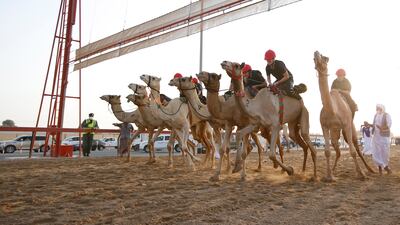
Female participants compete during the first Female Camel Racing Series C1 Championship at Al Marmoom Camel Racing Track in Dubai. EPA -
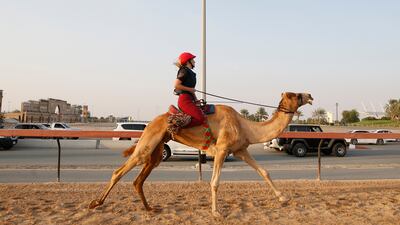
Eight female participants took part in the race. EPA -

The all-female camel racing team. EPA -
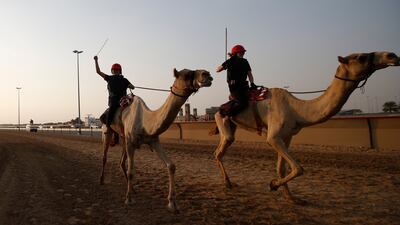
Travelling at speeds of up to 45kmph, riders hold on to a small handle for support and use a stick to help direct the camel. EPA



