


With new cases emerging at a rate of more than 200,000 each day and lockdowns being re-imposed, the coronavirus pandemic is not over.
It is also clear that its impact has varied hugely, with some rich nations hit far harder than poorer neighbours.
Tentative explanations for this situation from comparisons of how countries responded to the viral threat are beginning to emerge.
Tying them together is a phenomenon which repeatedly caught governments out – with tragic results.
Scientists gave it the unremarkable name of non-linearity, but its power is anything but unremarkable.
It means that small effects do not always have small consequences. We have all experienced non-linearity in everyday life – such as sleeping through an alarm call. Getting out of bed 15 minutes late could mean we miss a crucial meeting – with long-term consequences for our careers.
Now nations are witnessing the consequences of what were, at first glance, slight errors in their response to the pandemic.
Nowhere demonstrates this more clearly than the United Kingdom. In mid-March, a week after the country’s first recorded death from the disease, Prime Minister Boris Johnson announced that unless action was taken “cases could double every five to six days”.
Even at the time, that seemed too slow – members of the public said official figures suggested a doubling time of around three days.
It later emerged the government's figure was based not on data from the UK but from Wuhan, the city in central China where the outbreak was first reported. Analysis showed that the “armchair experts” were closer to the truth and, on March 23, Mr Johnson announced an immediate lockdown.
The debacle had consequences beyond embarrassment for government advisers. A pandemic is the quintessential non-linear phenomenon. One infected person passes the virus to several others. After a few days of incubation and contact with others, each of them infects several more people – an effect which gives the so-called reproduction number "R".
The result is exponential growth. If R equals 3, this means the number of infected people grows as powers of 3 – that is 9, 27, 81, 243 and so on – a rate of growth which can quickly engulf a nation.
To end the pandemic, R must be brought below 1. But its non-linear effect means even a short delay in taking action can vastly increase the death-toll.
In the case of the UK, where case numbers were doubling every three to four days, the mathematics of exponential growth showed that the epidemic roughly quadrupled in size every week.
And, crucially, that four-fold increase remains “baked in” for the rest of the epidemic. In other words, one week of delay keeps the numbers of cases four times higher than they need have been, week in, week out until the epidemic ends.
Put another way, as much as 75 per cent of the UK’s current toll of 45,000 deaths – among the worst per capita in the world – could have been avoided.
It is a lesson in the power of non-linearity underlined by the experience of other countries which have fared much better.
Vietnam, which borders China, had its first case of Covid-19 – a man visiting from Wuhan – on January 23. The government put its pandemic response plans into action the next day. Districts were put into strict lockdown, along with mass testing of both the sick and healthy.
Seen by some at the time as an over-reaction, the rapid response led to Vietnam having fewer than 400 cases, and not a single death.
In general, Asian countries – including China – have demonstrated the effectiveness of speed when facing the non-linear threat of epidemics.
-
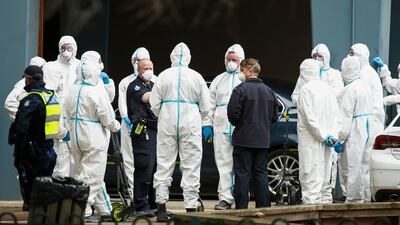
Workers in personal protective equipment are seen alongside police patrols in Melbourne, Australia. Nine public housing towers are placed under lockdown, with a stay-at-home order announced for the whole city starting from Wednesday. Getty Images -
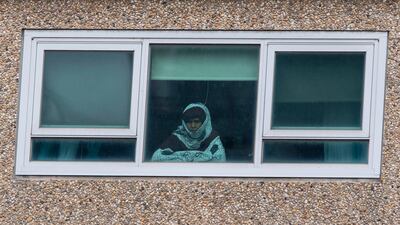
A woman looks out a window from a locked-down public housing tower in Melbourne. AP Photo -
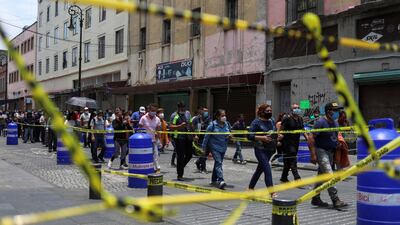
People walk along the street before entering the area where stores are open, during the gradual reopening of commercial activities in in Mexico City. Reuters -
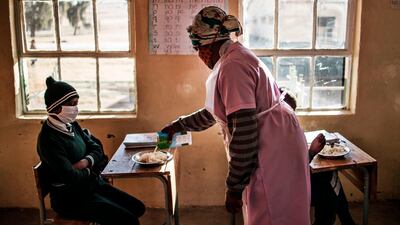
Grade 7 pupils of the Sitoromo Junior Secondary School in Sterkspruit, South Africa, sit in their classroom as a cook pours milk into a steaming dish of maize porridge. The school reopened only for Grade 7 pupils after being shut for two weeks because of a Covid-19 case found among its staff. AFP -

Serbian army soldiers prepare a makeshift field hospital inside the Belgrade Arena. AFP -
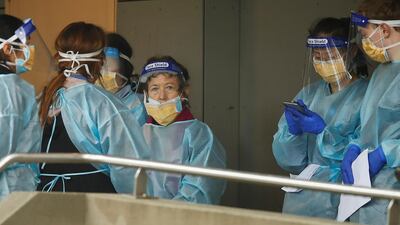
Workers in personal protective equipment in Melbourne, Australia. Getty Images -
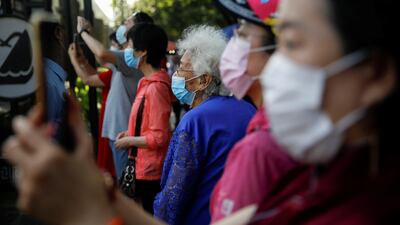
People wearing face masks stand outside a high school as their wards write the annual national college entrance exam, which had been postponed by a month, in Beijing, China. Reuters -
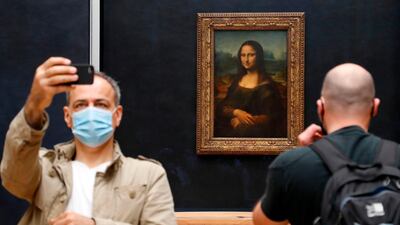
A visitor wearing a face mask takes a selfie in front of Leonardo da Vinci masterpiece "Mona Lisa" at the Louvre Museum in Paris, on the museum's reopening day. AFP -
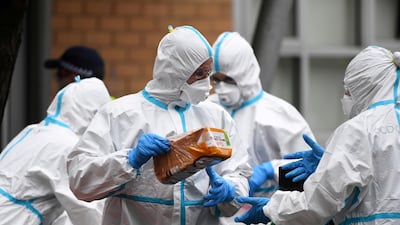
Firefighters prepare to distribute food at a public housing tower in Melbourne, Australia. Reuters -
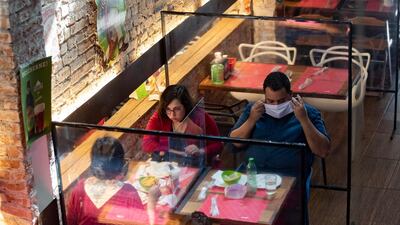
People eat lunch at a restaurant with plastic dividers between tables, as a preventative measure amid the Covid-19 pandemic in Sao Paulo, Brazil. AP Photo -

Marcela Alvarez holds her birthday party in her home's balcony in Buenos Aires. AP Photo -
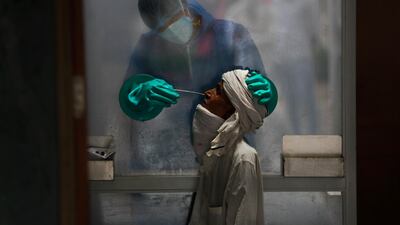
A health worker takes a nasal swab of a person for a Covid-19 test at a hospital in New Delhi, India. AP Photo


But there is one key exception: Japan. It, too, has achieved a toll of fewer than 1,000 deaths – a per capita rate 80 times below that of the UK – and despite having a more elderly and vulnerable demographic.
Yet this success is perplexing given that Japan’s response has been far less draconian than some of its neighbours. Plans to tackle the virus only took shape in late February, and the lockdown policy amounted to little more than a polite request. Mass testing has never been carried out there.
But Dr Tomoya Saito, director of the crisis management team at Japan’s National Institute of Public Health, highlighted three key features of the nation's response.
First, the population has a long tradition of wearing face masks – now regarded a simple means of keeping infection rates low.
Second, the country has a well-established track-and-trace system for contacting and isolating infected people to prevent further spread.
Finally, while shunning blanket lockdowns, the government has advised the public to avoid the Three Cs: closed, crowded spaces with close contact. Studies early in the epidemic revealed these to be prime culprits for outbreaks.
In short, there are multiple reasons for Japan’s success in dealing with the epidemic with relatively minor upheaval.
And that highlights the flip-side of non-linearity. By amplifying small effects, it can turn seemingly minor countermeasures into major victories against the virus.
This holds important lessons not just for future pandemics, but for the one now engulfing the world.
Six months after the virus first emerged in China, scientists are still arguing over the effectiveness of face masks, levels of social distancing, and other measures like antiseptic gargling.
Recent research has shown, however, that the non-linear nature of epidemics can turn modest benefit into potential game-changers – especially after lockdowns are lifted.
There are now calls for a global coalition to be set up to investigate this multi-pronged strategy as a matter of urgency.
Governments around the world need to take this call seriously, because the biggest lesson of the pandemic so far is that every second counts.
Robert Matthews is visiting professor of science at Aston University, Birmingham, UK

