


Early detection of heart defects in babies through portable ultrasound machines developed at the Mohamed bin Zayed University of Artificial Intelligence could help save millions of lives in the developing world.
Once paired with AI technology for predictive diagnosis, scanners can pick up signs an unborn baby may have a treatable congenital heart anomaly.
By cross-checking scans taken between 18 and 21 weeks of pregnancy with other anonymous foetal data, the AI can quickly identify potential problems needing further medical attention.
The point of care handheld scanners costs around $5,000 (Dh18,300), significantly cheaper than the $70,000 (Dh62,400) or so required for a hospital-grade ultrasound machine.
paediatric cardiologist
Continuing research at the university has found the AI-based system, which compares scans with a broad database of similar results, reduces the time taken to assess images from around an hour to 10 minutes in some cases.
Researchers said the affordable system could be rolled out to developing nations with limited health resources, reducing time spent by doctors checking pregnancy scans.
“Currently, many people in villages and remote areas of developing regions are left without access to scans, which means severe but treatable conditions are left to develop unchecked, a tragedy for the patients and their families,” said Mohammad Yaqub, an associate professor in Computer Vision at the university, who led the research.
“Using AI to detect anomalies has the potential to reduce the time taken to assess each scan from a mean average of between 40 minutes and one hour to just 10-20 minutes.
“It is worth highlighting that the AI component of this type of medical treatment does not replace the human clinician; rather, it helps by doing the heavy lifting of interpreting scans and flagging those that need attention.
“In many parts of the world, this service could give millions of people their first access to reliable foetal cardiovascular and pregnancy checks.”
Environmental factors
Congenital heart disease occurs when the foetal heart doesn’t develop correctly in the uterus.
It can be due to abnormal chromosomes or genetics, drinking or smoking during pregnancy or a maternal illness or viral infection.
Some cases heal themselves, while others develop but don’t require treatment. More serious cases must be treated soon after birth.
Around one in every 100 people will be born with a heart malformation of some kind or congenital heart disease.
Half of them will require medical intervention at some point, with 25 per cent requiring lifesaving surgery in their first year.

Without access to reliable cardiac care, 90 per cent of babies born with a congenital heart problem in low- to middle-income countries are at greater risk of death or disability.
Researchers said clinics could use portable ultrasound scanners to perform and analyse mid-pregnancy anomaly scans, typically given between 18 and 21 weeks.
“The advantage of ultrasound scans is they are relatively affordable and easy to administer,” said Dr Yaqub.
“It is important to recognise that the challenge of providing healthcare services to a growing global population will require the combined efforts of governments, research organisations and the public and private sectors to solve.”
Lifesaving scans
A detailed cardiac scan in pregnancy can detect several serious conditions, such as ventricular and atrial septal defects, aortic arch anomalies and hypoplastic left heart syndrome, which prevents normal blood flow through the heart.
A foetal cardiac echocardiography and specialised ultrasound is given during high-risk pregnancies, showing the structure, function and blood flow of a baby’s heart.
“These scans are highly important and lifesaving,” said Dr Mariam Awatai, a consultant in obstetrics and gynaecology with over 30 years' experience, who operates her own clinic in Dubai Healthcare City.
“Current international guidelines state every pregnant woman should have a detailed anomaly scan between 20-22 weeks, including a detailed cardiac scan.
“In low-resource countries, this becomes difficult.

“The machines are expensive and require a lot of electricity and professional training, which also takes time.
“Unfortunately, in a low-resource setting, it is difficult for pregnant women to access this.
“Innovating smaller, portable machines, although not giving the exact same resolution to pick up congenital abnormalities, will be useful in bridging the gap of accessibility.”
Survival rates
Although survival rates for congenital heart disease in the developed world increased from around 10 per cent in the 1950s to more than 90 per cent today, poorer nations still lag behind, largely a result of late detection or lack of expert care.
Rheumatic heart disease is another preventable non-communicable disease that affects between 1.5 and 3 per cent of school-age children in Africa, with one in 10 children dying within 12 months of diagnosis, World Heart Federation data shows.
“Small defects cannot always be picked up before birth, but this kind of scan is very important to picking up particularly dangerous conditions,” said Dr Fadel Husrom, a paediatric cardiologist at NMC Royal Hospital Sharjah.
“It allows treatment to be planned very soon after birth.
“Congenital heart disease is present in 10 of every 1,000 births, so it is a significant percentage, with critical cases accounting for a third of those births," Dr Husrom added.
“If we can detect these problems early and give the right treatment we can save thousands, if not millions of lives worldwide each year.”
Mohamed bin Zayed University of Artificial Intelligence - in pictures
-

Mohamed bin Zayed University of Artificial Intelligence commencement of class 2023 ceremony at the Abu Dhabi Energy Centre on June 4, 2023. All photos: Khushnum Bhandari / The National -
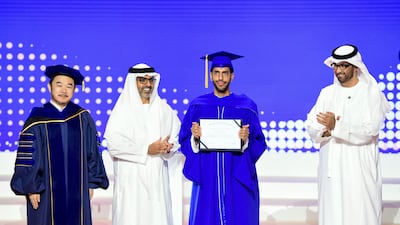
The ceremony was attended by Sheikh Hamed bin Zayed, director of Abu Dhabi Investment Authority, and Dr Sultan Al Jaber, Minister of Industry and Advanced Technology -
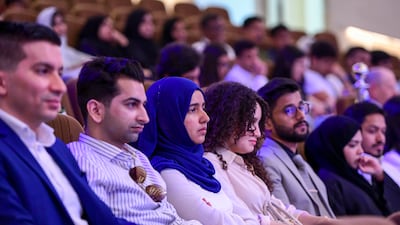
Guests in the audience during the Mohamed bin Zayed University of Artificial Intelligence commencement of class 2023 ceremony. -

A commencement ceremony on Sunday saw 59 students receive their postgraduate degrees -
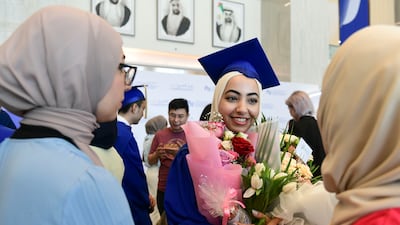
It is estimated that AI could contribute $320 billion to the Middle East economy in 2030, with the UAE seeing the greatest gain. -

Family and friends take photos with the graduates at the Mohamed bin Zayed University of Artificial Intelligence commencement of class 2023 ceremony. -
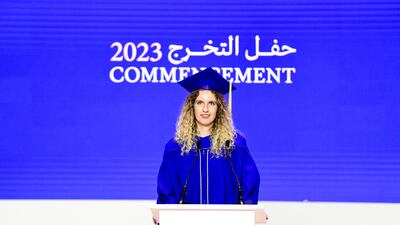
Klea Ziu, Master of Science in Machine Learning, Class of 2023 Valedictorian the Mohamed bin Zayed University of Artificial Intelligence commencement of class 2023 ceremony. -

The graduating class comes from 25 different countries, including the UAE, China, Africa and other parts of the Middle East.



