



Eight countries have pledged to devote all resources needed to eradicate Guinea worm disease by 2030.
Officials from Chad, Ethiopia, South Sudan, Angola, Sudan, the Democratic Republic of the Congo, and Cameroon agreed to fight the disease and endorsed the Abu Dhabi Declaration on the Eradication of Guinea Worm Disease in the UAE capital on Wednesday.
These countries participated in the 2022 Guinea Worm Summit, held from March 20 to March 22.
The three-day event was co-hosted by The Carter Centre and Reaching the Last Mile, which consists of several global health programmes working to eliminate the disease.
For more than 30 years, The Carter Centre, founded by former US president Jimmy Carter, has been on a mission to wipe out this ancient disease. If progress continues, it is poised to become the second human disease in history to be eradicated – smallpox was the first.
Several dignitaries from formerly endemic countries and partner countries offered support to the nations where the disease remains. Donor countries and organisations also renewed their pledges to support the campaign.
The aim of the summit was to secure recommitments from the final Guinea worm-endemic countries (Angola, Chad, Ethiopia, Mali, South Sudan) and pre-certification countries (Congo and Sudan), as well as Cameroon, a country affected by cross-border infection.
In 1986, when The Carter Centre started the eradication campaign, there were nearly 3.5 million cases in 21 countries.
But in 2021, just 15 human cases of Guinea worm disease were reported in four countries.
“Thanks to the commitment of The Carter Centre and partners around the world, we have made incredible progress towards ending Guinea worm disease – but the work is not over," said Sheikh Shakhbut bin Nahyan, UAE Minister of State.
"This week we were honored to convene global champions of the eradication effort in Abu Dhabi to renew our shared commitment towards reaching that last mile of disease eradication.
“It is a privilege to continue the legacy of the founder of our nation, late Sheikh Zayed, who believed no one should suffer from a preventable disease. Reaching the last mile of Guinea worm disease cannot come soon enough.”
In July 1990, the late Sheikh Zayed invited former US president Jimmy Carter to the UAE for the first time.
During the meeting, Mr Carter described his initiative to wipe out a parasitic disease affecting millions of people across Africa and Asia.
The late Sheikh Zayed responded with a substantial personal donation to The Carter Centre, and since then Abu Dhabi has remained committed to eradicating the disease.
“We observed a dramatic reduction in both human cases and animal infections last year, and I want to help our country partners continue this progress,” said Adam J. Weiss, director of the Guinea Worm Eradication Programme at The Carter Centre.

“The final part of any eradication campaign is the most difficult and expensive, and significant resources are being devoted to eradicating Guinea worm disease. We need to be aggressive to achieve eradication, and this recommitment comes at just the right time.”
Dr Tedros Adhanom Ghebreyesus, director general of the World Health Organisation, said: “We are more than 99 per cent of the way towards consigning Guinea worm to history, but the last mile is the hardest, and the gains we have made can be easily lost.
"Our goal is tantalizingly close, but we need relentless political commitment, fidelity to science, more village volunteers, and sustained financial resources to finish the job and ensure future generations live free of this terrible disease.”
Jason Carter, chairman of The Carter Centre Board of Trustees and grandson of the Centre’s founders, said his grandfather and late Shiekh Zayed were good friends and they formed an important alliance to fight the disease.
"That rich partnership has endured through three generations, and I believe it will go on even after Guinea worm disease is eradicated," he said.
What is Guinea worm disease?
The parasitic infection is caused by a worm called Dracunculus medinensis. It measures about a metre in length when fully grown.
People become infected when they drink water contaminated with tiny water fleas that carry Guinea worm larvae.
Human beings and animals can also contract the disease by eating raw fish that temporarily harbour the larvae.
While there is no medicine to cure Guinea worm nor a vaccine to prevent it, disease transmission has been drastically reduced through community-based interventions and awareness campaigns focusing on behavioural changes.
The disease incapacitates people for extended periods of time, making them unable to care for themselves, work, grow food for their families, or attend school.
Tackling Guinea worm disease - in pictures
-
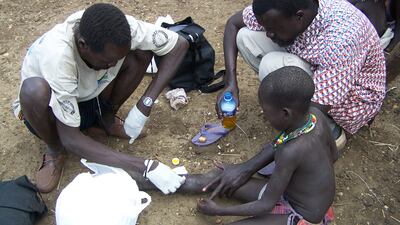
A health worker extracts a worm from a child's leg as Samuel Makoy Yibi, the national co-ordinator for the Guinea Worm Eradication Programme in South Sudan, assists. -
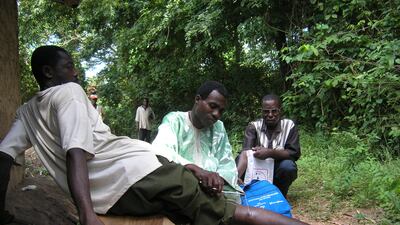
A volunteer in Nigeria inspects a Guinea worm emerging from a man's calf. Guinea worm is on track to become the second human disease, and the first parasitic infection, to be eradicated as cases hit an all-time low. -
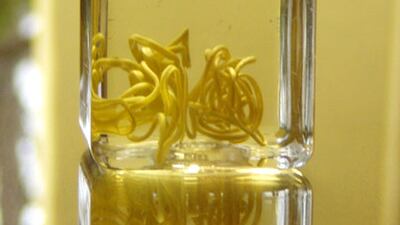
Guinea worms are thin, thread-like parasites. Inside the human body, they can grow up to one metre before emerging through the skin. -

A woman in Nigeria filters drinking water using a simple cloth filter. Nigeria, previously the world’s most endemic country, reported its last case of Guinea worm disease in 2008. -
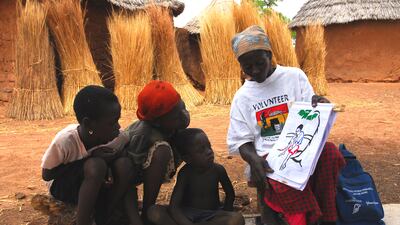
A woman uses flip charts to show schoolchildren how Guinea worm disease is contracted, and what they must do to prevent it. Last year, the UAE pledged $10 million to help fight the disease. -

Former US president Jimmy Carter comforts a child who is being treated for Guinea worm disease. A non-profit he founded, The Carter Centre, has been on a mission to wipe out the disease.



