


Scientists in Dubai are preparing to roll out a Covid-19 vaccine for animals that was developed in the early stages of the pandemic.
The Central Veterinary Research Laboratory (CVRL), a state-of-the-art testing centre established in Dubai in 1985, is determining which members of the animal kingdom will benefit most from being immunised.
While the global campaign to vaccine the human population marches on, important strides are also being made to better understand how the virus impacts animals.
The centre is using an Elisa test, which detects antibodies, to analyse 500 samples of blood serum from 19 animal species to look for antibodies against the coronavirus.
Antibodies are specialised proteins produced by the immune system in response to infection or vaccination.
“If we find antibodies, it means they’ve had contact with the virus and most probably they can get sick,” said Dr Ulrich Wernery, the CVRL’s scientific director.
“For vaccination, we should concentrate on the animals that have developed Covid-19 antibodies. Very soon we’ll have results.”
There have already been outbreaks of Covid-19 in animals, including among mink on fur farms, which caught the virus from their human handlers.
Some mink passed the coronavirus back to people, a concerning development since it raises the risk of new mutated forms of the pathogen emerging when the virus crosses the species barrier.
Thousands of mink were culled to stem the outbreaks in fur farms, but vaccination may be able to prevent this happening again.
It could also be employed to protect endangered animals, including zoo animals, where the loss of individuals could further threaten a species.
Camels, which are the focus of much of the CVRL’s work, are not thought to be vulnerable to Covid-19, whereas big cats in zoos may be.
-
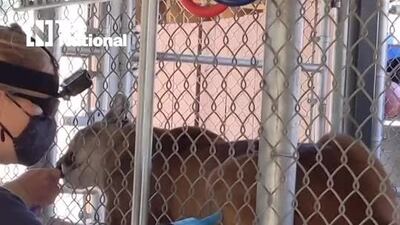
Oakland Zoo has began to vaccinate its animals against Covid-19. All pictures courtesy AP -

The Oakland Zoo is vaccinating its large cats, bears and ferrets against the coronavirus using an experimental vaccine being donated to zoos, sanctuaries and conservatories across the country -
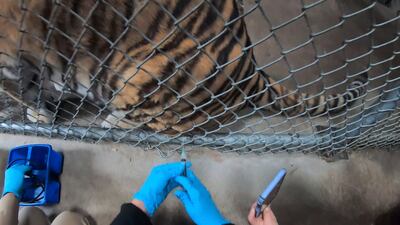
A tiger receives a Covid-19 vaccine at the Oakland Zoo in Oakland, California -
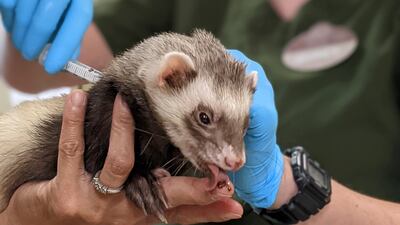
Archie, the ferret receives a Covid-19 vaccine while enjoying a treat from veterinarians at the Oakland Zoo -
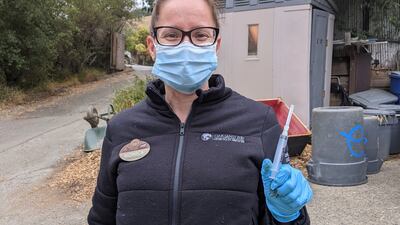
Monica Fox administers vaccines at the Oakland Zoo -
The health of animals is being protected at Oakland Zoo during the pandemic


The deaths earlier this year of two white tiger cubs in a zoo in Pakistan and a lioness at an Indian zoo are thought to have been due to Covid-19.
A species is thought to be more likely to be at risk if it has a receptor called ACE2 on the outside of its cells, as the virus can latch onto this and use it to enter the cells and replicate.
Dr Michael Francis, a virologist who has been involved in the development of several animal vaccines, said that so far animal vaccinations against Covid-19 had been “fairly limited”.
Vaccination drive could boost agriculture
However, while animal vaccination for the coronavirus that causes Covid-19 has not been widespread, there are established vaccines to combat other coronavirus infections in animals.
Most animal vaccination against Covid-19 has, Dr Francis said, involved particular species, such as large cats and primates in zoos, which may be able to contract the coronavirus from their keepers.
“I think people are worried about these more precious animals,” he said, adding that if he were responsible for zoo animals he would be “somewhat concerned” about the risk that they could become infected and die.
Farms may also want to vaccinate their animals against Covid-19, as disease can spread easily, particularly under intensive farming conditions.
“If [mink farmers] are allowed to build their farms back up, they could include Covid on the list of diseases they vaccinate against,” said Dr Francis, who is managing director of BioVacc Consulting in the UK.
CVRL’s jab is an inactivated vaccine, made harmless by chemical treatment.
No organisations have yet approached the CVRL to purchase the jab, which was developed in March last year, but the centre could produce batches within a short period.
“We are confident we can produce this vaccine if we are asked because we have already developed this vaccine in a small volume,” said Dr Sunitha Joseph, head of the virology department at CVRL, who has been involved in the Covid-19 research.

