


An Abu Dhabi resident has spoken about her decades-long battle with a rare autoimmune disease, and how doctors at Cleveland Clinic treated the condition.
Dania Malki, 52, suffered for 30 years from eosinophilic granulomatosis with polyangiitis (EGPA), a condition that affects two to five in every one million people each year.
Ms Malki said she visited many doctors in the UAE and US, but all of them put her on steroids to treat the symptoms that are similar to asthma.
EGPA happens when certain types of cells in a person's blood or tissues swell.
While EGPA can affect a patient's nerves, heart and kidneys, it most commonly affects the lungs and upper airways.
Although the cause of the inflammation is unknown, experts suspect it is linked to the immune system failing to function.
It causes shortness of breath, coughing, and could easily be mistaken for asthma.
Ms Malki, a Syrian-American citizen, started to develop symptoms in 1992 while studying at a university in Los Angeles.
“It started as asthma and I was treated for it,” she said.
At the time the disease was not as well-known among doctors as it is today, she said.
Her condition flared up every few years owing to emotional stress, which aggravated the symptoms.
“It was quite erratic in my case," said Ms Malki, a communications professional and artist.

“The first bad attack happened in the late 90s, when I went back to Syria after finishing my studies in the US.
“The second time it escalated was after my divorce, nearly 10 years later, and the third time was in 2011 or so when my family was stuck in Syria during the beginning of the war.”
Dr Fulvio Salvo, an immunologist at Cleveland Clinic Abu Dhabi who treated Ms Malki, said asthma and EGPA can have a "relevant impact on the mental health of patients".
"Stress and anxiety may worsen asthma, increasing the rate of exacerbation and the use of medication," he said.
In Ms Malki’s case, there were years when she did not experience any symptoms but her condition deteriorated over time.
Every time her symptoms flared, she struggled to breathe and could not walk even for a few steps.
“I found it difficult to breathe after light activities like going up the stairs, doing groceries, or painting with oil as the solvent tends to have strong fumes,” she said.
“I love to paint and there were times when the smell of the paint would affect me so much I couldn’t do it any more.
“There were years where I just couldn’t do anything. I used to work full time and felt very weak by the end of the day.
“Eight years ago, I had to give up work because I had become too weak. I would have to lie down to rest every two hours.”
Ms Malki’s social life also suffered.
“I felt too weak to see people,” she said.
After she had the disease diagnosed, Ms Malki tried many treatments, including asthma inhalers and immunosuppressants usually given to patients who have had an organ transplant.
She was also constantly on cortisone, a steroid.
“I was going from one doctor to another. Some would know about EGPA, but most would just try to treat my asthma. I wasn’t really treated, but just put on long-term cortisone,” she said.
“Sometimes the doctors would try to stop the cortisone, telling me it’s not good to be on it for a long time, but the symptoms would come straight back when I stopped taking it.
“At the beginning, cortisone was like a magic pill as it minimised the symptoms but eventually it became almost toxic.”
In 2019, Ms Malki went to Cleveland Clinic for treatment.
“Their team of doctors introduced me to an injection, Nucala, which contains mepolizumab, a type of drug. It helps reduce asthma symptoms, specifically the ones related to eosinophilic,” she said.
The Nucala injection was first approved in the US in 2015, as an add-on maintenance treatment for patients with severe eosinophilic.
Nucala has also been found to be effective in treating EGPA, researchers in the US have said.
A recent year-long clinical study of people with the disease found out that 40 per cent of those treated with Nucala were free from symptoms for up to 36 weeks.
“When Dania came she had been struggling for a very long time," Dr Salvo said.
"She was highly symptomatic, struggled with her breathing and had many limitations in her daily life due to shortness of breath and coughing."
She had received a lot of care over the years, but was never able to achieve proper control of her symptoms, he said.
“Her symptoms were ruling her life despite the fact that she was on the maximal dose of asthma control medications, immunosuppressants and cortisone – the long-term effect of which can be very serious," he said.
Dr Salvo said he was concerned because she was on cortisone for more than 20 years.
“We decided to try a new treatment, a biologic medication that’s available here and has been shown to be effective in treating EGPA," he said.
After taking the monthly prescribed injections of Nucala, her dependence on other medications reduced gradually.
“As her condition improved, she could stop taking immunosuppressants and some of her asthma medications. Now she only receives a minimal dose of cortisone,” Dr Salvo said.
“Her condition has improved so much that she is exercising, planning to travel and hoping to display her art – paintings of street scenes and landscapes of Syria, her ancestral home.”
Ms Malki said she felt "better than ever". She is exercising again, meets friends and is making plans for the future.
“I’m on a monthly injection, but that is much better than taking several medicines with many side effects,” she said.
“Now I feel the effects of it and the results are clear.”
Doctors perform complex surgeries at Cleveland Clinic Abu Dhabi - in pictures
-
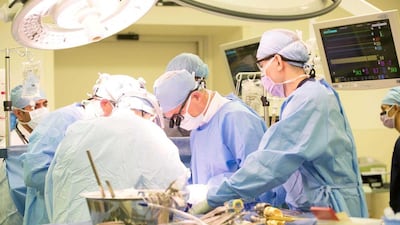
Surgeons perform a heart operation at Cleveland Clinic Abu Dhabi. Photo: Cleveland Clinic Abu Dhabi -
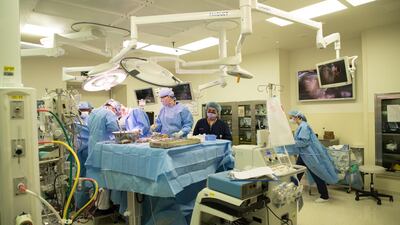
A kidney transplant operation is performed at Cleveland Clinic Abu Dhabi. Photo: Cleveland Clinic Abu Dhabi -
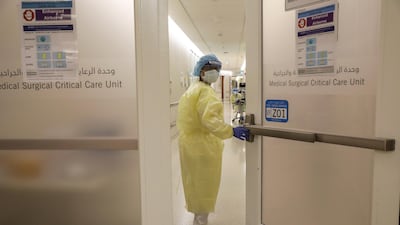
A nurse enters the intensive care unit at the Cleveland Clinic Abu Dhabi in Abu Dhabi. Reuters -
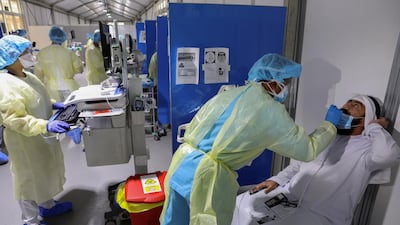
A member of medical staff swabs a man during testing at the Cleveland Clinic Abu Dhabi. Reuters -
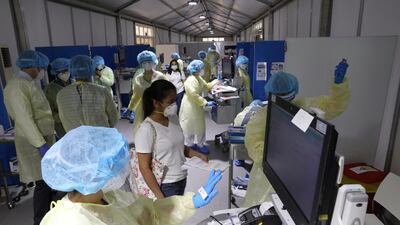
A woman waits to be tested by medical staff at Cleveland Clinic Abu Dhabi. Reuters -
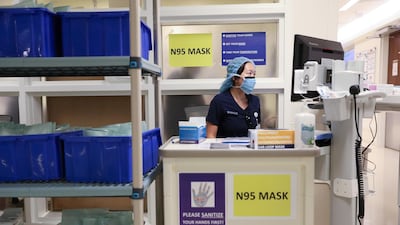
A member of medical staff works at an N95 face mask collection point at Cleveland Clinic Abu Dhabi. Reuters -
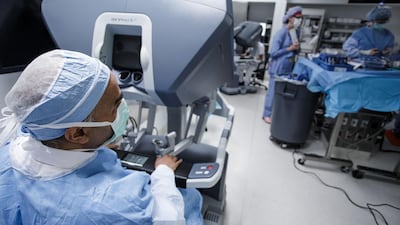
Robot-assisted surgery was performed on a man in Abu Dhabi after he was diagnosed with two kinds of cancer. Photo: Cleveland Clinic Abu Dhabi -
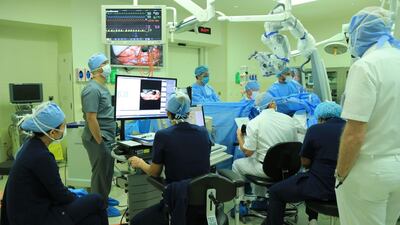
A team of medical specialists at Cleveland Clinic Abu Dhabi spent six weeks repairing complications following bariatric surgery on an Emirati patient. Photo: Cleveland Clinic Abu Dhabi -
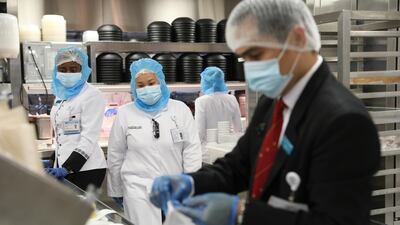
Hospital staff prepare meals for the Covid-19 patients at Cleveland Clinic Abu Dhabi. Reuters -
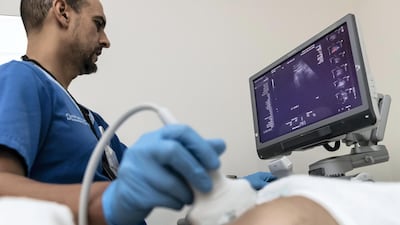
A medical technician performs an ultrasound at Cleveland Clinic Abu Dhabi. Antonie Robertson / The National -
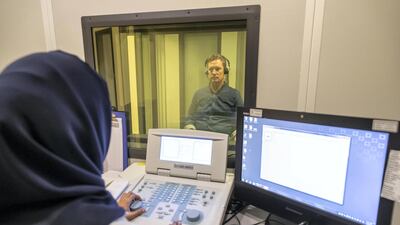
An audiologist performs a comprehensive hearing test at The Cleveland Clinic in Abu Dhabi. Antonie Robertson / The National -
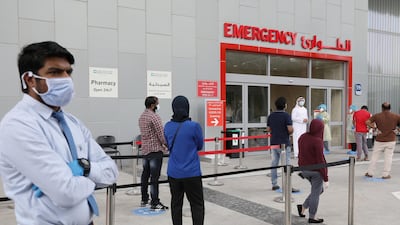
People wait to be tested for Covid-19 virus at Cleveland Clinic Abu Dhabi. Reuters -

A view of Cleveland Clinic Abu Dhabi. Victor Besa / The National



