
The UAE government will hold a brainstorming retreat this week to plot the country’s next 50 years of development.
Sheikh Mohammed bin Rashid, Vice President and Ruler of Dubai, will lead the event with Sheikh Mohamed bin Zayed, Crown Prince of Abu Dhabi and Deputy Supreme Commander of the Armed Forces.
Discussions on Tuesday and Wednesday will focus on how the Emirates will navigate the next half-century, what government will look like and “how to accelerate our development process”, Sheikh Mohammed wrote on Twitter.
Ministers and officials will also focus on how to “improve the business and economic environment in our country to achieve new competitive leaps”, he said.
A video that accompanied the tweet showed footage of the recent space missions including the Mars probe success, humanitarian operations and the pursuit of technology.
“The future needs proactive plans, innovative initiatives and new skills with which we can preserve our leadership and success story, and through which we provide a better life for the new generations in this country,” Sheikh Mohammed said.
The gathering is being held to put forward a series of plans and initiatives to prepare the country’s institutions for the next 50 years.
Government officials will be split into working groups and each presented with anticipated challenges to address with a plan. This must include defined responsibilities and specific goals.
Two committees were set up last year to form plans for the country's future and the Golden Jubilee celebration, and present these to the UAE Cabinet.
The 50-Year Preparedness Plan will focus on six areas: government, society, economy, education, infrastructure and environmental sustainability, and security and justice.
A website was launched to encourage community interaction and seek ideas from the public to plan the UAE anniversary.
On December 2, 2021, the country will be 50 years old.
Throughout this year, decision-makers will put the spotlight on its rapid journey to present day – and the challenges and opportunities the next half-century will bring.
UAE rulers lead Mars celebrations - in pictures
-
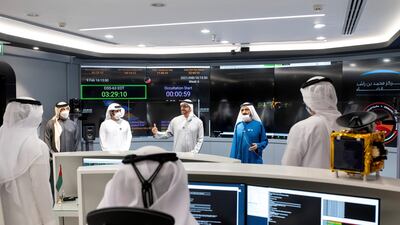
Sheikh Mohammed bin Rashid, Vice President and Ruler of Dubai, and Sheikh Mohamed bin Zayed, Crown Prince of Abu Dhabi and Deputy Supreme Commander of the Armed Forces, meet the Hope Probe team, after its successful entry into the orbit of Mars, at Mohammed Bin Rashid Space Centre. Seen with Sheikh Hamdan bin Mohammed, Crown Prince of Dubai, and Sheikh Mansour bin Zayed, Deputy Prime Minister and Minister of Presidential Affairs. Mohamed Al Hammadi / Ministry of Presidential Affairs -
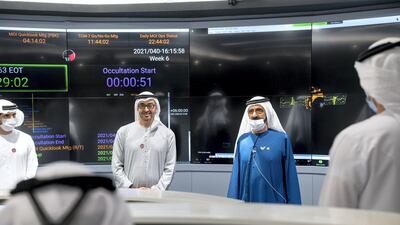
Sheikh Mohammed bin Rashid, Vice President and Ruler of Dubai, and Sheikh Mohamed bin Zayed, Crown Prince of Abu Dhabi and Deputy Supreme Commander of the Armed Forces, meet the Hope Probe team. Mohamed Al Hammadi / Ministry of Presidential Affairs -
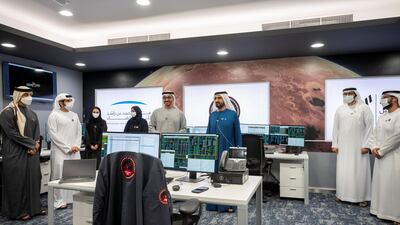
Sheikh Mohammed bin Rashid, Vice President and Ruler of Dubai, and Sheikh Mohamed bin Zayed, Crown Prince of Abu Dhabi and Deputy Supreme Commander of the Armed Forces, at Mohammed Bin Rashid Space Centre. Also there are Sheikh Hamdan bin Mohammed, Crown Prince of Dubai, and Sheikh Mansour bin Zayed, Deputy Prime Minister and Minister of Presidential Affairs. Rashid Al Mansoori / Ministry of Presidential Affairs -
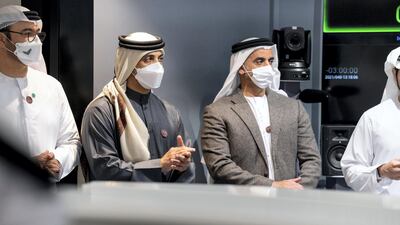
Sheikh Saif bin Zayed, Deputy Prime Minister and Minister of Interior, Sheikh Mansour bin Zayed, Deputy Prime Minister and Minister of Presidential Affairs, and Mohammed Abdulla Al Gergawi, Minister of Cabinet Affairs, at Mohammed Bin Rashid Space Centre. Mohamed Al Hammadi / Ministry of Presidential Affairs -
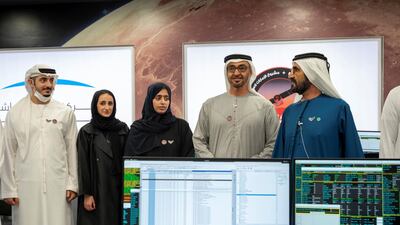
Sheikh Mohammed bin Rashid, Vice President and Ruler of Dubai, and Sheikh Mohamed bin Zayed, Crown Prince of Abu Dhabi and Deputy Supreme Commander of the Armed Forces, meet the Hope Probe team, after its successful entry into the orbit of Mars, at Mohammed Bin Rashid Space Centre. Rashid Al Mansoori / Ministry of Presidential Affairs -
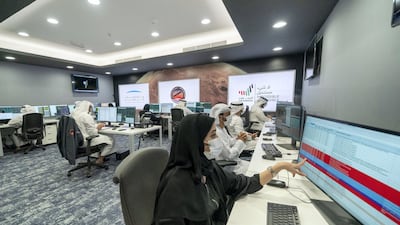
Members of Mohammed Bin Rashid Space Centre participate during the arrival of the Hope Probe in the orbit of Mars. Mohamed Al Hammadi / Ministry of Presidential Affairs -
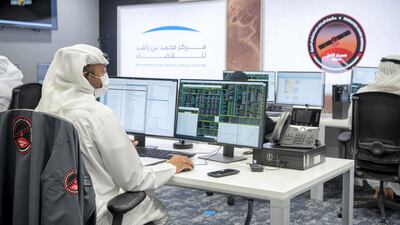
Member of Mohammed Bin Rashid Space Centre participates during the arrival of the Hope Probe in the orbit of Mars. Rashid Al Mansoori / Ministry of Presidential Affairs -

Sheikh Mohammed bin Rashid, Vice-President and Ruler of Dubai, and Sheikh Mohamed bin Zayed, Crown Prince of Abu Dhabi and Deputy Supreme Commander of the Armed Forces, Sheikh Mansour bin Zayed, Deputy Prime Minister and Minister of Presidential Affairs, Sheikh Saif bin Zayed, Deputy Prime Minister and Minister of Interior, Sheikh Hamdan bin Mohammed, Crown Prince of Dubai, Sheikh Hamdan bin Mohammed bin Zayed, Mohammed Al Gergawi, Minister of Cabinet Affairs, Talal Humaid Belhoul Al Falasi, Vice President of Mohammed bin Rashid Space Centre and Hamad Obaid Al Mansoori, Director-General of the Telecommunications Regulatory Authority, witness the arrival of the Hope Probe in the orbit of Mars, at Mohammed Bin Rashid Space Centre. Rashid Al Mansoori / Ministry of Presidential Affairs -

Mohammed Al Gergawi, Minister of Cabinet Affairs, Talal Humaid Belhoul Al Falasi, Vice President of Mohammed bin Rashid Space Centre, and Hamad Obaid Al Mansoori, Director-General of the Telecommunications Regulatory Authority, witness the arrival of the Hope Probe in the orbit of Mars, at Mohammed Bin Rashid Space Centre. Ismaeel Al Zaher / Ministry of Presidential Affairs -

Sheikh Hamdan bin Mohammed bin Zayed, witnesses the arrival of the Hope Probe in the orbit of Mars, at Mohammed Bin Rashid Space Centre. Rashid Al Mansoori / Ministry of Presidential Affairs -

Sheikh Mohammed bin Rashid, Vice President and Ruler of Dubai, Sheikh Mansour bin Zayed, Deputy Prime Minister and Minister of Presidential Affairs, Sheikh Saif bin Zayed, Deputy Prime Minister and Minister of Interior, and Sheikh Hamdan bin Mohammed bin Zayed, witness the arrival of the Hope Probe in the orbit of Mars, at Mohammed Bin Rashid Space Centre. Ismaeel Al Zaher / Ministry of Presidential Affairs -
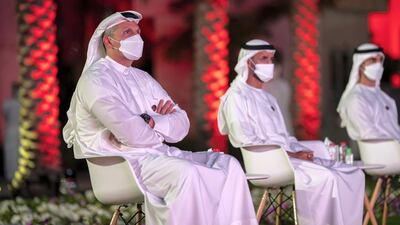
Khaldoon Al Mubarak, chief executive and managing director of Mubadala Investment Company, and Sheikh Mohammed bin Hamad bin Tahnoon, witness the arrival of the Hope Probe in the orbit of Mars, at Mohammed Bin Rashid Space Centre. Ismaeel Al Zaher / Ministry of Presidential Affairs



