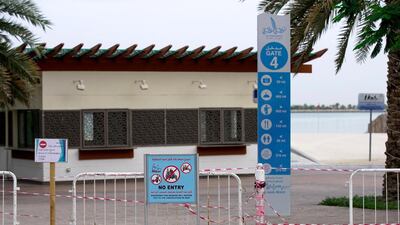
No entry signs at Corniche Beach in Abu Dhabi in April. Public beaches and parks were closed in March to prevent the spread of Covid-19. Victor Besa / The National

Coronavirus: Some Abu Dhabi public parks and beaches reopen


  • English
  • Arabic

Select public beaches and parks reopened in Abu Dhabi from Friday.

The beaches and parks across the emirate were closed in March to prevent the spread of coronavirus.

On Thursday, officials said anyone wishing to visit a public park or beach would have to make a booking in advance through Abu Dhabi's Department of Municipalities and Transport SmartHub.

On Friday, the office confirmed visitors would not have to present a negative Covid-19 test result on Al Hosn, a government smartphone application.

Masks and gloves will be mandatory and people will have their temperatures checked before entering the beach or park. No showers will be available at public beaches.

Groups of no more than four are allowed to visit and facilities will be capped at 40 per cent capacity.

Food and beverage outlets will operate at 30 per cent seating capacity, with a maximum of four people per table and a minimum of 2.5m between tables. Play areas will be closed and parking will be restricted to 50 per cent capacity.

All visitors must maintain at least 2 metres distance from each other.

Areas will be marked out on the ground to ensure social distancing is maintained.

Individual loungers will be spaced in rows at a minimum of 2.5m intervals and couples’ loungers will be placed in pairs with a minimum of 1m between at a minimum of 2.5m intervals.

Those found not adhering to these rules will be fined.

Facilities will be frequently sanitised by municipality workers to ensure the safety of visitors.

The parks set to reopen on Friday include: Umm Al Emarat, Khalifa Park, Al Sulaimi Park in Al Ain and Madinat Zayed Public Park in Al Dhafra.

The beaches include: Corniche Beach, Al Hudayriat and Al Marfa in Al Dhafra.

On Thursday, the municipality said this was the first stage of reopening all public facilities in the emirate.

Park managers said they had been preparing for reopening by disinfecting their amenities.

“We have been working tirelessly in preparation for the reopening as the safety and health of our visitors and employees remains our top priority. We are co-ordinating with the relevant government entities to ensure that the highest standards of safety and precautionary measures are met,” said Rasha Kablawi, head of Umm Al Emarat Park’s corporate affairs and communications department.

“Parks have proven themselves to be vital to health and well-being, particularly in urban environments, and even more so in times like these. We look forward to seeing families and friends come together again to learn, explore, have fun and dine.”


Ten tax points to be aware of in 2026

1. Domestic VAT refund amendments: request your refund within five years

If a business does not apply for the refund on time, they lose their credit.

2. E-invoicing in the UAE

Businesses should continue preparing for the implementation of e-invoicing in the UAE, with 2026 a preparation and transition period ahead of phased mandatory adoption. 

3. More tax audits

Tax authorities are increasingly using data already available across multiple filings to identify audit risks. 

4. More beneficial VAT and excise tax penalty regime

Tax disputes are expected to become more frequent and more structured, with clearer administrative objection and appeal processes. The UAE has adopted a new penalty regime for VAT and excise disputes, which now mirrors the penalty regime for corporate tax.

5. Greater emphasis on statutory audit

There is a greater need for the accuracy of financial statements. The International Financial Reporting Standards standards need to be strictly adhered to and, as a result, the quality of the audits will need to increase.

6. Further transfer pricing enforcement

Transfer pricing enforcement, which refers to the practice of establishing prices for internal transactions between related entities, is expected to broaden in scope. The UAE will shortly open the possibility to negotiate advance pricing agreements, or essentially rulings for transfer pricing purposes. 

7. Limited time periods for audits

Recent amendments also introduce a default five-year limitation period for tax audits and assessments, subject to specific statutory exceptions. While the standard audit and assessment period is five years, this may be extended to up to 15 years in cases involving fraud or tax evasion. 

8. Pillar 2 implementation 

Many multinational groups will begin to feel the practical effect of the Domestic Minimum Top-Up Tax (DMTT), the UAE's implementation of the OECD’s global minimum tax under Pillar 2. While the rules apply for financial years starting on or after January 1, 2025, it is 2026 that marks the transition to an operational phase.

9. Reduced compliance obligations for imported goods and services

Businesses that apply the reverse-charge mechanism for VAT purposes in the UAE may benefit from reduced compliance obligations. 

10. Substance and CbC reporting focus

Tax authorities are expected to continue strengthening the enforcement of economic substance and Country-by-Country (CbC) reporting frameworks. In the UAE, these regimes are increasingly being used as risk-assessment tools, providing tax authorities with a comprehensive view of multinational groups’ global footprints and enabling them to assess whether profits are aligned with real economic activity. 

Contributed by Thomas Vanhee and Hend Rashwan, Aurifer

The%20specs
%3Cp%3E%3Cstrong%3EPowertrain%3A%20%3C%2Fstrong%3ESingle%20electric%20motor%0D%3Cbr%3E%3Cstrong%3EPower%3A%20%3C%2Fstrong%3E201hp%0D%3Cbr%3E%3Cstrong%3ETorque%3A%20%3C%2Fstrong%3E310Nm%0D%3Cbr%3E%3Cstrong%3ETransmission%3A%20%3C%2Fstrong%3ESingle-speed%20auto%0D%3Cbr%3E%3Cstrong%3EBattery%3A%20%3C%2Fstrong%3E53kWh%20lithium-ion%20battery%20pack%20(GS%20base%20model)%3B%2070kWh%20battery%20pack%20(GF)%0D%3Cbr%3E%3Cstrong%3ETouring%20range%3A%20%3C%2Fstrong%3E350km%20(GS)%3B%20480km%20(GF)%0D%3Cbr%3E%3Cstrong%3EPrice%3A%20%3C%2Fstrong%3EFrom%20Dh129%2C900%20(GS)%3B%20Dh149%2C000%20(GF)%0D%3Cbr%3E%3Cstrong%3EOn%20sale%3A%3C%2Fstrong%3E%20Now%3C%2Fp%3E%0A
How to register as a donor

1) Organ donors can register on the Hayat app, run by the Ministry of Health and Prevention

2) There are about 11,000 patients in the country in need of organ transplants

3) People must be over 21. Emiratis and residents can register. 

4) The campaign uses the hashtag  #donate_hope

The Pope's itinerary

Sunday, February 3, 2019 - Rome to Abu Dhabi
1pm: departure by plane from Rome / Fiumicino to Abu Dhabi
10pm: arrival at Abu Dhabi Presidential Airport


Monday, February 4
12pm: welcome ceremony at the main entrance of the Presidential Palace
12.20pm: visit Abu Dhabi Crown Prince at Presidential Palace
5pm: private meeting with Muslim Council of Elders at Sheikh Zayed Grand Mosque
6.10pm: Inter-religious in the Founder's Memorial


Tuesday, February 5 - Abu Dhabi to Rome
9.15am: private visit to undisclosed cathedral
10.30am: public mass at Zayed Sports City – with a homily by Pope Francis
12.40pm: farewell at Abu Dhabi Presidential Airport
1pm: departure by plane to Rome
5pm: arrival at the Rome / Ciampino International Airport