

The Terracotta State Drawing Room in Downing Street, where the major deals between the UAE and UK were signed today, serves as the second reception room of the British Prime Minister's residence.
On the first floor of Number 10 Downing Street, it is the middle of three interlinked state drawing rooms, sandwiched between the Pillared Drawing Room, which is used to for events and grand receptions, and the White Drawing Room, which is often used for Downing Street staff meetings.
The Terracotta Room derives its name from the colour in which it is painted. When Margaret Thatcher came to power in the late 1970s it was called the Blue Room.
She appointed architect Quinlan Terry to refurbish the state drawing rooms at the end of the 1980s. The refurbishment included ornate plasterwork on the ceilings to present a more stately look.
Mr Terry built large Doric order columns into the door surrounds as part of the refurbishment. He also designed a vast Palladian overmantel for the fireplace with small double Doric columns on each side with the royal arms above.
After the refurbishment it was renamed the Green Room, before becoming the Terracotta Room.
Sir Robert Walpole, who held the title of First Lord of the Treasury and effectively served as Britain's first prime minister, used this space as a dining room during his time in office.
The walls of the room are decorated with famous works of art on loan from the Government Art Collection.
-

Sheikh Mohamed bin Zayed Al Nahyan, Crown Prince of Abu Dhabi and Deputy Supreme Commander of the UAE Armed Forces meets with The Rt Hon Anne-Marie Trevelyan, Secretary of State for International Trade. Ministry of Presidential Affairs -

Sheikh Mohamed bin Zayed meets with Alok Sharma, COP26 President. Ministry of Presidential Affairs -

Sheikh Mohamed bin Zayed with UK Prime Minister Boris Johnson, at 10 Downing Street. Ministry of Presidential Affairs -
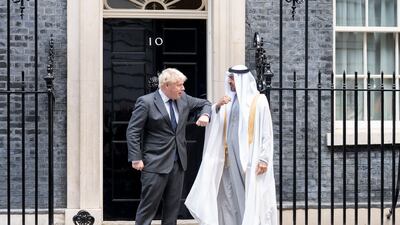
Sheikh Mohamed bin Zayed and Prime Minister Boris Johnson held wide-ranging talks in London. Ministry of Presidential Affairs -
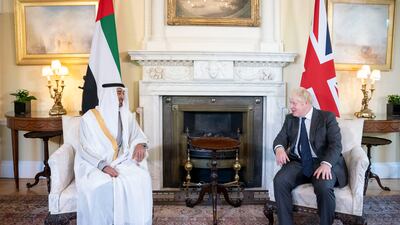
Sheikh Mohamed bin Zayed and Prime Minister Boris Johnson announced the launch of a Partnership for the Future between the UAE and the UK. Ministry of Presidential Affairs -
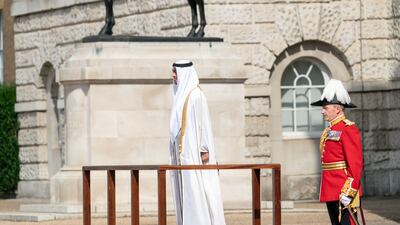
Sheikh Mohamed bin Zayed at a military guard of honour before attending a UK-UAE business reception. Ministry of Presidential Affairs -
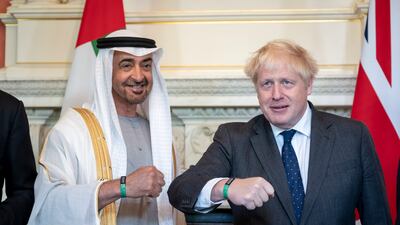
Sheikh Mohamed bin Zayed and Prime Minister Boris Johnson wear EXPO 2020 wristbands during a reception at 10 Downing Street. Ministry of Presidential Affairs -
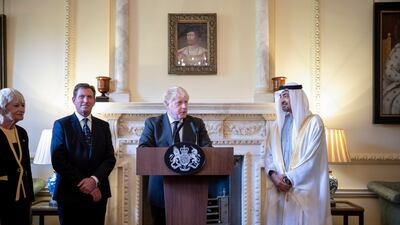
Boris Johnson and Sheikh Mohamed bin Zayed in front of an audience of businessmen, bankers and senior politicians at Downing Street. Ministry of Presidential Affairs -
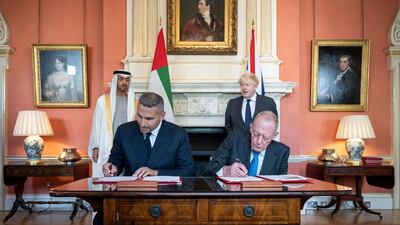
Sheikh Mohamed bin Zayed and Prime Minister Boris Johnson witness the signing of key agreements between the UAE and the UK. Ministry of Presidential Affairs -
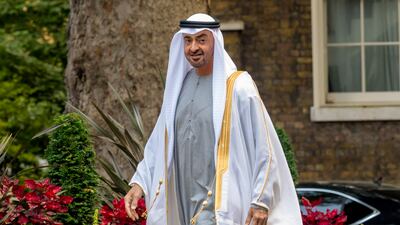
Sheikh Mohamed bin Zayed arrives to a reception hosted by Prime Minister Boris Johnson at 10 Downing Street. Ministry of Presidential Affairs -

Boris Johnson thanked the UAE for its role in facilitating evacuations from Afghanistan after the Taliban took control of the country. Ministry of Presidential Affairs -
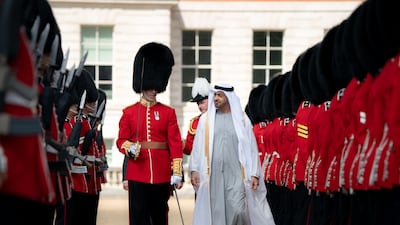
Sheikh Mohamed bin Zayed reviews a military guard of honour at Horse Guards Parade shortly after his arrival in London. Ministry of Presidential Affairs -

Sheikh Mohamed bin Zayed was given a guard of honour shortly after his arrival in London on an official visit to the UK. Ministry of Presidential Affairs



