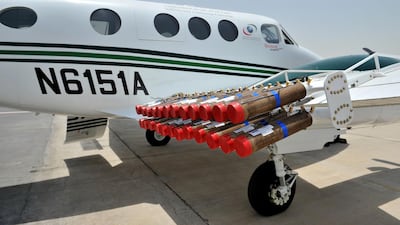
An aircraft fitted for cloud-seeding operations in the UAE. Courtesy: National Centre for Meteorology

UAE carries out 219 cloud seeding operations in first six months of the year


  • English
  • Arabic

More than 200 cloud seeding operations were carried out in the UAE during the first half of this year.

On Monday, the National Centre of Meteorology said a team of pilots and technicians used 4,841 flares, and 419 ground generator flares, during the flights

Since January, it has completed 219 operations.

“NCM’s cloud seeding operations demonstrate the importance placed by the UAE on providing sustainable water resources through encouraging research and innovation in water-related technologies," NCM said in a statement.

Seeding exercises work by creating rainfall from existing cloud formations.

By producing rain artificially, it helps top-up the country’s water resources, which are among one of the scarcest in the world.

Source: National Centre of Meteorology

Using a network of radars and weather stations that monitor the country’s atmosphere around-the-clock, local experts analyse data on clouds to determine if they are suitable for seeding or not.

Seedability is evaluated by analysing data from at least 150 cumulus clouds.

Once data is collected, dedicated aircraft fitted with special flares are then used to fire salt crystals into convective clouds that have an updraft, hence creating rain.

Global droughts have become more commonplace in recent decades due to climate change.

The UAE receives an average of less than 100 millimetres of annual rainfall, leading officials to embrace cloud-seeding as a viable way to bolster those numbers.

Dr Abdulla Al Mandous, director of NCM, said the centre was the “forerunner in adopting rain enhancement technologies” in the region.

“Our state-of-the-art infrastructure, coupled with excellent research and development capabilities, have helped the programme cement its prominent position in cloud seeding research,” he said.

“[We] attract top global scientists and research institutions specialised in this important scientific domain.

“Emirates Weather Enhancement Factory has also allowed the centre to produce high-quality flares to use in its cloud seeding operations."

The excess rainfall in the country brought about by cloud seeding over the past few years has had a positive effect on the country’s agricultural industry by impacting crop yield, while dams across the Emirates have benefited too.

Infiniti QX80 specs

Engine: twin-turbocharged 3.5-liter V6

Power: 450hp

Torque: 700Nm

Price: From Dh450,000, Autograph model from Dh510,000

Available: Now

Porsche Macan T: The Specs

Engine: 2.0-litre 4-cyl turbo 

Power: 265hp from 5,000-6,500rpm 

Torque: 400Nm from 1,800-4,500rpm 

Transmission: 7-speed dual-clutch auto 

Speed: 0-100kph in 6.2sec 

Top speed: 232kph 

Fuel consumption: 10.7L/100km 

On sale: May or June 

Price: From Dh259,900  

The specs: 2019 Lincoln MKC

Price, base / as tested: Dh169,995 / Dh192,045

Engine: Turbocharged, 2.0-litre, in-line four-cylinder

Transmission: Six-speed automatic

Power: 253hp @ 5,500rpm

Torque: 389Nm @ 2,500rpm

Fuel economy, combined: 10.7L / 100km

The Outsider

Stephen King, Penguin

The specs

Engine: 2.0-litre 4cyl turbo

Power: 261hp at 5,500rpm

Torque: 405Nm at 1,750-3,500rpm

Transmission: 9-speed auto

Fuel consumption: 6.9L/100km

On sale: Now

Price: From Dh117,059

Mercer, the investment consulting arm of US services company Marsh & McLennan, expects its wealth division to at least double its assets under management (AUM) in the Middle East as wealth in the region continues to grow despite economic headwinds, a company official said.

Mercer Wealth, which globally has $160 billion in AUM, plans to boost its AUM in the region to $2-$3bn in the next 2-3 years from the present $1bn, said Yasir AbuShaban, a Dubai-based principal with Mercer Wealth.

Within the next two to three years, we are looking at reaching $2 to $3 billion as a conservative estimate and we do see an opportunity to do so,” said Mr AbuShaban.

Mercer does not directly make investments, but allocates clients’ money they have discretion to, to professional asset managers. They also provide advice to clients.

“We have buying power. We can negotiate on their (client’s) behalf with asset managers to provide them lower fees than they otherwise would have to get on their own,” he added.

Mercer Wealth’s clients include sovereign wealth funds, family offices, and insurance companies among others.

From its office in Dubai, Mercer also looks after Africa, India and Turkey, where they also see opportunity for growth.

Wealth creation in Middle East and Africa (MEA) grew 8.5 per cent to $8.1 trillion last year from $7.5tn in 2015, higher than last year’s global average of 6 per cent and the second-highest growth in a region after Asia-Pacific which grew 9.9 per cent, according to consultancy Boston Consulting Group (BCG). In the region, where wealth grew just 1.9 per cent in 2015 compared with 2014, a pickup in oil prices has helped in wealth generation.

BCG is forecasting MEA wealth will rise to $12tn by 2021, growing at an annual average of 8 per cent.

Drivers of wealth generation in the region will be split evenly between new wealth creation and growth of performance of existing assets, according to BCG.

Another general trend in the region is clients’ looking for a comprehensive approach to investing, according to Mr AbuShaban.

“Institutional investors or some of the families are seeing a slowdown in the available capital they have to invest and in that sense they are looking at optimizing the way they manage their portfolios and making sure they are not investing haphazardly and different parts of their investment are working together,” said Mr AbuShaban.

Some clients also have a higher appetite for risk, given the low interest-rate environment that does not provide enough yield for some institutional investors. These clients are keen to invest in illiquid assets, such as private equity and infrastructure.

“What we have seen is a desire for higher returns in what has been a low-return environment specifically in various fixed income or bonds,” he said.

“In this environment, we have seen a de facto increase in the risk that clients are taking in things like illiquid investments, private equity investments, infrastructure and private debt, those kind of investments were higher illiquidity results in incrementally higher returns.”

The Abu Dhabi Investment Authority, one of the largest sovereign wealth funds, said in its 2016 report that has gradually increased its exposure in direct private equity and private credit transactions, mainly in Asian markets and especially in China and India. The authority’s private equity department focused on structured equities owing to “their defensive characteristics.”

Need to know

When: October 17 until November 10

Cost: Entry is free but some events require prior registration

Where: Various locations including National Theatre (Abu Dhabi), Abu Dhabi Cultural Center, Zayed University Promenade, Beach Rotana (Abu Dhabi), Vox Cinemas at Yas Mall, Sharjah Youth Center

What: The Korea Festival will feature art exhibitions, a B-boy dance show, a mini K-pop concert, traditional dance and music performances, food tastings, a beauty seminar, and more.

For more information: www.koreafestivaluae.com
