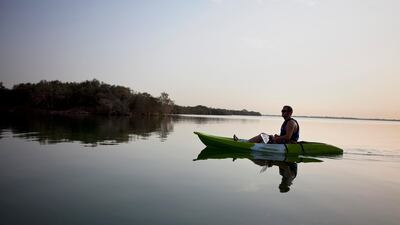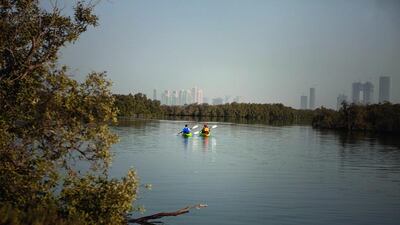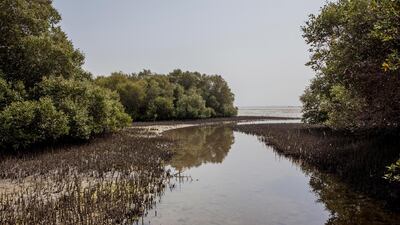
A view of the mangroves along a tributary of the Umm Al Quwain mangroves. Antonie Robertson/The National

Study of one of the UAE's largest and oldest mangrove forests offers key to preserving nature


Gillian Duncan
  • English
  • Arabic

Researchers have uncovered the secrets of one of the UAE's largest and most diverse ecosystems.

The sprawling Khor Al Beida mangrove forest in Umm Al Quwain has been untouched by development.

Experts wanted to study it as a baseline to compare with mangrove forests that are closer to built-up areas to analyse how they were affected.

They studied the levels of trace metals in the water and sediment, as well as the presence of algae, which is the base of the sea’s food chain, to determine how healthy Khor Al Beida is.

Thankfully our study shows that the environmental status of the Khor Al Beida mangrove ecosystem could be considered undisturbed

Metals can find their way into water in various ways, said Dr Fatin Samara, associate professor of environmental sciences, at American University of Sharjah, who led the study.

Some come from vehicle emissions, while others are produced naturally by rocks.

Researchers did find trace levels of metals such as zinc in the water, as well as both aluminium and iron in sediments, but not at levels that would result in harm to the environment.

“When you find high amounts of heavy metals, it typically means there has been a lot of discharges, a lot of pollution nearby,” said Dr Samara.

“In most of the studies that I have done, usually I find high concentrations of pollutants. I was really surprised how undisturbed this ecosystem is.

“With the fast progress of the UAE and the speedy development, I was a little surprised.

“Although physically you can see there is not much around this area.”

In other good news, the team discovered the sediment in the forest was home to 53 algae groups, which was further evidence to suggest the ecosystem is healthy.

"They are sensitive to pollution, so their reduced abundance or diversity would have been an indicator of ecosystem disturbance," said Dr Nadia Solovieva Kettell, assistant professor at the Higher Colleges of Technology in Sharjah and University College London.

“Thankfully our study shows that the environmental status of the Khor Al Beida mangrove ecosystem could be considered undisturbed as shown by the healthy diversity of algae.”

Taken together, the low levels of metals and diverse algae suggest the forest was still in good health.

Dr Samara said the results show if steps are taken to protect mangroves from developments, they can still thrive.

“This suggests we can still develop, but we need to be careful with the development we do and we need to always have that environmental awareness in mind.”

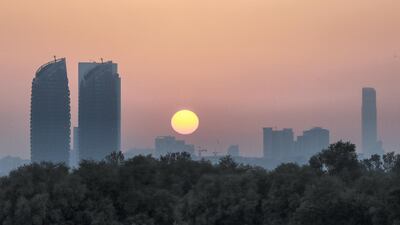
  • The sunset over Al Reem Island is seen from the Eastern Mangroves area of Abu Dhabi. Victor Besa / The National
    The sunset over Al Reem Island is seen from the Eastern Mangroves area of Abu Dhabi. Victor Besa / The National
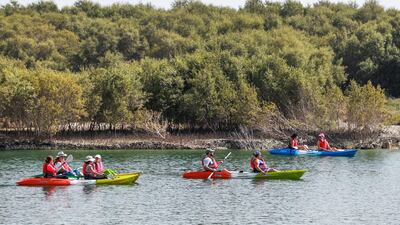
  • Tourists set off for a kayaking trip through the Eastern Mangroves. Victor Besa / The National
    Tourists set off for a kayaking trip through the Eastern Mangroves. Victor Besa / The National
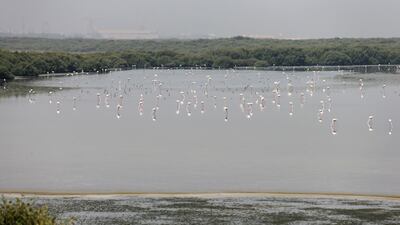
  • Flamingos at Al Zorah Natural Reserve in Ajman. Sarah Dea / The National
    Flamingos at Al Zorah Natural Reserve in Ajman. Sarah Dea / The National
  • Mangroves line the bay near the Anantara Al Yamm Villa Resort on the Sir Bani Yas Island, one of the largest natural islands in the UAE. Visiting guests helped plant mangroves, contributing to the stability of the local ecosystem. Silvia Razgova / The National
    Mangroves line the bay near the Anantara Al Yamm Villa Resort on the Sir Bani Yas Island, one of the largest natural islands in the UAE. Visiting guests helped plant mangroves, contributing to the stability of the local ecosystem. Silvia Razgova / The National
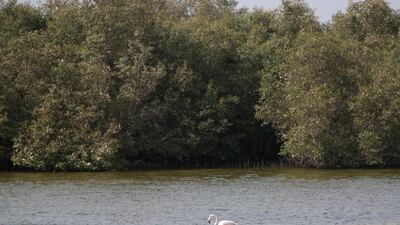
  • A flamingo wades in the shallow water in front of Mangroves in Abu Dhabi. Sammy Dallal / The National
    A flamingo wades in the shallow water in front of Mangroves in Abu Dhabi. Sammy Dallal / The National
  • Kayakers navigate the cool early-morning waters between mangrove islands in Abu Dhabi. (Silvia Razgova/The National)
    Kayakers navigate the cool early-morning waters between mangrove islands in Abu Dhabi. (Silvia Razgova/The National)
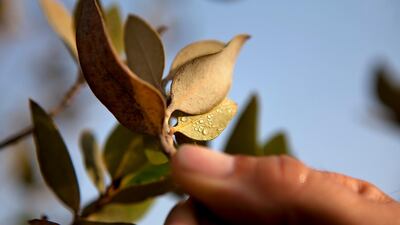
  • Salt-water crystals are exposed on mangrove trees in Abu Dhabi. Silvia Razgova/The National
    Salt-water crystals are exposed on mangrove trees in Abu Dhabi. Silvia Razgova/The National
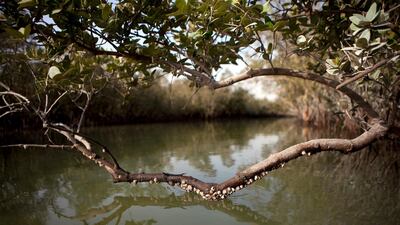
  • Marine life attaches to a mangrove branch which hangs just above the water in the Eastern Mangroves, Abu Dhabi. Silvia Razgova/The National
    Marine life attaches to a mangrove branch which hangs just above the water in the Eastern Mangroves, Abu Dhabi. Silvia Razgova/The National
  • Kayaking in the mangroves, Abu Dhabi. Silvia Razgova / The National
    Kayaking in the mangroves, Abu Dhabi. Silvia Razgova / The National

Mangrove forests help protect the UAE coast from the effects of rising sea levels and storms, which are becoming more frequent owing to climate change.

They also act as a carbon reservoir, or sink, preventing carbon from entering the atmosphere, which is a major contributor to climate change.

Though much smaller in size than the planet's forests, these coastal systems sequester carbon at a much faster rate and can continue to store it for thousands of years.

The vast majority of the country’s mangroves are found in Abu Dhabi, which is home to the 19-square-kilometre Mangrove National Park. It constitutes 75 per cent of the total 4,000 hectares of mangroves in the UAE.

A researcher takes samples for the American University of Sharjah-led study. Courtesy: American University of Sharjah

There are 13 major mangrove sites in the UAE.

A detailed study conducted by the Environment Agency Abu Dhabi in 2018 revealed that more than 80 per cent of the mangroves there were healthy, while 15 per cent were in moderate health and 5 per cent were identified as being in “deteriorating” health due to development.

The country undertook huge mangrove plantation programmes in the late 1970s under the directives of the late Sheikh Zayed, the UAE's Founding Father.

But between 2001 and 2011, some 20 square kilometres of mangroves alone were cleared to make room for coastal developments.

Thousands of mangrove trees have been planted since in an effort to rehabilitate many areas.

Last month, environment authorities announced they will use drones to plant new mangroves along the western coast of the emirate.

Environment Agency Abu Dhabi is working with Engie to rehabilitate the mangrove habitats near the French utility company's plant in Mirfa – about 90-minute drive west from the capital's city centre.


PLAY-OFF%20DRAW
%3Cp%3EBarcelona%20%20v%20Manchester%20United%0D%3Cbr%3E%0D%3Cbr%3EJuventus%20v%20Nantes%20%0D%3Cbr%3E%0D%3Cbr%3ESporting%20Lisbon%20v%20Midtjylland%20%0D%3Cbr%3E%0D%3Cbr%3EShakhtar%20Donetsk%20v%20Rennes%20%0D%3Cbr%3E%0D%3Cbr%3EAjax%20v%20Union%20Berlin%0D%3Cbr%3E%0D%3Cbr%3EBayer%20Leverkusen%20v%20Monaco%20%0D%3Cbr%3E%0D%3Cbr%3ESevilla%20v%20PSV%20Eindhoven%0D%3Cbr%3E%0D%3Cbr%3ESalzburg%20v%20Roma%3C%2Fp%3E%0A
Frida%20
%3Cp%3E%3Cstrong%3EDirector%3A%20%3C%2Fstrong%3ECarla%20Gutierrez%3C%2Fp%3E%0A%3Cp%3E%3Cstrong%3EStarring%3A%3C%2Fstrong%3E%20Frida%20Kahlo%3C%2Fp%3E%0A%3Cp%3E%3Cstrong%3ERating%3A%3C%2Fstrong%3E%204%2F5%3C%2Fp%3E%0A
THE SPECS

Engine: 1.5-litre turbocharged four-cylinder

Transmission: Constant Variable (CVT)

Power: 141bhp 

Torque: 250Nm 

Price: Dh64,500

On sale: Now

MATCH INFO

Uefa Champions League semi-finals, first leg
Liverpool v Roma

When: April 24, 10.45pm kick-off (UAE)
Where: Anfield, Liverpool
Live: BeIN Sports HD
Second leg: May 2, Stadio Olimpico, Rome

The biog

DOB: 25/12/92
Marital status: Single
Education: Post-graduate diploma in UAE Diplomacy and External Affairs at the Emirates Diplomatic Academy in Abu Dhabi
Hobbies: I love fencing, I used to fence at the MK Fencing Academy but I want to start again. I also love reading and writing
Lifelong goal: My dream is to be a state minister

Global state-owned investor ranking by size

1.

United States

2.

China

3.

UAE

4.

Japan

5

Norway

6.

Canada

7.

Singapore

8.

Australia

9.

Saudi Arabia

10.

South Korea

'The Ice Road'

Director: Jonathan Hensleigh
Stars: Liam Neeson, Amber Midthunder, Laurence Fishburne

2/5

Mercer, the investment consulting arm of US services company Marsh & McLennan, expects its wealth division to at least double its assets under management (AUM) in the Middle East as wealth in the region continues to grow despite economic headwinds, a company official said.

Mercer Wealth, which globally has $160 billion in AUM, plans to boost its AUM in the region to $2-$3bn in the next 2-3 years from the present $1bn, said Yasir AbuShaban, a Dubai-based principal with Mercer Wealth.

Within the next two to three years, we are looking at reaching $2 to $3 billion as a conservative estimate and we do see an opportunity to do so,” said Mr AbuShaban.

Mercer does not directly make investments, but allocates clients’ money they have discretion to, to professional asset managers. They also provide advice to clients.

“We have buying power. We can negotiate on their (client’s) behalf with asset managers to provide them lower fees than they otherwise would have to get on their own,” he added.

Mercer Wealth’s clients include sovereign wealth funds, family offices, and insurance companies among others.

From its office in Dubai, Mercer also looks after Africa, India and Turkey, where they also see opportunity for growth.

Wealth creation in Middle East and Africa (MEA) grew 8.5 per cent to $8.1 trillion last year from $7.5tn in 2015, higher than last year’s global average of 6 per cent and the second-highest growth in a region after Asia-Pacific which grew 9.9 per cent, according to consultancy Boston Consulting Group (BCG). In the region, where wealth grew just 1.9 per cent in 2015 compared with 2014, a pickup in oil prices has helped in wealth generation.

BCG is forecasting MEA wealth will rise to $12tn by 2021, growing at an annual average of 8 per cent.

Drivers of wealth generation in the region will be split evenly between new wealth creation and growth of performance of existing assets, according to BCG.

Another general trend in the region is clients’ looking for a comprehensive approach to investing, according to Mr AbuShaban.

“Institutional investors or some of the families are seeing a slowdown in the available capital they have to invest and in that sense they are looking at optimizing the way they manage their portfolios and making sure they are not investing haphazardly and different parts of their investment are working together,” said Mr AbuShaban.

Some clients also have a higher appetite for risk, given the low interest-rate environment that does not provide enough yield for some institutional investors. These clients are keen to invest in illiquid assets, such as private equity and infrastructure.

“What we have seen is a desire for higher returns in what has been a low-return environment specifically in various fixed income or bonds,” he said.

“In this environment, we have seen a de facto increase in the risk that clients are taking in things like illiquid investments, private equity investments, infrastructure and private debt, those kind of investments were higher illiquidity results in incrementally higher returns.”

The Abu Dhabi Investment Authority, one of the largest sovereign wealth funds, said in its 2016 report that has gradually increased its exposure in direct private equity and private credit transactions, mainly in Asian markets and especially in China and India. The authority’s private equity department focused on structured equities owing to “their defensive characteristics.”