A researcher examining a sediment sample collected from the sea to examine microplastics and better understand its impact on marine life. AFP

How do we stop the microplastic invasion and how harmful are they?


Daniel Bardsley
  • English
  • Arabic

Microplastics have been detected in everything from human breast milk to water.

Researchers last year found microplastics — usually defined as pieces less than 5mm in size — were present in three-quarters of breast milk samples taken from 34 women who had given birth in Rome.

Just a few months earlier, in July, researchers in the Netherlands detected microplastics in a range of meat and milk products. Scientists have also found them in beverages and seafood.

And in Dubai, microplastics were in the news this week when dozens of bags containing millions of tiny beads washed up on the city's Sunset Beach.

An impressive community effort helped municipal workers to scoop up the bulk of the spillage from the pristine sand.

Here, we look at the microplastic invasion - and ask what can be done to tackle it.

The microplastic food chain

Many microplastics end up, or are formed, in the sea, allowing them to spread around the globe and absorb toxins.

Some of these toxins may have been released into the environment decades ago.

Marine microplastics may enter the food chain by being eaten by progressively larger organisms until, eventually, they can be consumed by people eating seafood. Fish, scallops, mussels and oysters have been all found, in some instances, to be contaminated.

How microplastics are produced and make their way into our food. Roy Cooper / The National

“They can be formed by accident or they’re deliberately produced,” says Dan Eatherley, a British environmental consultant who has worked on ways to reduce plastic waste with Google, Greenpeace and the UK government.

So-called primary microplastics are those that are deliberately produced, such as the microbeads in some cosmetics, while secondary microplastics are formed when waste plastics break down in the environment, often, Mr Eatherley says, due to the action of waves and rocks in the sea.

“There’s a lot of plastic that gets into the ocean from nets and other plastic gear fishers use, and then there’s plastic packaging that doesn’t get properly recycled and is instead washed into rivers and out to sea,” he says.

Mr Eatherley suggests that individuals can try to reduce their use of single-use plastics, such as by using refillable drinks containers and avoiding plastic cutlery.

Takeaway cutlery can last for centuries

Plastic cutlery, often provided with takeaway food, can impact the planet for centuries. Getty

The UK’s Natural History Museum says plastic cutlery is used for an average of just three minutes, but can remain in the environment for hundreds of years.

Because plastic is “built into the entire economy of modern society”, Mr Eatherley says, avoiding its use altogether is not easy.

“We instead need to shift to a more circular economy, where all of the plastic we use gets captured and recycled,” he says.

“At the moment, though, this is difficult because so many different types of plastic are used, making it hard to separate them.”

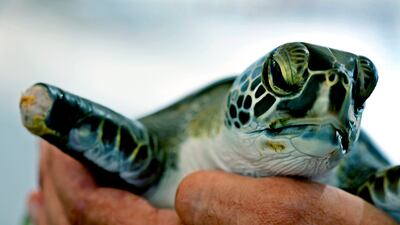
  • A green sea turtle that lost a flipper when it became caught in marine debris, at the Khor Kalba Conservation Reserve in Kalba, on the UAE's east coast. All photos: AP Photo
    A green sea turtle that lost a flipper when it became caught in marine debris, at the Khor Kalba Conservation Reserve in Kalba, on the UAE's east coast. All photos: AP Photo
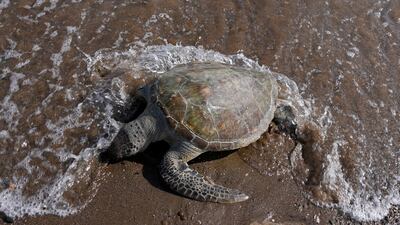
  • Three quarters of green turtles and more than half of loggerhead turtles found dead in Sharjah had eaten marine debris, including plastic bags, bottle caps, rope and fishing nets, says a study published in the 'Marine Pollution Bulletin'.
    Three quarters of green turtles and more than half of loggerhead turtles found dead in Sharjah had eaten marine debris, including plastic bags, bottle caps, rope and fishing nets, says a study published in the 'Marine Pollution Bulletin'.
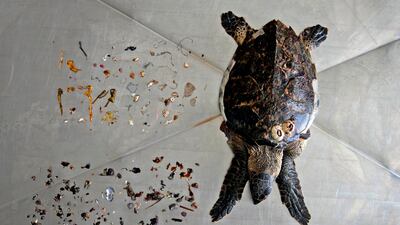
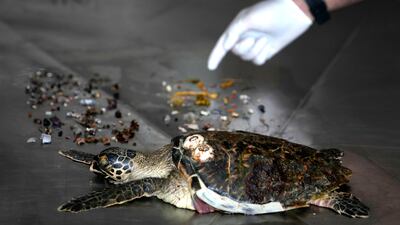
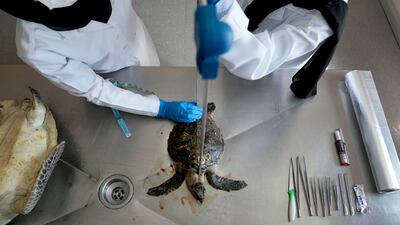
  • Plastic discovered in an autopsy on a dead turtle. The study documents the damage caused by a surge in discarded plastic and other debris in the world's seas.
    Plastic discovered in an autopsy on a dead turtle. The study documents the damage caused by a surge in discarded plastic and other debris in the world's seas.
  • No plastic was found in the bodies of turtles in the only previous Gulf of Oman study, in 1985. 'When the majority of sea turtles have plastics in their bodies, you know you have a significant problem,' said Fadi Yaghmour, a marine expert who carried out the study.
    No plastic was found in the bodies of turtles in the only previous Gulf of Oman study, in 1985. 'When the majority of sea turtles have plastics in their bodies, you know you have a significant problem,' said Fadi Yaghmour, a marine expert who carried out the study.
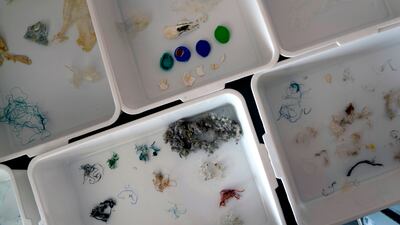
  • Debris found inside dead turtles in Sharjah. One turtle had 325 shards, another 32 pieces of fishing net. They can cause blockages that prevent the animals from eating.
    Debris found inside dead turtles in Sharjah. One turtle had 325 shards, another 32 pieces of fishing net. They can cause blockages that prevent the animals from eating.
  • The study found that green sea turtles were inclined to eat drifting plastic bags and ropes, which resemble their diet of cuttlefish and jellyfish. Loggerheads ate bottle caps and other small pieces of hard plastic mistaken for marine invertebrates. The youngest turtles ate the most plastic.
    The study found that green sea turtles were inclined to eat drifting plastic bags and ropes, which resemble their diet of cuttlefish and jellyfish. Loggerheads ate bottle caps and other small pieces of hard plastic mistaken for marine invertebrates. The youngest turtles ate the most plastic.
  • Conservationists in the UAE are seeking to protect the country’s turtles from the threats. Community officers respond to reports of turtles in distress and rescue the reptiles for rehabilitation. 'If we lose these turtles, the ecosystem will die,' said Abdulkarim Vettan operational manager at Al Qurum Mangrove Centre in Kalba.
    Conservationists in the UAE are seeking to protect the country’s turtles from the threats. Community officers respond to reports of turtles in distress and rescue the reptiles for rehabilitation. 'If we lose these turtles, the ecosystem will die,' said Abdulkarim Vettan operational manager at Al Qurum Mangrove Centre in Kalba.

Laboratory studies indicate that microplastics can be harmful to human cells, but studies conclusively showing negative impacts on human health are lacking.

Many UAE residents may wonder whether the bottled water they consume has an impact on their health.

A 2018 study by researchers in Brazil, Portugal and the US, who looked at bottled water from nine countries, found that 93 per cent of samples contained microplastics, mostly plastic fragments, with fibres the next most prevalent category.

Two years later the publisher Consumer Reports tested 47 bottled waters and found Perfluoroalkyl and Polyfluoroalkyl Substances (PFASs), known as “forever chemicals” because they linger in the environment, in “many products”.

These chemicals, the source of which was unclear, have been associated with developmental changes, cancer and harm to the immune system, among other effects.

In the majority of still water samples, PFAS levels were below one part per trillion, while a slight majority of carbonated waters were above this threshold. In nearly all samples, heavy metal quantities were within safety limits.

What are the main sources of microplastics?

A single load of washing can release as many as 700,000 individual microplastic fibres. Getty

Clothing

Washing clothes adds huge numbers of microplastic particles to the environment. Figures published by the Natural History Museum say a single load of washing can release as many as 700,000 individual fibres. Narrower than a human hair, these tend not to be removed by filtration systems, so find their way into waterways and, ultimately, the sea. The Marine Conservation Society says domestic and industrial washing cycles may generate 35 per cent of primary microplastics. Laundry bags are available to help reduce microplastic pollution from washing machines.

Car tyres

These are one of the biggest sources of microplastic pollution because, as any driver knows, they wear out. As little as one fifth of tyre content is natural rubber with much of the rest being human-made substances, including plastics. Friends of the Earth, the environmental organisation, says half a million tonnes of plastic fragments are released from tyres each year on Europe’s roads. A large proportion of these fragments end up in rivers and oceans after being washed into drains by rainwater.

Toiletries and cosmetics

Numerous products contain intentionally added microplastics or microbeads, which may be eaten by fish or birds that mistake them for food. Colgate, the toothpaste company, says microbeads are added for various purposes, including to improve shelf life, add bulk, allow the timed release of active ingredients and as abrasives or exfoliants. Some countries have restricted the use of microbeads, such as the US with its 2015 Microbead-Free Waters Act, which “prohibits the manufacturing, packaging and distribution of rinse-off cosmetics containing plastic microbeads”.

Packaging

Because plastic does not biodegrade, plastic items such as food packaging, drinks bottles and the like are physically broken down into smaller pieces, which ultimately become microplastics. More than eight billion tonnes of plastic has been produced over time, less than 10 per cent of which has been recycled. About 12 per cent is incinerated, the UK’s University of Nottingham says, leaving the rest in landfill sites or the environment.

Dust

A significant proportion of dust in the air consists of microplastics, some of which may contain toxic materials such as pesticides and heavy metals, and may be breathed in. Carpets and paint are sources of this microplastic dust, although categories above, such as tyres and, in particular, clothing, are also key culprits. Echoing the global movement of plastic in the oceans, this dust can travel long distances when it is lifted high into the atmosphere and transported by air currents.

A version of this article was first published in October 2022.

Wicked: For Good

Director: Jon M Chu

Starring: Ariana Grande, Cynthia Erivo, Jonathan Bailey, Jeff Goldblum, Michelle Yeoh, Ethan Slater

Rating: 4/5

PSA DUBAI WORLD SERIES FINALS LINE-UP

Men’s:
Mohamed El Shorbagy (EGY)
Ali Farag (EGY)
Simon Rosner (GER)
Tarek Momen (EGY)
Miguel Angel Rodriguez (COL)
Gregory Gaultier (FRA)
Karim Abdel Gawad (EGY)
Nick Matthew (ENG)

Women's:
Nour El Sherbini (EGY)
Raneem El Welily (EGY)
Nour El Tayeb (EGY)
Laura Massaro (ENG)
Joelle King (NZE)
Camille Serme (FRA)
Nouran Gohar (EGY)
Sarah-Jane Perry (ENG)

Jetour T1 specs

Engine: 2-litre turbocharged

Power: 254hp

Torque: 390Nm

Price: From Dh126,000

Available: Now

GAC GS8 Specs

Engine: 2.0-litre 4cyl turbo

Power: 248hp at 5,200rpm

Torque: 400Nm at 1,750-4,000rpm

Transmission: 8-speed auto

Fuel consumption: 9.1L/100km

On sale: Now

Price: From Dh149,900

The biog

Born: Kuwait in 1986
Family: She is the youngest of seven siblings
Time in the UAE: 10 years
Hobbies: audiobooks and fitness: she works out every day, enjoying kickboxing and basketball

Young women have more “financial grit”, but fall behind on investing

In an October survey of young adults aged 16 to 25, Charles Schwab found young women are more driven to reach financial independence than young men (67 per cent versus. 58 per cent). They are more likely to take on extra work to make ends meet and see more value than men in creating a plan to achieve their financial goals. Yet, despite all these good ‘first’ measures, they are investing and saving less than young men – falling early into the financial gender gap.

While the women surveyed report spending 36 per cent less than men, they have far less savings than men ($1,267 versus $2,000) – a nearly 60 per cent difference.

In addition, twice as many young men as women say they would invest spare cash, and almost twice as many young men as women report having investment accounts (though most young adults do not invest at all). 

“Despite their good intentions, young women start to fall behind their male counterparts in savings and investing early on in life,” said Carrie Schwab-Pomerantz, senior vice president, Charles Schwab. “They start off showing a strong financial planning mindset, but there is still room for further education when it comes to managing their day-to-day finances.”

Ms Schwab-Pomerantz says parents should be conveying the same messages to boys and girls about money, but should tailor those conversations based on the individual and gender.

"Our study shows that while boys are spending more than girls, they also are saving more. Have open and honest conversations with your daughters about the wage and savings gap," she said. "Teach kids about the importance of investing – especially girls, who as we see in this study, aren’t investing as much. Part of being financially prepared is learning to make the most of your money, and that means investing early and consistently."

England-South Africa Test series

1st Test England win by 211 runs at Lord's, London

2nd Test South Africa win by 340 runs at Trent Bridge, Nottingham

3rd Test July 27-31 at The Oval, London

4th Test August 4-8 at Old Trafford, Manchester

Mercer, the investment consulting arm of US services company Marsh & McLennan, expects its wealth division to at least double its assets under management (AUM) in the Middle East as wealth in the region continues to grow despite economic headwinds, a company official said.

Mercer Wealth, which globally has $160 billion in AUM, plans to boost its AUM in the region to $2-$3bn in the next 2-3 years from the present $1bn, said Yasir AbuShaban, a Dubai-based principal with Mercer Wealth.

Within the next two to three years, we are looking at reaching $2 to $3 billion as a conservative estimate and we do see an opportunity to do so,” said Mr AbuShaban.

Mercer does not directly make investments, but allocates clients’ money they have discretion to, to professional asset managers. They also provide advice to clients.

“We have buying power. We can negotiate on their (client’s) behalf with asset managers to provide them lower fees than they otherwise would have to get on their own,” he added.

Mercer Wealth’s clients include sovereign wealth funds, family offices, and insurance companies among others.

From its office in Dubai, Mercer also looks after Africa, India and Turkey, where they also see opportunity for growth.

Wealth creation in Middle East and Africa (MEA) grew 8.5 per cent to $8.1 trillion last year from $7.5tn in 2015, higher than last year’s global average of 6 per cent and the second-highest growth in a region after Asia-Pacific which grew 9.9 per cent, according to consultancy Boston Consulting Group (BCG). In the region, where wealth grew just 1.9 per cent in 2015 compared with 2014, a pickup in oil prices has helped in wealth generation.

BCG is forecasting MEA wealth will rise to $12tn by 2021, growing at an annual average of 8 per cent.

Drivers of wealth generation in the region will be split evenly between new wealth creation and growth of performance of existing assets, according to BCG.

Another general trend in the region is clients’ looking for a comprehensive approach to investing, according to Mr AbuShaban.

“Institutional investors or some of the families are seeing a slowdown in the available capital they have to invest and in that sense they are looking at optimizing the way they manage their portfolios and making sure they are not investing haphazardly and different parts of their investment are working together,” said Mr AbuShaban.

Some clients also have a higher appetite for risk, given the low interest-rate environment that does not provide enough yield for some institutional investors. These clients are keen to invest in illiquid assets, such as private equity and infrastructure.

“What we have seen is a desire for higher returns in what has been a low-return environment specifically in various fixed income or bonds,” he said.

“In this environment, we have seen a de facto increase in the risk that clients are taking in things like illiquid investments, private equity investments, infrastructure and private debt, those kind of investments were higher illiquidity results in incrementally higher returns.”

The Abu Dhabi Investment Authority, one of the largest sovereign wealth funds, said in its 2016 report that has gradually increased its exposure in direct private equity and private credit transactions, mainly in Asian markets and especially in China and India. The authority’s private equity department focused on structured equities owing to “their defensive characteristics.”

Charlotte Gainsbourg

Rest

(Because Music)

MATCH INFO

Tottenham Hotspur 3 (Son 1', Kane 8' & 16') West Ham United 3 (Balbuena 82', Sanchez og 85', Lanzini 90' 4)

Man of the match Harry Kane

Afghanistan fixtures
  • v Australia, today
  • v Sri Lanka, Tuesday
  • v New Zealand, Saturday,
  • v South Africa, June 15
  • v England, June 18
  • v India, June 22
  • v Bangladesh, June 24
  • v Pakistan, June 29
  • v West Indies, July 4

PAST 10 BRITISH GRAND PRIX WINNERS

2016 - Lewis Hamilton (Mercedes-GP)
2015 - Lewis Hamilton (Mercedes-GP)
2014 - Lewis Hamilton (Mercedes-GP)
2013 - Nico Rosberg (Mercedes-GP)
2012 - Mark Webber (Red Bull Racing)
2011 - Fernando Alonso (Ferrari)
2010 - Mark Webber (Red Bull Racing)
2009 - Sebastian Vettel (Red Bull Racing)
2008 - Lewis Hamilton (McLaren)
2007 - Kimi Raikkonen (Ferrari)

Brief scores

Toss India, chose to bat

India 281-7 in 50 ov (Pandya 83, Dhoni 79; Coulter-Nile 3-44)

Australia 137-9 in 21 ov (Maxwell 39, Warner 25; Chahal 3-30)

India won by 26 runs on Duckworth-Lewis Method

JUDAS AND THE BLACK MESSIAH

Directed by: Shaka King

Starring: Daniel Kaluuya, Lakeith Stanfield, Jesse Plemons

Four stars

Engine: 3.5-litre V6

Transmission: eight-speed automatic

Power: 290hp

Torque: 340Nm

Price: Dh155,800

On sale: now

Global state-owned investor ranking by size

1.

United States

2.

China

3.

UAE

4.

Japan

5

Norway

6.

Canada

7.

Singapore

8.

Australia

9.

Saudi Arabia

10.

South Korea

Key findings of Jenkins report
  • Founder of the Muslim Brotherhood, Hassan al Banna, "accepted the political utility of violence"
  • Views of key Muslim Brotherhood ideologue, Sayyid Qutb, have “consistently been understood” as permitting “the use of extreme violence in the pursuit of the perfect Islamic society” and “never been institutionally disowned” by the movement.
  • Muslim Brotherhood at all levels has repeatedly defended Hamas attacks against Israel, including the use of suicide bombers and the killing of civilians.
  • Laying out the report in the House of Commons, David Cameron told MPs: "The main findings of the review support the conclusion that membership of, association with, or influence by the Muslim Brotherhood should be considered as a possible indicator of extremism."
Desert Warrior

Starring: Anthony Mackie, Aiysha Hart, Ben Kingsley

Director: Rupert Wyatt

Rating: 3/5

Our legal columnist

Name: Yousef Al Bahar

Advocate at Al Bahar & Associate Advocates and Legal Consultants, established in 1994

Education: Mr Al Bahar was born in 1979 and graduated in 2008 from the Judicial Institute. He took after his father, who was one of the first Emirati lawyers

MATCH INFO

Rugby World Cup (all times UAE)

Third-place play-off: New Zealand v Wales, Friday, 1pm

Final: England v South Africa, Saturday, 1pm

Lexus LX700h specs

Engine: 3.4-litre twin-turbo V6 plus supplementary electric motor

Power: 464hp at 5,200rpm

Torque: 790Nm from 2,000-3,600rpm

Transmission: 10-speed auto

Fuel consumption: 11.7L/100km

On sale: Now

Price: From Dh590,000

UAE squad

Ali Kashief, Salem Rashid, Khalifa Al Hammadi, Khalfan Mubarak, Ali Mabkhout, Omar Abdelrahman, Mohammed Al Attas (Al Jazira), Mohmmed Al Shamsi, Hamdan Al Kamali, Mohammad Barghash, Khalil Al Hammadi (Al Wahda), Khalid Eisa, Mohammed Shakir, Ahmed Barman, Bandar Al Ahbabi (Al Ain), Adel Al Hosani, Al Hassan Saleh, Majid Suroor (Sharjah), Waleed Abbas, Ismail Al Hammadi, Ahmed Khalil (Shabab Al Ahli Dubai) Habib Fardan, Tariq Ahmed, Mohammed Al Akbari (Al Nasr), Ali Saleh, Ali Salmeen (Al Wasl), Hassan Al Mahrami (Baniyas)

Trump v Khan

2016: Feud begins after Khan criticised Trump’s proposed Muslim travel ban to US

2017: Trump criticises Khan’s ‘no reason to be alarmed’ response to London Bridge terror attacks

2019: Trump calls Khan a “stone cold loser” before first state visit

2019: Trump tweets about “Khan’s Londonistan”, calling him “a national disgrace”

2022:  Khan’s office attributes rise in Islamophobic abuse against the major to hostility stoked during Trump’s presidency

July 2025 During a golfing trip to Scotland, Trump calls Khan “a nasty person”

Sept 2025 Trump blames Khan for London’s “stabbings and the dirt and the filth”.

Dec 2025 Trump suggests migrants got Khan elected, calls him a “horrible, vicious, disgusting mayor”

The%20specs%3A%202024%20Mercedes%20E200
%3Cp%3E%3Cstrong%3EEngine%3A%20%3C%2Fstrong%3E2.0-litre%20four-cyl%20turbo%20%2B%20mild%20hybrid%0D%3Cbr%3E%3Cstrong%3EPower%3A%20%3C%2Fstrong%3E204hp%20at%205%2C800rpm%20%2B23hp%20hybrid%20boost%0D%3Cbr%3E%3Cstrong%3ETorque%3A%20%3C%2Fstrong%3E320Nm%20at%201%2C800rpm%20%2B205Nm%20hybrid%20boost%0D%3Cbr%3E%3Cstrong%3ETransmission%3A%20%3C%2Fstrong%3E9-speed%20auto%0D%3Cbr%3E%3Cstrong%3EFuel%20consumption%3A%20%3C%2Fstrong%3E7.3L%2F100km%0D%3Cbr%3E%3Cstrong%3EOn%20sale%3A%20%3C%2Fstrong%3ENovember%2FDecember%0D%3Cbr%3E%3Cstrong%3EPrice%3A%20%3C%2Fstrong%3EFrom%20Dh205%2C000%20(estimate)%3C%2Fp%3E%0A
UAE currency: the story behind the money in your pockets
Timeline

1947
Ferrari’s road-car company is formed and its first badged car, the 125 S, rolls off the assembly line

1962
250 GTO is unveiled

1969
Fiat becomes a Ferrari shareholder, acquiring 50 per cent of the company

1972
The Fiorano circuit, Ferrari’s racetrack for development and testing, opens

1976
First automatic Ferrari, the 400 Automatic, is made

1987
F40 launched

1988
Enzo Ferrari dies; Fiat expands its stake in the company to 90 per cent

2002
The Enzo model is announced

2010
Ferrari World opens in Abu Dhabi

2011
First four-wheel drive Ferrari, the FF, is unveiled

2013
LaFerrari, the first Ferrari hybrid, arrives

2014
Fiat Chrysler announces the split of Ferrari from the parent company

2015
Ferrari launches on Wall Street

2017
812 Superfast unveiled; Ferrari celebrates its 70th anniversary

Updated: February 21, 2023, 8:06 AM