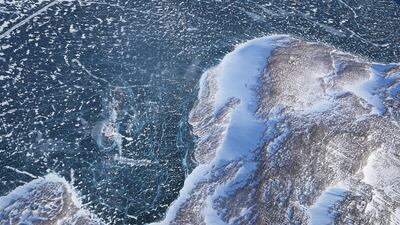
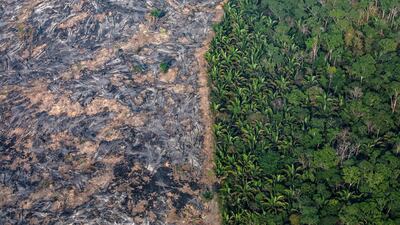
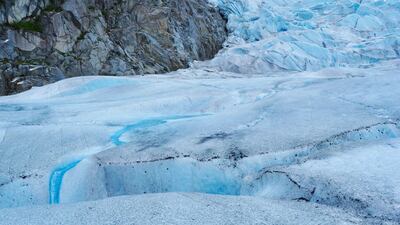
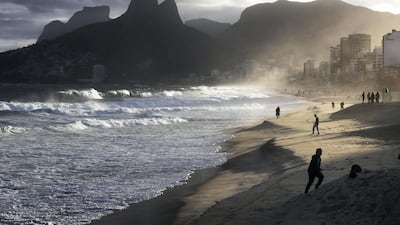
Humanity is “going in the wrong direction” on climate change, the UN said on Tuesday in an assessment showing that planet-warming emissions are higher than before the coronavirus pandemic.
The UN's World Meteorological Organisation and its Environment Programme said that catastrophes will become commonplace should countries fail to decarbonise in line with what science says is needed to prevent the worst impacts of global warming.
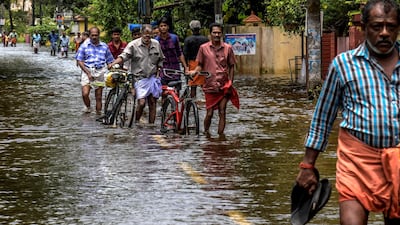
The agencies pointed to Pakistan's monumental floods and China's crop-withering heatwave this year as examples of what to expect.
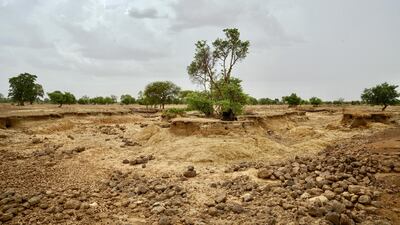
The UN said last month that the drought gripping the Horn of Africa and threatening millions with acute food shortages was now likely to extend into a fifth year.
“Floods, droughts, heatwaves, extreme storms and wildfires are going from bad to worse, breaking records with alarming frequency,” said UN Secretary General Antonio Guterres.
“There is nothing natural about the new scale of these disasters. They are the price of humanity's fossil fuel addiction.”
The UN's United in Science report underscores how, nearly three years since Covid-19 handed governments a unique opportunity to reassess how to power their economies, countries are continuing to pollute.
It found that after an unprecedented 5.4 per cent fall in emissions in 2020 due to lockdowns and travel restrictions, preliminary data from January-May this year shows global CO2 emissions are 1.2 per cent higher than before Covid-19.
This is mostly down to large year-on-year increases in the US, India and most European countries, the assessment found.
“The science is unequivocal: we are going in the wrong direction,” said WMO Secretary General Petteri Taalas.
“Greenhouse gas concentrations are continuing to rise, reaching new record highs. Fossil fuel emission rates are now above pre-pandemic levels. The past seven years were the warmest on record.”
Last week, the European Union's Copernicus climate monitor said that summer 2022 was the hottest in Europe and one of the hottest globally since records began in the 1970s.
Tuesday's report said there was a 93 per cent chance that the record for the hottest year globally — currently 2016 — will be broken within five years.
It said that the continued use of fossil fuels meant the chance of the annual mean global temperature temporarily exceeding 1.5°C above pre-industrial levels in one of the next five years was roughly even, at 48 per cent.
Polluters paying no heed to Paris Agreement
Keeping longer-term temperatures below 1.5°C is the most ambitious goal of the 2015 Paris Agreement.
Despite more than three decades of UN-led negotiations, rich polluters show little sign of being willing to make the kind of large-scale emissions cuts that would keep the goal in play.
The UN's Environment Programme, in an update to its annual “emissions gap” assessment following new pledges made at last November's Cop26 summit in Glasgow, said on Tuesday that even these promises were far from adequate.
In fact, it said the ambition even in countries' most recent pledges would need to be four times greater to limit warming to 2°C, and seven times higher to make 1.5°C.
All told, current worldwide climate policies put Earth on course to warm by 2.8°C by 2100, the agency said.
Mr Guterres said that Tuesday's assessment showed “climate impacts heading into uncharted territory of destruction”.
“Yet each year, we double down on this fossil fuel addiction, even as the symptoms get rapidly worse,” he said in a video message.
Tasneem Essop, executive director of Climate Action Network, said that the coming Cop27 climate conference in Egypt needed leaders to agree to new funding to help communities in at-risk nations rebuild after extreme events.
“The terrifying picture painted by the United in Science report is already a lived reality for millions of people facing recurring climate disasters,” she said.
Climate change tipping points — in pictures
Farage on Muslim Brotherhood
Nigel Farage told Reform's annual conference that the party will proscribe the Muslim Brotherhood if he becomes Prime Minister.
"We will stop dangerous organisations with links to terrorism operating in our country," he said. "Quite why we've been so gutless about this – both Labour and Conservative – I don't know.
“All across the Middle East, countries have banned and proscribed the Muslim Brotherhood as a dangerous organisation. We will do the very same.”
It is 10 years since a ground-breaking report into the Muslim Brotherhood by Sir John Jenkins.
Among the former diplomat's findings was an assessment that “the use of extreme violence in the pursuit of the perfect Islamic society” has “never been institutionally disowned” by the movement.
The prime minister at the time, David Cameron, who commissioned the report, said membership or association with the Muslim Brotherhood was a "possible indicator of extremism" but it would not be banned.
SNAPSHOT
While Huawei did launch the first smartphone with a 50MP image sensor in its P40 series in 2020, Oppo in 2014 introduced the Find 7, which was capable of taking 50MP images: this was done using a combination of a 13MP sensor and software that resulted in shots seemingly taken from a 50MP camera.
Jetour T1 specs
Engine: 2-litre turbocharged
Power: 254hp
Torque: 390Nm
Price: From Dh126,000
Available: Now
Mercer, the investment consulting arm of US services company Marsh & McLennan, expects its wealth division to at least double its assets under management (AUM) in the Middle East as wealth in the region continues to grow despite economic headwinds, a company official said.
Mercer Wealth, which globally has $160 billion in AUM, plans to boost its AUM in the region to $2-$3bn in the next 2-3 years from the present $1bn, said Yasir AbuShaban, a Dubai-based principal with Mercer Wealth.
“Within the next two to three years, we are looking at reaching $2 to $3 billion as a conservative estimate and we do see an opportunity to do so,” said Mr AbuShaban.
Mercer does not directly make investments, but allocates clients’ money they have discretion to, to professional asset managers. They also provide advice to clients.
“We have buying power. We can negotiate on their (client’s) behalf with asset managers to provide them lower fees than they otherwise would have to get on their own,” he added.
Mercer Wealth’s clients include sovereign wealth funds, family offices, and insurance companies among others.
From its office in Dubai, Mercer also looks after Africa, India and Turkey, where they also see opportunity for growth.
Wealth creation in Middle East and Africa (MEA) grew 8.5 per cent to $8.1 trillion last year from $7.5tn in 2015, higher than last year’s global average of 6 per cent and the second-highest growth in a region after Asia-Pacific which grew 9.9 per cent, according to consultancy Boston Consulting Group (BCG). In the region, where wealth grew just 1.9 per cent in 2015 compared with 2014, a pickup in oil prices has helped in wealth generation.
BCG is forecasting MEA wealth will rise to $12tn by 2021, growing at an annual average of 8 per cent.
Drivers of wealth generation in the region will be split evenly between new wealth creation and growth of performance of existing assets, according to BCG.
Another general trend in the region is clients’ looking for a comprehensive approach to investing, according to Mr AbuShaban.
“Institutional investors or some of the families are seeing a slowdown in the available capital they have to invest and in that sense they are looking at optimizing the way they manage their portfolios and making sure they are not investing haphazardly and different parts of their investment are working together,” said Mr AbuShaban.
Some clients also have a higher appetite for risk, given the low interest-rate environment that does not provide enough yield for some institutional investors. These clients are keen to invest in illiquid assets, such as private equity and infrastructure.
“What we have seen is a desire for higher returns in what has been a low-return environment specifically in various fixed income or bonds,” he said.
“In this environment, we have seen a de facto increase in the risk that clients are taking in things like illiquid investments, private equity investments, infrastructure and private debt, those kind of investments were higher illiquidity results in incrementally higher returns.”
The Abu Dhabi Investment Authority, one of the largest sovereign wealth funds, said in its 2016 report that has gradually increased its exposure in direct private equity and private credit transactions, mainly in Asian markets and especially in China and India. The authority’s private equity department focused on structured equities owing to “their defensive characteristics.”
What can you do?
Document everything immediately; including dates, times, locations and witnesses
Seek professional advice from a legal expert
You can report an incident to HR or an immediate supervisor
You can use the Ministry of Human Resources and Emiratisation’s dedicated hotline
In criminal cases, you can contact the police for additional support
Specs
Engine: 51.5kW electric motor
Range: 400km
Power: 134bhp
Torque: 175Nm
Price: From Dh98,800
Available: Now
The National's picks
4.35pm: Tilal Al Khalediah
5.10pm: Continous
5.45pm: Raging Torrent
6.20pm: West Acre
7pm: Flood Zone
7.40pm: Straight No Chaser
8.15pm: Romantic Warrior
8.50pm: Calandogan
9.30pm: Forever Young
Islamophobia definition
A widely accepted definition was made by the All Party Parliamentary Group on British Muslims in 2019: “Islamophobia is rooted in racism and is a type of racism that targets expressions of Muslimness or perceived Muslimness.” It further defines it as “inciting hatred or violence against Muslims”.
Dr Amal Khalid Alias revealed a recent case of a woman with daughters, who specifically wanted a boy.
A semen analysis of the father showed abnormal sperm so the couple required IVF.
Out of 21 eggs collected, six were unused leaving 15 suitable for IVF.
A specific procedure was used, called intracytoplasmic sperm injection where a single sperm cell is inserted into the egg.
On day three of the process, 14 embryos were biopsied for gender selection.
The next day, a pre-implantation genetic report revealed four normal male embryos, three female and seven abnormal samples.
Day five of the treatment saw two male embryos transferred to the patient.
The woman recorded a positive pregnancy test two weeks later.
The specs
Engine: 3.0-litre six-cylinder turbo
Power: 398hp from 5,250rpm
Torque: 580Nm at 1,900-4,800rpm
Transmission: Eight-speed auto
Fuel economy, combined: 6.5L/100km
On sale: December
Price: From Dh330,000 (estimate)