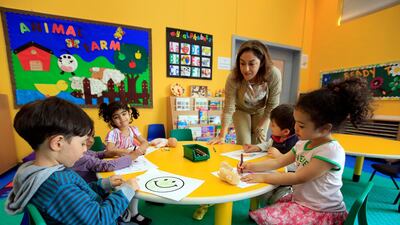
Children will be able to return to nurseries in Sharjah on March 28.

Sharjah nurseries set to reopen with strict Covid-19 safety measures


  • English
  • Arabic

Seventy-four public and private nurseries in Sharjah will reopen for in-person classes on March 28, education authorities in the emirate said on Tuesday.

The nurseries have been asked to follow strict Covid-19 safety protocols, Sharjah's emergency, crisis and disaster management team and the Sharjah Private Education Authority said.

"The safety and health of pupils, teachers, parents and all staff members is a priority for us and this decision was only taken after we made sure the nurseries are adhering to safety rules and are ready to welcome children back," said Dr Muhadditha Al Hashimi, chairman of Sharjah Private Education Authority.

Authorities took the decision after carrying out inspections to ensure nurseries were prepared to resume classes safely.

Schools across most of the Northern Emirates switched to online learning in mid-February following a rise in Covid-19 cases in the UAE.

At the time, all public and private schools and nurseries in Sharjah, Ras Al Khaimah and Umm Al Quwain were asked to resume distance learning.

At the end of February, Sharjah education authorities announced all schools and nurseries in the emirate would continue distance learning for the rest of the spring term.


Ads on social media can 'normalise' drugs

A UK report on youth social media habits commissioned by advocacy group Volteface found a quarter of young people were exposed to illegal drug dealers on social media.

The poll of 2,006 people aged 16-24 assessed their exposure to drug dealers online in a nationally representative survey.

Of those admitting to seeing drugs for sale online, 56 per cent saw them advertised on Snapchat, 55 per cent on Instagram and 47 per cent on Facebook.

Cannabis was the drug most pushed by online dealers, with 63 per cent of survey respondents claiming to have seen adverts on social media for the drug, followed by cocaine (26 per cent) and MDMA/ecstasy, with 24 per cent of people.

UAE currency: the story behind the money in your pockets
HAEMOGLOBIN DISORDERS EXPLAINED

Thalassaemia is part of a family of genetic conditions affecting the blood known as haemoglobin disorders.

Haemoglobin is a substance in the red blood cells that carries oxygen and a lack of it triggers anemia, leaving patients very weak, short of breath and pale.

The most severe type of the condition is typically inherited when both parents are carriers. Those patients often require regular blood transfusions - about 450 of the UAE's 2,000 thalassaemia patients - though frequent transfusions can lead to too much iron in the body and heart and liver problems.

The condition mainly affects people of Mediterranean, South Asian, South-East Asian and Middle Eastern origin. Saudi Arabia recorded 45,892 cases of carriers between 2004 and 2014.

A World Health Organisation study estimated that globally there are at least 950,000 'new carrier couples' every year and annually there are 1.33 million at-risk pregnancies.