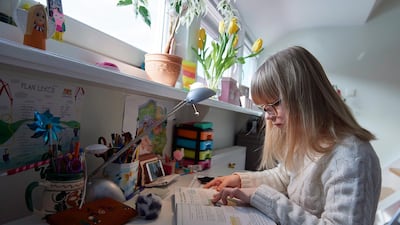
UAE parents have backed plans for schoolchildren to return to the classroom for the start of the new academic year – providing it is safe to do so.
Schools closed their doors in March to stem the spread of coronavirus and agreed to adopt distance learning for more than a million pupils across the country.
On Monday, education chiefs confirmed they were drawing up plans to reopen schools in September with strict safety measures in place, including reduced class sizes, pupil temperature checks, a ban on sharing food and a 30 per cent cap on school bus passengers.
Dubai's school pupils and university students should expect to return to classrooms and lecture halls after the summer, the city's education regulator said.
My children keep asking me: 'When are we going back?'
The Knowledge and Human Development Authority said the learning experience would look different and to expect a mix of in-class learning and home study.
Abir Saud, 37, a mother of three in Dubai, said it was important for children to return to normality as soon as possible.
"We cannot keep our children from the outside world and with things opening up, it seems quite ridiculous not to send them to school," she said.
"There is also weighing the effects of distance learning on our children's psychology and how they interact and learn from being with other children and professional teachers.
"My twins are in foundation stage and will not benefit from any sort of lessons on iPads and Zoom.
“We had a few trials with their nursery and it just does not work. They got so bored. My seven-year-old hates online learning and she hates staring at her iPad and not being with her friends."
Ms Saud said she was not in favour of blended learning.
"The effect of distance learning so far has been negative and I do not wish it to continue as it affects the wellbeing of my children," she said.
Ms Saud said schools would need to take to ensure continuous sanitation of premises and monitor children for any sign of illness.
Clementina Kongslund, 42, a Romanian with two children aged seven and nine in Dubai, said her daughters, Valentina, nine, and Benedicte, seven, were eager to return to school but she would want them to return only when it is safe to do so.
Ms Kongslund said schools should offer the choice of in-person lessons and online schooling to parents, as some may want to be careful.
"If some children have low immunity, parents may prefer to keep them home. How will the schools help these children?" said Ms Kongslund.
"My children keep asking me: 'When are we going back?' My husband and I are working full time, so we have so many things to consider now.
"I would have to hire a tutor for online learning and I would expect at least a 25-per-cent discount in fees," said the mother who pays close to Dh90,000 in school fees for her children.
She said schools should install sanitisers, ensure pupils wear masks properly, and maintain social distance when they open.
Radwa Allabban, Egyptian-British managing director of an Abu Dhabi communications consultancy, is the mother of three boys aged four, six and 10. She said she wanted to send her children back to school full-time but only when a vaccine was available.
“I would be happy to send my kids to school in September, provided the school can perhaps arrange for reduced class capacity to maintain a degree of social distancing," Ms Allabban said.
"So, if the school would have half the children for two days and then the other half for the other two days of the week, that would be reasonable in the short term.
"My husband and I tried to support our children with distance learning, but that isn’t sustainable in the long term. Both of us work full-time and have demanding careers, so we feel that our children will miss out on valuable education and personal development if they spend another school year at home.”
Alison Rego, 37, from India, said she would be happy to send her seven-year-old daughter back to school in Sharjah in September if the number of coronavirus cases continued to decline.
She hopes to initially send her child back to school for a few days each week to gradually get her back into the classroom environment, but expects discounts on fees to be offered.
“If I am sending my child to school for only 50 per cent of the time, I expect that the school would only charge me 50 per cent of the fees,” she said.
“If I am only sending my child to school for half the time, how can I be expected to pay the entire amount?
“I have not re-registered my daughter at her school and I will evaluate the situation in August and make a decision.
"If the number of coronavirus cases is on the rise at that time, I would not want to send my child to school."

The years Ramadan fell in May
Company: Instabug
Founded: 2013
Based: Egypt, Cairo
Sector: IT
Employees: 100
Stage: Series A
Investors: Flat6Labs, Accel, Y Combinator and angel investors
Ten tax points to be aware of in 2026
1. Domestic VAT refund amendments: request your refund within five years
If a business does not apply for the refund on time, they lose their credit.
2. E-invoicing in the UAE
Businesses should continue preparing for the implementation of e-invoicing in the UAE, with 2026 a preparation and transition period ahead of phased mandatory adoption.
3. More tax audits
Tax authorities are increasingly using data already available across multiple filings to identify audit risks.
4. More beneficial VAT and excise tax penalty regime
Tax disputes are expected to become more frequent and more structured, with clearer administrative objection and appeal processes. The UAE has adopted a new penalty regime for VAT and excise disputes, which now mirrors the penalty regime for corporate tax.
5. Greater emphasis on statutory audit
There is a greater need for the accuracy of financial statements. The International Financial Reporting Standards standards need to be strictly adhered to and, as a result, the quality of the audits will need to increase.
6. Further transfer pricing enforcement
Transfer pricing enforcement, which refers to the practice of establishing prices for internal transactions between related entities, is expected to broaden in scope. The UAE will shortly open the possibility to negotiate advance pricing agreements, or essentially rulings for transfer pricing purposes.
7. Limited time periods for audits
Recent amendments also introduce a default five-year limitation period for tax audits and assessments, subject to specific statutory exceptions. While the standard audit and assessment period is five years, this may be extended to up to 15 years in cases involving fraud or tax evasion.
8. Pillar 2 implementation
Many multinational groups will begin to feel the practical effect of the Domestic Minimum Top-Up Tax (DMTT), the UAE's implementation of the OECD’s global minimum tax under Pillar 2. While the rules apply for financial years starting on or after January 1, 2025, it is 2026 that marks the transition to an operational phase.
9. Reduced compliance obligations for imported goods and services
Businesses that apply the reverse-charge mechanism for VAT purposes in the UAE may benefit from reduced compliance obligations.
10. Substance and CbC reporting focus
Tax authorities are expected to continue strengthening the enforcement of economic substance and Country-by-Country (CbC) reporting frameworks. In the UAE, these regimes are increasingly being used as risk-assessment tools, providing tax authorities with a comprehensive view of multinational groups’ global footprints and enabling them to assess whether profits are aligned with real economic activity.
Contributed by Thomas Vanhee and Hend Rashwan, Aurifer
Classification of skills
A worker is categorised as skilled by the MOHRE based on nine levels given in the International Standard Classification of Occupations (ISCO) issued by the International Labour Organisation.
A skilled worker would be someone at a professional level (levels 1 – 5) which includes managers, professionals, technicians and associate professionals, clerical support workers, and service and sales workers.
The worker must also have an attested educational certificate higher than secondary or an equivalent certification, and earn a monthly salary of at least Dh4,000.
How to help
Call the hotline on 0502955999 or send "thenational" to the following numbers:
2289 - Dh10
2252 - Dh50
6025 - Dh20
6027 - Dh100
6026 - Dh200
MATCH RESULT
Al Jazira 3 Persepolis 2
Jazira: Mabkhout (52'), Romarinho (77'), Al Hammadi (90' 6)
Persepolis: Alipour (42'), Mensha (84')
The Voice of Hind Rajab
Starring: Saja Kilani, Clara Khoury, Motaz Malhees
Director: Kaouther Ben Hania
Rating: 4/5
THE BIO
Bio Box
Role Model: Sheikh Zayed, God bless his soul
Favorite book: Zayed Biography of the leader
Favorite quote: To be or not to be, that is the question, from William Shakespeare's Hamlet
Favorite food: seafood
Favorite place to travel: Lebanon
Favorite movie: Braveheart
The low down
Producers: Uniglobe Entertainment & Vision Films
Director: Namrata Singh Gujral
Cast: Rajkummar Rao, Nargis Fakhri, Bo Derek, Candy Clark
Rating: 2/5
Mercer, the investment consulting arm of US services company Marsh & McLennan, expects its wealth division to at least double its assets under management (AUM) in the Middle East as wealth in the region continues to grow despite economic headwinds, a company official said.
Mercer Wealth, which globally has $160 billion in AUM, plans to boost its AUM in the region to $2-$3bn in the next 2-3 years from the present $1bn, said Yasir AbuShaban, a Dubai-based principal with Mercer Wealth.
“Within the next two to three years, we are looking at reaching $2 to $3 billion as a conservative estimate and we do see an opportunity to do so,” said Mr AbuShaban.
Mercer does not directly make investments, but allocates clients’ money they have discretion to, to professional asset managers. They also provide advice to clients.
“We have buying power. We can negotiate on their (client’s) behalf with asset managers to provide them lower fees than they otherwise would have to get on their own,” he added.
Mercer Wealth’s clients include sovereign wealth funds, family offices, and insurance companies among others.
From its office in Dubai, Mercer also looks after Africa, India and Turkey, where they also see opportunity for growth.
Wealth creation in Middle East and Africa (MEA) grew 8.5 per cent to $8.1 trillion last year from $7.5tn in 2015, higher than last year’s global average of 6 per cent and the second-highest growth in a region after Asia-Pacific which grew 9.9 per cent, according to consultancy Boston Consulting Group (BCG). In the region, where wealth grew just 1.9 per cent in 2015 compared with 2014, a pickup in oil prices has helped in wealth generation.
BCG is forecasting MEA wealth will rise to $12tn by 2021, growing at an annual average of 8 per cent.
Drivers of wealth generation in the region will be split evenly between new wealth creation and growth of performance of existing assets, according to BCG.
Another general trend in the region is clients’ looking for a comprehensive approach to investing, according to Mr AbuShaban.
“Institutional investors or some of the families are seeing a slowdown in the available capital they have to invest and in that sense they are looking at optimizing the way they manage their portfolios and making sure they are not investing haphazardly and different parts of their investment are working together,” said Mr AbuShaban.
Some clients also have a higher appetite for risk, given the low interest-rate environment that does not provide enough yield for some institutional investors. These clients are keen to invest in illiquid assets, such as private equity and infrastructure.
“What we have seen is a desire for higher returns in what has been a low-return environment specifically in various fixed income or bonds,” he said.
“In this environment, we have seen a de facto increase in the risk that clients are taking in things like illiquid investments, private equity investments, infrastructure and private debt, those kind of investments were higher illiquidity results in incrementally higher returns.”
The Abu Dhabi Investment Authority, one of the largest sovereign wealth funds, said in its 2016 report that has gradually increased its exposure in direct private equity and private credit transactions, mainly in Asian markets and especially in China and India. The authority’s private equity department focused on structured equities owing to “their defensive characteristics.”
Sholto Byrnes on Myanmar politics
Superpower%20
%3Cp%3E%3Cstrong%3EDirector%3A%20%3C%2Fstrong%3ESean%20Penn%2C%20Aaron%20Kaufman%3C%2Fp%3E%0A%3Cp%3E%3Cstrong%3ERating%3A%20%3C%2Fstrong%3E3%2F5%3C%2Fp%3E%0A
MATCH INFO
Uefa Champions League semi-finals, first leg
Liverpool v Roma
When: April 24, 10.45pm kick-off (UAE)
Where: Anfield, Liverpool
Live: BeIN Sports HD
Second leg: May 2, Stadio Olimpico, Rome
Three trading apps to try
Sharad Nair recommends three investment apps for UAE residents:
- For beginners or people who want to start investing with limited capital, Mr Nair suggests eToro. “The low fees and low minimum balance requirements make the platform more accessible,” he says. “The user interface is straightforward to understand and operate, while its social element may help ease beginners into the idea of investing money by looking to a virtual community.”
- If you’re an experienced investor, and have $10,000 or more to invest, consider Saxo Bank. “Saxo Bank offers a more comprehensive trading platform with advanced features and insight for more experienced users. It offers a more personalised approach to opening and operating an account on their platform,” he says.
- Finally, StashAway could work for those who want a hands-off approach to their investing. “It removes one of the biggest challenges for novice traders: picking the securities in their portfolio,” Mr Nair says. “A goal-based approach or view towards investing can help motivate residents who may usually shy away from investment platforms.”