

The UAE has announced a nationwide action plan to cut food waste by 50 per cent by 2030.
Mariam Al Mheiri, Minister of Climate Change and Environment, set out the UAE's plan to eliminate food waste as she unveiled the Ne’ma Food Loss and Waste Reduction Roadmap on Sunday.
The wide-ranging strategy will focus on changing attitudes towards food loss and developing more sustainable practices across the public and private sector.
More than 200 interviews have been carried out with leading companies and organisations across the industry – including Jumeirah Group, Hilton Group, Rotana Group and Expo City – who all signed agreements with the UAE's food loss and waste initiative, Ne'ma, to embrace food loss and waste reduction as a priority.
This was announced on Sunday at the fourth National Dialogue on Food Security, which was held under the theme Call for Change: Reducing Food Loss and Waste in the UAE.
Minister of Climate Change and Environment
“With only a few days away to our nation hosting Cop28, this event underlines the strong commitment of the UAE in addressing all sectors that have a defining role in addressing the impact of climate change,” Ms Al Mheiri said.
“And food and agriculture systems play a pivotal role in this regard, especially with food loss and waste one of the core challenges that humanity must address as a priority.”
Khuloud Al Nuwais, who leads Ne'ma, said this week that fines could eventually be imposed on households generating high levels of food waste.
Ne'ma was established in March 2022 to co-ordinate government agencies, the private sector, non-government organisations and society to reduce food loss and waste across the supply chain.
The transformation of food and agricultural systems will be placed high on the agenda at the climate conference, which begins next week.
Ms Al Mheiri is at the forefront of that push, having announced the Cop28 Food Systems and Agricultural Agenda this year.
“The importance of addressing food loss and waste is a strategic imperative for the world,” she said.
“Today, one third of food produced for human consumption is lost or wasted globally. Further, it is estimated that all the food produced but never eaten would be sufficient to feed two billion people.”
-

A rehearsal of 'Alya in Terraland,' a musical on climate change that will be open to all visitors of the Cop28 green zone at Expo City Dubai. The performance urges the audience to leave a positive impact on the environment. All photos: Khushnum Bhandari / The National -

Hend Al Mheiri, director of special projects at Expo City Dubai, Marjan Faraidooni, chief of education and culture, Nadia Verjee, executive director of Expo Dubai Group, Matt Brown, chief of sustainability at Expo City Dubai, and Yousuf Caires, executive director of the Expo Live Innovation Programme announce Expo City Dubai's public programming for Cop28. -

Hend Al Mheiri, director of special projects Expo City Dubai, said hosting Cop28 shows the UAE's commitment to working towards environmental sustainability and helping to address the global challenges of climate change. -

A rehearsal at the Terra Pavilion, of the musical Alya in Terraland, at Expo City. -

Cast members during the rehearsal of Alya in Terraland. -
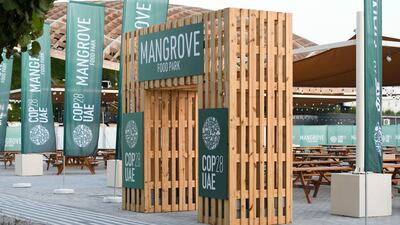
Reused material from palm trees has been used in Cop28 signs across Expo City Dubai. -
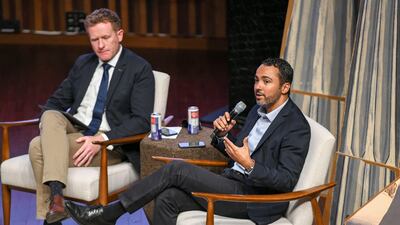
Matt Brown, sustainability chief, Expo City Dubai (left) and Yousuf Caires, executive director, Expo Live Innovation Programme, share details of an organic farm and workshops on climate action open to all in the Cop28 green zone. -

Ms Faraidooni says youth engagement is a key component of Cop28. -

A 45-minute musical Alya in Terraland aims to inspire people to participate in climate discussions. -
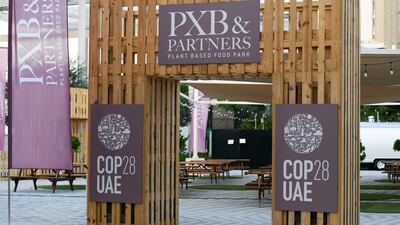
Sustainable material has been used in the Cop28 signs across Expo City Dubai.


The UAE’s plan at Cop28 is to limit food wastage and the carbon impact of the food served while inviting other countries to ratify the Emirates Declaration on Resilient Food Systems, Sustainable Agriculture and Climate Action.
“Our goal is to become a nation where no food is wasted,” Ms Al Mheiri said.
Ahmed Al Shamsi, chief executive of the Emirates Foundation charitable organisation, said: “This new road map is incredibly important as we recognise the profound impact of food loss on our shared goals of food security, sustainable consumption, and the cultivation of circular ecosystems.
“Addressing the challenges of today requires a united effort grounded in a shared understanding of the intricate relationship between food loss and these critical objectives.
“It is incumbent upon us to acknowledge that every piece of wasted food is a missed opportunity to alleviate hunger and reduce environmental strain.
“Through a collective commitment to responsible consumption, we can forge a path towards a more sustainable future. Let us, as global citizens, work together to minimise waste, maximise efficiency, and foster a resilient food system that not only nourishes the present but preserves the abundance of our planet for generations to come.”

