



The discovery of 52 critically endangered geckos on the UAE’s east coast has raised hopes for the survival of the threatened species.
The Emirati leaf-toed gecko – Asaccus caudivolvulus – was thought to be on the brink of extinction but a 2022 expedition found the geckos in five locations despite heavy development in the area.
Geckos play a crucial role in ecosystems because they feed on insects and help to balance the number of species.
But due to habitat loss caused by development, the gecko population has dwindled.
The species is now classified as critically endangered by the International Union for Conservation of Nature (IUCN).
The expedition was financed by the Mohamed bin Zayed Species Conservation Fund and aims to help bring the creature back from the brink of extinction.
"There was a lot of pressure because there is a lot of effort and money involved," said Prof Salvador Carranza, from the Institute of Evolutionary Biology at Pompeu Fabra University in Barcelona, who led the expedition.
Breeding Centre for Endangered Arabian Wildlife, Sharjah Environment and Protected Areas Authority
The field trip took place over 15 hot and humid nights in late May and early June last year, which the team identified as the best time to spot the reptiles.
They deliberately picked two weeks with little moonlight, when the geckos are more active because there is a reduced risk from predators. They are nocturnal species and retreat into deep cracks and crevices during the heat of the day.
“These nights are perfect,” Prof Carranza said. “If you go in winter you don’t see anything, even if they are there.”
The gecko is native to a small part of the Hajar Mountains on the north-east of the UAE and is the only known vertebrate species endemic to the UAE.
The six-strong team travelled as much as 15 kilometres a night and used only flashlights to chart a path through mountains, down craggy slopes and across rock faces searching for the elusive and shy creature.
The gecko is about 11 centimetres long, slightly transparent, has long and thin legs for climbing and can lay only one egg at a time.

It gets its name from the pads on its toes that resemble a leaf. It also has light colouring, orange eyes and orange to brown markings on its back.
“It is a very shy creature,” Prof Carranza said. “When you shed light, they hide immediately. We found them in places we were absolutely not expecting.”
The team was also able to complete the genome sequence of the gecko. This is crucial to build a picture of the animal and aid conservation efforts. It showed a reduction in genetic diversity that can be attributed to a severe and ongoing decline in its population size.
“If a habitat is reduced then inbreeding can take place,” said Bernat Burriel, one of Prof Carranza’s students who worked on this analysis.
“Inbreeding means you have less capabilities of adapting to new situations. This ends up in an ‘extinction vortex’, which means species cannot adapt and go extinct,” he said. “We need to preserve it as fast as possible.”
Last summer's expedition was not just two weeks' work but the culmination of years of effort from experts around the world, the fund and the authorities on the east coast who aided the trip.
The team highlighted that a significant amount of conservation work was accomplished with the $9,000 (Dh33,052) grant.

“It was a big surprise to find 52,” said Johannes Els, from the Breeding Centre for Endangered Arabian Wildlife at Sharjah’s Environment and Protected Areas Authority, who was also part of the expedition.
“But it was a pleasant surprise. These are fragmented populations but now we have important data that allows us to assess the species.”
Mr Els said a reassessment of the species could now take place which, in theory, could trigger a different and more positive assessment from the IUCN.
He pointed to the success of the Arabian oryx programme, which brought the animal back from the brink, as a sign of what could be achieved.
“The first step is always trying to conserve as much of the habitat that is there and leave them untouched," Mr Els said.
"You can’t always stop development but you can make people aware and do it in a way that has least impact on population in the area.”
Mr Els said authorities were raising conservation efforts and had been informed of the study so the gecko could be considered in future development plans. Some of the geckos' habitats are in areas that are already protected.
More conservation plans that are yet to be revealed are also in the works.
“The rediscovery of a species that had been thought to be extinct is a relief and a boost to anyone who loves nature and the web of biodiversity which sustains our planet,” said Nicolas Heard, acting director general of the Mohamed bin Zayed Species Conservation Fund, which has now supported more than 2,600 such projects around the world with individual grants of up to $25,000 (Dh91,812).
“It brings optimism that maybe we can reduce the rate of extinction and the damage we are causing to our environment. In this case, finding a population of the Emirati leaf-toed gecko is particularly poignant,” he said.
“For a number of years, we thought that the UAE had lost for ever the only vertebrate unique to this country and nowhere else. That would have been truly tragic, and its rediscovery will hopefully encourage further conservation effort and enthusiasm.”
How the UAE aids conservation and sustainability - in pictures
-
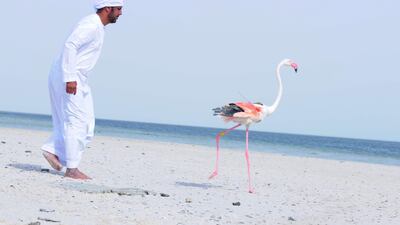
The UAE is known for protecting the environment. Here Environment Agency Abu Dhabi staff release a tagged flamingo as part of Abu Dhabi Birdathon initiative. Courtesy Environment Agency Abu Dhabi -

Umbrella Thorn Acacia trees are among the UAE's rich flora. Silvia Razgova / The National -
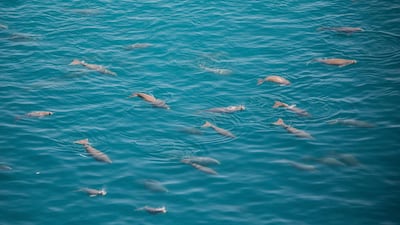
Abu Dhabi has the second-largest dugong population in the world. Environment Agency Abu Dhabi -
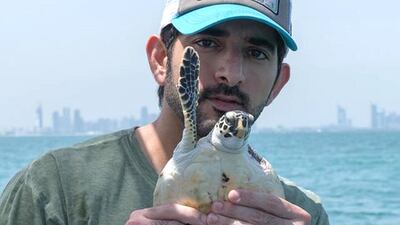
Love of nature is part of life here. Sheikh Hamdan bin Mohammed, Crown Prince of Dubai, with a sea turtles he helped release into the wild. Instagram/ @faz3 -
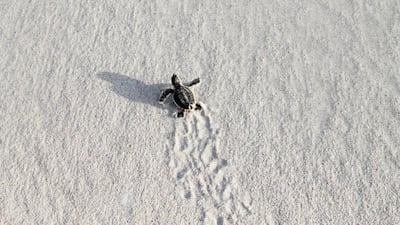
Abu Dhabi's environment agency is working to protect Hawksbill and Green turtles which live in the emirate's waters. Courtesy TDIC -
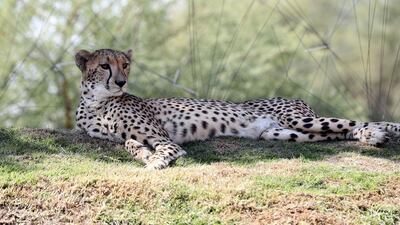
A cheetah at Al Ain Zoo, Al Ain. The zoo was founded by the Late President, Sheikh Zayed. Chris Whiteoak / The National -
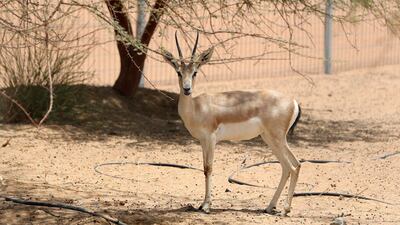
An Arabian sand gazelle at the Mleiha Archaeological Centre in Sharjah. Chris Whiteoak / The National -

The UAE is also embracing clean energy. This computer-generated image shows what phase four of Dubai's Mohammed Bin Rashid Solar Park, currently under construction in Dubai. Image courtesy of Acwa Power -

Nuclear energy is also important. The first reactor at Barakah nuclear plant reached 100 per cent power in December 2020. -

Abu Dhabi's new Midfield Terminal has won a coveted three-pearl rating under Abu Dhabi's Estidama, Arabic for sustainability, system. Courtesy KPF -
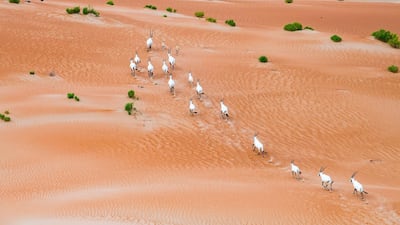
A breeding programme run by Environment Agency Abu Dhabi helped bring Arabian Oryx back from the brink of extinction. Courtesy: EAD



