


The UAE’s new, more ambitious emission-reduction targets revealed this week are set to involve wide-ranging changes across several sectors from transport to power generation, water production, waste and agriculture.
Mariam Al Mheiri, Minister of Climate Change and Environment, announced the Emirates' goal of cutting emissions by 40 per cent by 2030 compared to business as usual only months before the UAE hosts the Cop28 climate change conference.
Ms Al Mheiri said the government “views climate action not only as a strategic imperative for the environment and our future generations, but also as an opportunity for sustainable economic growth and socially inclusive prosperity”.
Through the UN process for cutting emissions, government pledges are set out in what are called nationally determined contributions (NDCs).
Asher Minns, executive director of the Tyndall Centre for Climate Change research at the University of East Anglia in the UK, said it was "really important" for countries not only to make NDC pledges, but to act on them and to step them up.
"At the moment emissions reductions are relatively easy – the low-hanging fruit," Mr Minns said. "It’s going to get harder and harder over time."
Emissions reductions tend to become more difficult over time because authorities typically focus initially on areas where cuts are less difficult to make, such as in carbon-intensive power generation.
The NDCs are being made by governments as part of the 2015 Paris Agreement, which set out the aspiration to limit average global temperature increases to 1.5°C above pre-industrial levels.
Countries are expected to come up with strengthened pledges over time. The latest announcement is the country’s third revision of its second NDC.
Reducing greenhouse emissions
In 2020, UAE authorities announced they were aiming for annual greenhouse gas emissions in 2030 equivalent to 240 million tonnes of carbon dioxide (MtCO2e), compared to 310 million tonnes under business-as-usual practices, which assumes an absence of emission-reduction efforts.
A second update came last year, with a target of 208 MtCO2e, followed by this latest revision, which sets emissions at 182 MtCO2e, a cut of at least 40 per cent compared to business as usual.
The new target also means that by 2030, annual emissions should be 19 per cent lower in actual terms than they were in 2019, a milestone on the path to achieving net zero and particularly significant given the country’s continued economic and population growth.
__________________________________________________________________________________
Climate change pushing ecosystems beyond 'tipping points'
-
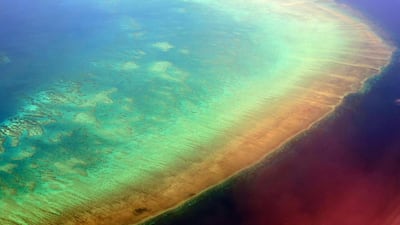
An aerial shot of the Great Barrier Reef in Australia, showing parts of the reef that has been subjected to coral bleaching. -

A house located on land that has been deformed by permafrost thaw at a former airfield in Churapcha, Russia. Reuters -

Native vegetation has been cut down to give space for eucalyptus plantations in the Setubinha region in Brazil. AFP -
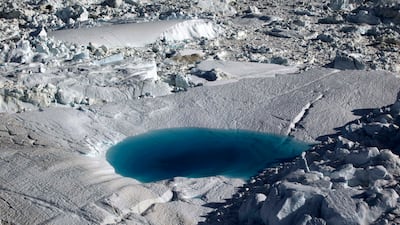
A large melt pool forms in the Ilulissat ice fjord below the Jakobshavn Glacier at the fringe of the Greenland ice sheet. AP -
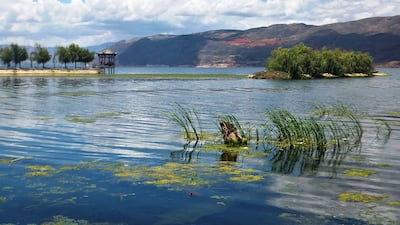
Lake Erhai in China has become eutrophic (where an entire body of water becomes enriched with nutrients and minerals) which caused algal growth that destroyed other life. Photo: Ronan O'Connell -
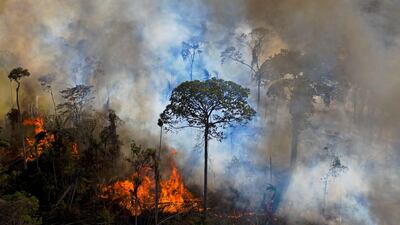
Deforestation in Para state, Brazil. AFP -
Moai statues in Easter Island, Chile, were damaged after a wildfire. Reuters


__________________________________________________________________________________
In late 2021, ahead of the Cop26 gathering in Glasgow, the UAE became the first Gulf state to make a net-zero commitment when it set out the ambition to achieve this by 2050.
Key to the country’s efforts are decarbonising energy, which traditionally has been dependent on the burning of fossil fuels.
The development of the Barakah Nuclear Power Plant is a central measure and in February it was announced the third of its four reactors had entered commercial operations. The four reactors will together be able to generate 5,600 megawatts of power.
Increasing investment in renewable energy
Earlier this month the UAE announced it was investing up to Dh200 billion as part of a national energy strategy that will see a tripling of renewable energy output by the end of the decade.
The UAE had in 2017 committed to increasing clean energy’s share of the country’s energy mix to 50 per cent by the middle of the century.
Major investments date back more than a decade, with the Shams 1 in Madinat Zayed inaugurated in 2013.
The Abu Dhabi National Oil Company (Adnoc) is investing $15 billion in low-carbon technology, including "carbon capture and storage, electrification and investments in hydrogen and renewables", the Ministry of Climate Change and Environment said in Accelerating Action Towards a Green, Inclusive and Resilient Economy, a document released to accompany this week’s NDC announcement.
Recycling more water
Other key parts of the UAE’s 2030 plans include reducing the carbon impact of desalination, such as by recycling more water.
Transport is expected to achieve a 56 per cent reduction in emission, helped by a national network of charging stations for electric vehicles.
Emissions from waste are set to be cut by 8 per cent, while the government wants emissions from agriculture to fall 22 per cent.

The UAE is not looking only to advanced technology to achieve climate goals, it is also employing natural methods to capture carbon, having previously announced plans to plant 30 million mangrove seedlings by 2030. Mangroves both capture CO2 and act as a bulwark against sea-level rises.
Dr Michael Mason, director of the Middle East Centre at the London School of Economics, said the UAE, as host of this year’s Cop28, is keen to "demonstrate and signify their commitments in this area are meaningful".
The resources are there
He described the UAE as "certainly" having the resources to invest in low-carbon technology.
"Their whole economic plan is to reduce their emissions anyway to move to more clean energy in their domestic sector," he said.
While there are commitments to cut domestically generated carbon emissions, Dr Mason said Gulf states intended to remain major fossil fuel exporters.
The continuation of exporting hydrocarbons is sometimes justified on the basis there will be demand for fossil fuels until economies have transitioned to low-carbon technology, and extraction of oil and gas in the Gulf region is less carbon intensive than in many other parts of the world.
The UAE states that its oil has a carbon intensity of less than half of the average for the industry.

