• By January 1, companies in the UAE with 50 employees or more must ensure that 3 per cent of their workforce is Emirati. Emirates Global Aluminium's (pictured) Emiratisation rate exceeds 42 per cent. Bloomberg
    By January 1, companies in the UAE with 50 employees or more must ensure that 3 per cent of their workforce is Emirati. Emirates Global Aluminium's (pictured) Emiratisation rate exceeds 42 per cent. Bloomberg
  • Private companies with 20 to 49 employees must hire at least one UAE citizen by 2024 and another by 2025. Silvia Razgova / The National
    Private companies with 20 to 49 employees must hire at least one UAE citizen by 2024 and another by 2025. Silvia Razgova / The National
  • Semi-government owned companies such as Strata, which makes aircraft parts, are major employers of Emiratis. The government wants more private companies to hire Emiratis. Photo: Mubadala
    Semi-government owned companies such as Strata, which makes aircraft parts, are major employers of Emiratis. The government wants more private companies to hire Emiratis. Photo: Mubadala
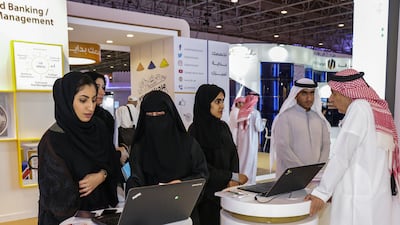
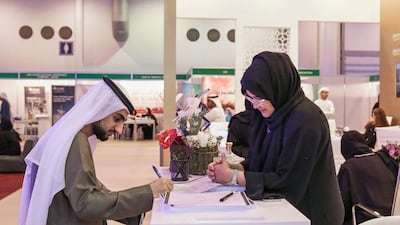
  • Young Emiratis are being encouraged to look to the private sector, instead of the government, for opportunities. Satish Kumar / The National
    Young Emiratis are being encouraged to look to the private sector, instead of the government, for opportunities. Satish Kumar / The National
  • Sheikh Mansour bin Zayed, Vice President, Deputy Prime Minister and Minister of the Presidential Court, and Sheikh Abdullah bin Zayed, Minister of Foreign Affairs, chair the National Competitiveness Council. Photo: UAE Government Media Office
    Sheikh Mansour bin Zayed, Vice President, Deputy Prime Minister and Minister of the Presidential Court, and Sheikh Abdullah bin Zayed, Minister of Foreign Affairs, chair the National Competitiveness Council. Photo: UAE Government Media Office
  • Abdulrahman Al Awar, Minister of Human Resources and Emiratisation, said a greater mix of Emiratis and foreign talent will make the country more competitive. Victor Besa / The National
    Abdulrahman Al Awar, Minister of Human Resources and Emiratisation, said a greater mix of Emiratis and foreign talent will make the country more competitive. Victor Besa / The National

Emiratisation explained: What are the new rules and fines?


  • English
  • Arabic

Emiratis who work in the private sector are eligible to receive a Dh7,000 monthly salary top-up, as per rules announced by government leaders in November last year.

The move is designed to attract more Emiratis away from government jobs, where salaries tend to be higher.

This week, new rules were announced for private sector companies with 20 to 49 employees.

Here's everything you need to know about Emiratisation in the UAE:

What is Emiratisation?

The government has been trying to boost the number of Emiratis who work in the private sector through its Emiratisation drive.

While public sector hours and wages have been traditionally more attractive, the government has been encouraging Emiratis to develop more skills in the workforce.

In September 2022, authorities set out quotas for hiring Emiratis for the first time and gave private companies deadlines to reach them.

Private sector companies with at least 50 employees needed to ensure 3 per cent of their workforce was made up of Emiratis by July 7.

On July 11, the Ministry of Human Resources and Emiratisation announced a new update to the rules, whereby private companies with 20 to 49 employees are now included in the government's Emiratisation drive.

The new rules now apply to companies across 14 economic sectors including property, education, construction and health care.

The Emirati employment rate is projected to increase to 6 per cent in 2024, 8 per cent in 2025 and 10 per cent in 2026.

Those end-of-year goals remain in place, but private businesses must now make sure they reach those targets, with an increase of 1 per cent every six months.

The measures apply to skilled positions and companies in free zones are exempt. They are, however, encouraged to participate in the scheme.

Businesses are being asked to increase the number of citizens they hire by 2 per cent each year to reach 10 per cent by the start of 2027.

What are the top-up payments?

Officials say they are pragmatic about the expectations of Emirati university graduates, in particular those who want a good starting salary.

At the same time, they know that private businesses operate in a highly competitive market and cannot pay people higher salaries simply to hit a quota.

The salary top-up was introduced for this reason.

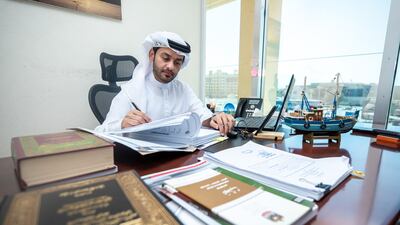
  • Rashed Abdulla Al Sumaity, an associate at Galadari Advocates & Legal Consultants in Dubai. The legal and banking professions have the highest Emiratisation in the private sector. All photos by Victor Besa / The National
    Rashed Abdulla Al Sumaity, an associate at Galadari Advocates & Legal Consultants in Dubai. The legal and banking professions have the highest Emiratisation in the private sector. All photos by Victor Besa / The National
  • Official announcements show the UAE government’s resolve to encourage citizens to take on private sector jobs and persuade companies to take Emiratis on board.
    Official announcements show the UAE government’s resolve to encourage citizens to take on private sector jobs and persuade companies to take Emiratis on board.
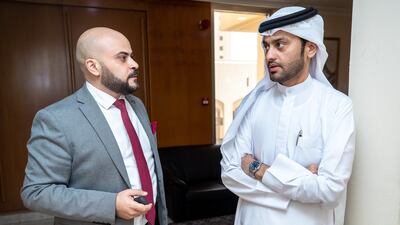
  • Raka Roy (R), partner at Galadari Advocates & Legal Consultants and Eslam Oraif, legal counsel, break down the government announcements that offer extra salary and benefits to UAE citizens taking jobs in the private sector.
    Raka Roy (R), partner at Galadari Advocates & Legal Consultants and Eslam Oraif, legal counsel, break down the government announcements that offer extra salary and benefits to UAE citizens taking jobs in the private sector.
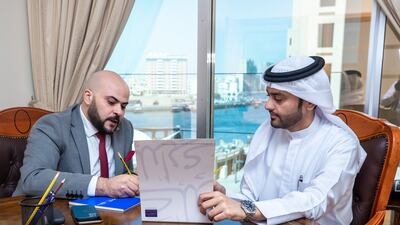
  • Rashed Abdulla Al Sumaity (R) with Eslam Oraif of Galadari Advocates & Legal Consultants. The UAE government's Nafis scheme has set a target of 75,000 Emiratis in private sector jobs by 2026.
    Rashed Abdulla Al Sumaity (R) with Eslam Oraif of Galadari Advocates & Legal Consultants. The UAE government's Nafis scheme has set a target of 75,000 Emiratis in private sector jobs by 2026.
  • The UAE Cabinet approved that private companies with more than 50 employees should have at least a 2 per cent Emirati workforce by 2021.
    The UAE Cabinet approved that private companies with more than 50 employees should have at least a 2 per cent Emirati workforce by 2021.
  • UAE government support programmes will empower and protect Emirati employees in the private sector.
    UAE government support programmes will empower and protect Emirati employees in the private sector.
  • Salary incentives are being offered to Emirati university graduates and UAE citizens in training for skilled jobs.
    Salary incentives are being offered to Emirati university graduates and UAE citizens in training for skilled jobs.

For example, an Emirati graduate being offered Dh13,000 a month in a starting role would take home Dh18,000 under the original Nafis programme, set out in September 2021.

This rose to Dh20,000 following the decision made in November 2022.

There are other benefits available, particularly for those who have children, with Dh800 per child given every month and up to Dh3,200 per family.

What happens if companies don't hit the deadline?

Private companies who failed to meet the July 7 deadline for Emiratisation targets now face fines of up to Dh500,000.

Earlier this month, the ministry said it would be reviewing companies' compliance with the required targets, and a fine of Dh42,000 would be imposed for each Emirati not employed.

Companies who fabricate or mislead authorities regarding their Emiratisation numbers will also face steep fines.

Previously, it was announced that firms that fail to reach the 4 per cent mark in 2023 would pay Dh84,000 for each Emirati not hired, with this figure rising to Dh120,000 per worker for 2026.

For private companies with 20 to 49 employees, those that fail to employ at least one Emirati in 2024 will face a fine of Dh96,000 ($26,000).

That fine will increase to Dh108,000 ($30,000) for businesses that have not employed at least two Emiratis in 2025.

Which companies are hiring the most?

As of July 9, about 80,000 Emiratis are now working in the private sector – a leap of 30,000 in the past six months.

About 79,000 Emiratis have secured jobs in the private sector, the highest figure since the Emiratisation drive began.

Semi-government companies and local banks are currently the main employers of Emiratis in the private sector.

Companies such as Emirates Global Aluminium and Strata, the aircraft parts manufacturer in Al Ain, are major employers of UAE citizens, with thousands on the payroll.

However, Emiratis have since been hired in teaching and healthcare positions.

It is the wholly privately owned businesses that officials want to see act.

What happens next?

In 2021, officials announced an investment of Dh24 billion to create 75,000 new private sector jobs for UAE citizens.

A year later, the country's leaders said they wanted 75,000 Emiratis to enter the private sector workforce over the next four years.

With 80,000 Emiratis having joined the private sector as of this months, the initial target has been surpassed, showing huge growth within the sector.

In June, a PwC Middle East Emiratisation survey found that the majority of Emirati graduates have expressed an interest in joining the private sector.

It polled citizens working in the private and public sectors, as well as graduates entering the workplace.

According to the poll, entering the private sector is strong among the younger generation (61 per cent interested), and two thirds of those currently working in private companies are considering a return to the public sector.

“It is a moving market with new graduates coming in stream and thousands of jobs are created,” a Nafis spokesman said last year.

“We believe that in our dynamic economy, there will always be opportunities for everyone. In the meantime, we can tell you that what we see on the ground is very promising, but we aspire to see more.”


MATCH INFO

Champions League last 16, first leg

Tottenham v RB Leipzig, Wednesday, midnight (UAE)

Essentials

The flights
Emirates and Etihad fly direct from the UAE to Los Angeles, from Dh4,975 return, including taxes. The flight time is 16 hours. Alaska Airlines, United Airlines, Delta Air Lines, Aeromexico and Southwest all fly direct from Los Angeles to San Jose del Cabo from Dh1,243 return, including taxes. The flight time is two-and-a-half hours.

The trip
Lindblad Expeditions National Geographic’s eight-day Whales Wilderness itinerary costs from US$6,190 (Dh22,736) per person, twin share, including meals, accommodation and excursions, with departures in March and April 2018.


T20 SQUADS

Australia: Aaron Finch (c), Mitchell Marsh, Alex Carey, Ashton Agar, Nathan Coulter-Nile, Chris Lynn, Nathan Lyon, Glenn Maxwell, Ben McDermott, D’Arcy Short, Billy Stanlake, Mitchell Starc, Andrew Tye, Adam Zampa.

Pakistan: Sarfraz Ahmed (c), Fakhar Zaman, Mohammad Hafeez, Sahibzada Farhan, Babar Azam, Shoaib Malik, Asif Ali, Hussain Talat, Shadab Khan, Shaheen Shah Afridi, Usman Khan Shinwari, Hassan Ali, Imad Wasim, Waqas Maqsood, Faheem Ashraf.

COMPANY PROFILE

Company name: SimpliFi

Started: August 2021

Founder: Ali Sattar

Based: UAE

Industry: Finance, technology

Investors: 4DX, Rally Cap, Raed, Global Founders, Sukna and individuals

Mercer, the investment consulting arm of US services company Marsh & McLennan, expects its wealth division to at least double its assets under management (AUM) in the Middle East as wealth in the region continues to grow despite economic headwinds, a company official said.

Mercer Wealth, which globally has $160 billion in AUM, plans to boost its AUM in the region to $2-$3bn in the next 2-3 years from the present $1bn, said Yasir AbuShaban, a Dubai-based principal with Mercer Wealth.

Within the next two to three years, we are looking at reaching $2 to $3 billion as a conservative estimate and we do see an opportunity to do so,” said Mr AbuShaban.

Mercer does not directly make investments, but allocates clients’ money they have discretion to, to professional asset managers. They also provide advice to clients.

“We have buying power. We can negotiate on their (client’s) behalf with asset managers to provide them lower fees than they otherwise would have to get on their own,” he added.

Mercer Wealth’s clients include sovereign wealth funds, family offices, and insurance companies among others.

From its office in Dubai, Mercer also looks after Africa, India and Turkey, where they also see opportunity for growth.

Wealth creation in Middle East and Africa (MEA) grew 8.5 per cent to $8.1 trillion last year from $7.5tn in 2015, higher than last year’s global average of 6 per cent and the second-highest growth in a region after Asia-Pacific which grew 9.9 per cent, according to consultancy Boston Consulting Group (BCG). In the region, where wealth grew just 1.9 per cent in 2015 compared with 2014, a pickup in oil prices has helped in wealth generation.

BCG is forecasting MEA wealth will rise to $12tn by 2021, growing at an annual average of 8 per cent.

Drivers of wealth generation in the region will be split evenly between new wealth creation and growth of performance of existing assets, according to BCG.

Another general trend in the region is clients’ looking for a comprehensive approach to investing, according to Mr AbuShaban.

“Institutional investors or some of the families are seeing a slowdown in the available capital they have to invest and in that sense they are looking at optimizing the way they manage their portfolios and making sure they are not investing haphazardly and different parts of their investment are working together,” said Mr AbuShaban.

Some clients also have a higher appetite for risk, given the low interest-rate environment that does not provide enough yield for some institutional investors. These clients are keen to invest in illiquid assets, such as private equity and infrastructure.

“What we have seen is a desire for higher returns in what has been a low-return environment specifically in various fixed income or bonds,” he said.

“In this environment, we have seen a de facto increase in the risk that clients are taking in things like illiquid investments, private equity investments, infrastructure and private debt, those kind of investments were higher illiquidity results in incrementally higher returns.”

The Abu Dhabi Investment Authority, one of the largest sovereign wealth funds, said in its 2016 report that has gradually increased its exposure in direct private equity and private credit transactions, mainly in Asian markets and especially in China and India. The authority’s private equity department focused on structured equities owing to “their defensive characteristics.”

8 UAE companies helping families reduce their carbon footprint

Greenheart Organic Farms 

This Dubai company was one of the country’s first organic farms, set up in 2012, and it now delivers a wide array of fruits and vegetables grown regionally or in the UAE, as well as other grocery items, to both Dubai and Abu Dhabi doorsteps.

www.greenheartuae.com

Modibodi  

Founded in Australia, Modibodi is now in the UAE with waste-free, reusable underwear that eliminates the litter created by a woman’s monthly cycle, which adds up to approximately 136kgs of sanitary waste over a lifetime.

www.modibodi.ae

The Good Karma Co

From brushes made of plant fibres to eco-friendly storage solutions, this company has planet-friendly alternatives to almost everything we need, including tin foil and toothbrushes. 

www.instagram.com/thegoodkarmaco

Re:told

One Dubai boutique, Re:told, is taking second-hand garments and selling them on at a fraction of the price, helping to cut back on the hundreds of thousands of tonnes of clothes thrown into landfills each year.

www.shopretold.com

Lush

Lush provides products such as shampoo and conditioner as package-free bars with reusable tins to store. 

www.mena.lush.com

Bubble Bro 

Offering filtered, still and sparkling water on tap, Bubble Bro is attempting to ensure we don’t produce plastic or glass waste. Founded in 2017 by Adel Abu-Aysha, the company is on track to exceeding its target of saving one million bottles by the end of the year.

www.bubble-bro.com

Coethical 

This company offers refillable, eco-friendly home cleaning and hygiene products that are all biodegradable, free of chemicals and certifiably not tested on animals.

www.instagram.com/coethical

Eggs & Soldiers

This bricks-and-mortar shop and e-store, founded by a Dubai mum-of-four, is the place to go for all manner of family products – from reusable cloth diapers to organic skincare and sustainable toys.

www.eggsnsoldiers.com

The biog

Favourite films: Casablanca and Lawrence of Arabia

Favourite books: Start with Why by Simon Sinek and Good to be Great by Jim Collins

Favourite dish: Grilled fish

Inspiration: Sheikh Zayed's visionary leadership taught me to embrace new challenges.

COMPANY%20PROFILE
%3Cp%3E%3Cstrong%3EName%3A%20%3C%2Fstrong%3EEjari%3Cbr%3E%3Cstrong%3EBased%3A%20%3C%2Fstrong%3ERiyadh%2C%20Saudi%20Arabia%3Cbr%3E%3Cstrong%3EFounders%3A%20%3C%2Fstrong%3EYazeed%20Al%20Shamsi%2C%20Fahad%20Albedah%2C%20Mohammed%20Alkhelewy%20and%20Khalid%20Almunif%3Cbr%3E%3Cstrong%3ESector%3A%20%3C%2Fstrong%3EPropTech%3Cbr%3E%3Cstrong%3ETotal%20funding%3A%20%3C%2Fstrong%3E%241%20million%3Cbr%3E%3Cstrong%3EInvestors%3A%20%3C%2Fstrong%3ESanabil%20500%20Mena%2C%20Hambro%20Perks'%20Oryx%20Fund%20and%20angel%20investors%3Cbr%3E%3Cstrong%3ENumber%20of%20employees%3A%20%3C%2Fstrong%3E8%3C%2Fp%3E%0A
MATCH INFO

Rugby World Cup (all times UAE)

Final: England v South Africa, Saturday, 1pm

The story in numbers

18

This is how many recognised sects Lebanon is home to, along with about four million citizens

450,000

More than this many Palestinian refugees are registered with UNRWA in Lebanon, with about 45 per cent of them living in the country’s 12 refugee camps

1.5 million

There are just under 1 million Syrian refugees registered with the UN, although the government puts the figure upwards of 1.5m

73

The percentage of stateless people in Lebanon, who are not of Palestinian origin, born to a Lebanese mother, according to a 2012-2013 study by human rights organisation Frontiers Ruwad Association

18,000

The number of marriages recorded between Lebanese women and foreigners between the years 1995 and 2008, according to a 2009 study backed by the UN Development Programme

77,400

The number of people believed to be affected by the current nationality law, according to the 2009 UN study

4,926

This is how many Lebanese-Palestinian households there were in Lebanon in 2016, according to a census by the Lebanese-Palestinian dialogue committee

Updated: July 12, 2023, 5:16 AM